

WHAT IF?
to understand, or at least can't express an under-
standing, of what the differences are between the can-
didates.
But this is not entirely their fault. "In trying to cap-
ture the middle ground, the two candidates have come
to sound very similar," noted one voter.
Besides, said Dr. Degani, most floating voters proba-
bly will make their decision based on their personal feel-
ing about the candidates, not on a final weighing of the
issues. One of the reasons these voters are still floating
is that they are not terribly enthusiastic about Messrs.
Peres or Netanyahu.
PHOTO BY GLENN TRIES
But neither Mr. Peres nor Mr. Netanyahu can win
with just his true believers. Floating voters — those who
are undecided, or who say they may change their deci-
sion by election day — account for about 20 percent of
the electorate, said Dr. Avi Degani, a Tel Aviv Universi-
ty social scientist and head of the Geocartography re-
search institute.
So the candidates have focused almost exclusively
on this uncommitted, m a lleable mass of votes in the po-
litical center. Mr. Netanyahu, trying to attract those who
fear he's too hawkish, stresses the goal of peace. Mr. Peres,
going after voters who think he's "soft on the Arabs,"
speaks of strength.
It is impossible to draw a composite profile of the float-
ing voter. A slight majority are women. The young are
overrepresented in these ranks, but so are the old. A large
number are Russian immigrants.
But the bulk, said Dr. Degani, are made up of lower-
middle-class Sephardim in their 30s and older.
Politically they lean to the right. Among those with a
tentative preference, those favoring Mr. Peres are "soft-
er" in their support than those for Mr. Netanyahu, Dr.
Degani added.
"A la of them are traditional Likud supporters who
switched to [the late Prime Minister Yitzhak] Rabin in
1992," said public opinion pollster Rafi Smith. "But they
had such high expectations, and when these weren't ful-
filled, they started moving back to the Likud and Ne-
tanyahu."
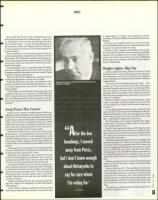
Benyamin Netanyahu visited Detroit last fall and spoke at an
area parlor meeting.a
Away From The Center
Yavne is a town where one might expect to find a con-
siderable number of floating voters. About 20 miles south
of Tel Aviv, it is one of the more successful "development
towns" set up to absorb North African immigrants in the
1950s. It is now more lower middle class than poor. While
traditionally pro-Likud, its best-known politician, former
mayor and current Knesset Member Meir Shetreet, is
probably the Likud's most left-wing member.
On the main street, one is struck by the variety of po-
litical posters — the predominant sentiment is for Mr.
Netanyahu, but Mr. Peres is well-represented, as is the
National Religious Party. On one stretch of the street
there were a number of posters for the Sephardi Hared-
im party Shas, but sandwiched in the middle was one for
Meretz.
Most people interviewed said without hesitation that
they were voting for Mr. Netanyahu, and that there was
\n no chance of them voting for Mr. Peres.
But at the taxi dispatcher's post, a driver in his 50s
said he had been going back and forth, but for now he
was leaning toward Mr. Peres. "We know Peres well. He's
for peace, which is good for Israel," the driver said.
In a bakery, Mazal Azulai, 50, said she and her hus-
band, Hanania, had always voted Likud and would again
in the Knesset elections, but they hadn't made up their
minds in the prime minister's race. 'Whoever's best for
the Israeli people," she said. Asked to set out Mr. Peres'
and Mr. Netanyahu's pros and cons, she couldn't come
up with an answer.
Neither could Dani Yitzhak, 36, a salesman and float-
ing voter. "Maybe I'll vote Peres," he said. "But they're
both garbage."
In line with Dr. Degani's reading that floating voters
tend to have relatively weak education, many don't seem
"t iter the bus
bombings, I moved
away from Peres,
but I don't know enough
about Netanyahu to
say for sure whom
I'm voting for."
— Monique Elul
Bright Lights, Big City
Another pocket of floating voters is in Tel Aviv's Yad
Eliahu section. In a city divided between the relatively
rich Ashkenazi north and the relatively poor Sephardi
south, Yad Eliahu is considered the best of the southern
neighborhoods.
"It's hard to tell the difference between them — Ne-
tanyahu is strong on security, but he also wants peace,
but then Peres also wants security," said Monique Elul,
22, a law student. "I'm more right wing than left wing,
and after the bus bombings I moved away from Peres,
but I don't know enough about Netanyahu to say for sure
whom I'm voting for."
Said Limor Ohayon, 23, an accounting student: "I feel
closer to the right, and Peres seems too far to the left,
so I'll probably vote for Bibi, but I haven't made up my
mind yet."
In the nightly political advertisements, there has been
more and more "man-in-the-street" testimony for the can-
didates by Sephardim. Their all-time political hero, Men-
achem Begin, lately has become one of the stars of the
ads — both Messrs. Netanyahu's and Peres'.
Mr. Netanyahu tries to compare himself to Mr. Begin,
and declared, "Menachem Begin made our first peace,
and we will make the next."
But Mr. Peres has been trotting out Mr. Begin to make
Mr. Netanyahu look bad by comparison. Sephardi men-
and women-in-the-street tell the camera that they adored
Mr. Begin for his simplicity and honesty, while they do
not trust Mr. Netanyahu.
All these messages are aimed at the lower-middle-class
Sephardi floating voter. But the young undecided also
are targets of the ads, especially those of Mr. Peres, who
is shown hugging and kissing teen-age admirers. Young
voters, traditionally more right wing than their elders,
moved sharply to the left after the Rabin assassination,
but shifted back after the bus bombings. Many are now
undecided, and Mr. Peres is trying hard to help them de-
cide.
Russian immigrants also have been shunting back and
forth over the last few years, and are now fluid in their
political loyalties.
Recent polls show Mr. Peres leading by 5 percent.
If the floating voters' overall right-wing tendency be-
comes the dominant factor in how they vote, they could
swing it for Mr. Netanyahu. But with so many of them
uninformed and uncommitted, they might decide to go
with the winner, and if Mr. Peres has a clear lead in the
polls on Election Day, they could tip to the prime min-
ister.
The election is in their hands, but nobody really knows
how they're going to vote. ❑
CO
C)
59