

H E A T H
In Sickness
And In Health
Caregivers tell their stories of coping when a spouse is ill.
RUTH LITTMANN SECTION EDITOR
I
llness can
strengthen or
detonate a mar-
riage. Beyond
sadness, couples deal-
ing with chronic and
fatal conditions feel
frustrated, helpless.
Six months after they married in
the mid-1980s, Paul Kadish, an
insurance man and two-time can-
didate for state Senate, was di-
agnosed with non-Hodgkin's
lymphoma. He has since recov-
ered. A year ago, his wife, Ina,
learned she has ovarian cancer.
Although both husband and
wife have battled life-threaten-
ing illnesses, they agree the role
of the patient is simple compared
to taking on responsibilities of the
caregiver.
Like so many caregivers, the
Kadishes describe their worst
emotion in a word: helplessness.
"The biggest frustration," Mr.
Kadish says, "came from know-
ing I couldn't do more about her
pain. It was the fear that I could
lose her and that, in the process,
she might have to suffer a great
deal."
Mrs. Kadish experienced sim-
ilar anxiety when her husband
was ill. In a last-ditch effort to
save his life, Mr. Kadish under-
went a 1990 bone marrow trans-
plant at Harper Hospital followed
by weeks of near-isolation in the
recovery unit.
On a typical afternoon, Mrs.
Kadish would arrive at the hos-
pital by 1 p.m. and wouldn't de-
part until nighttime. She wanted
to do something more.
Patients recovering from bone
marrow transplants spend many
days in near isolation at the hos-
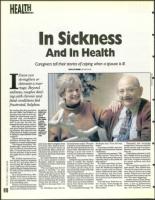
Ina and Paul
Kadish have
been each
other's
caregivers.
Mrs. Kadish
is acting
director of
Glida's Club,
a support
community
for cancer
patients and
their loved
ones.
pital. In an effort to brighten their
recoveries, Mrs. Kadish spear-
headed an art fund to spruce up
the unit's halls. Many people con-
tributed to the purchase of color-
ful murals depicting landscapes
and city views.
Dr. Chaim Brickman, director
of the lupus program at Sinai
Hospital, believes caregivers
should get involved in their loved
one's situation.
"The marriages that fail are
easiest to describe," he says.
"Healthy spouses, for whatever
reason, don't get involved. Their
mechanism of handling the dis-
ease is denial, distancing them-
selves and blaming the patient
rather than the disease — all in
an effort to decrease their own
pain."
Dr. Brickman says this be-
havior becomes cyclical. The more Brickman says, "it's a two-way
a healthy spouse distances him- street."
Sometimes healthy spouses,
self, the more abandoned the sick
spouse feels. Abandonment and though well-intentioned, become
feelings of guilt only serve to overbearing.
"Don't be overly attentive," Mr.
worsen the patient's condition
and the relationship spirals Kadish advises. "Don't fawn all
over the other person like you're
downward.
Caregivers can cope best if they expecting them to drop dead the
learn to modify the family's next minute."
Too little supervision, howev-
schedule to conserve energy. For
instance, if one spouse becomes er, can turn into an Rx for bad
too weak to grocery shop, he or news. Mr. Kadish has nudged his
she should take charge of the bills wife to comply with her doctors'
orders. Drink lots of water. Take
and correspondence.
Unhealthy spouses should not your medicine. Get lots of rest.
succumb to total dependence, Dr. Sometimes, Mrs Kadish isn't in
Brickman says. Even if they are the mood and her husband has
unable to contribute to household insisted.
"I've told her to drink her wa-
chores, they can educate children
about their illness and soothe ter," he says. "Even though she
got mad, she drank it. That's
their family's fears.
"In a successful marriage," Dr. what counts."
Therapists also encourage
caregivers to have an outlet for
excess energy and frustration.
Exercise is generally a good idea,
they say.
Cultivating optimism is vital.
Mrs. Kadish serves as acting di-
rector of the metro Detroit Gil-
da's Club, a support community
for cancer patients and their
loved ones.
"We're positive-mental-atti-
tude people," Mrs. Kadish says.
"You can let cancer take over your
lives, but our choice was to take
charge. There's never any doubt
in our mind that (cancer) was the
end. This was a beginning."
-Audrey Kron of West Bloom-
field learned she had Crohn's dis-
ease, a type of inflammatory
bowel disease (MD), at a young
age. Her husband, Lawrence,
rj:=: