
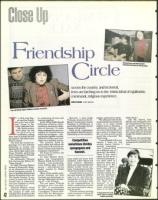

Friendship
Circle
Marsha Baron and Wendy Sadler
celebrate Chanukah by making latkes.
Across the country, and in Detroit,
Jews are latching on to the 1960s ideal of egalitarian,
communal, religious experience.
LESLEY PEARL STAFF WRITER
Jim and Wendy Sadler: Making a Jewish connection.
C.1)
w
Cr)
LU
CC
LL,
LU
F-
42
n 1975, Judy Har-
ris and her family
felt a bit "out of the
loop" living in De-
troit's Lafayette Park.
Ms. Harris wrote a
brief piece for the
neighborhood
newsletter, asking
other Jews to contact her and
get together. She didn't know
what to expect.
Yet from the humble be-
ginnings of a few families
gathering in homes and
apartments for monthly ser-
vices, third-night seders and
Oneg Shabbat gatherings
grew Congregation T'chiyah
in downtown Detroit.
Its philosophy followed
that of a havurah, Hebrew for
"many friends."
In 1968, Havurat Shalom
formed in Somerville, Mass.,
as an alternative to tradi-
tional synagogue worship. It
was, as founders Michael and
Sharon Strassfeld said in the
The Jewish Catalog, "to res-
urrect in some way the old
Jewish idea of community
and join together to work,
learn, pray and live."
Havurat Shalom, which
is still active, did away with
the concept of rabbi and
building fund, focusing on the
participation of all members
in conducting services and
learning together.
In the 1970s, Rabbi Harold
Schulweis of Encino, Calif.,
created an alternative defin-
ition of havurah. To make
large congregations more ac-
cessible, he created havurot
within the synagogue — join-
ing families together to study,
celebrate holidays and some-
times run a monthly service.
The question posed by
many within and without the
movement is "do havurot en-
hance or break away from the
synagogue experience?"
For many in Detroit, the
answer is "both."
At Adat Shalom Syna-
gogue and Congregation
Shaarey Zedek, havurot have
formed — some prospering,
some folding after a brief
period — and followed the
model created by Rabbi
Schulweis.
Many of the smaller gath-
erings claiming the title
havurah are throwbacks to
the late 1960s ideal of break-
ing off — like T'chiyah.
For two years, T'chiyah
existed as only a havurah.
In' 1977, to accommodate
growing interest, it formed as
a synagogue. T'chiyah affili-
ated with the Reconstruc-
tionist movement in 1985.
However, a step inside
T'chiyah, located in the St.
Mary's Community Center
Building in Greektown, is
proof that philosophy did not
change with growth.
Each week, congregants
are paired to lead the service.
Depending on the members,
Competition
sometimes divides
synagogues and
havurot.
some weeks are heavy with
tradition, while others are
more creative. Members
teach new song melodies and
debate weekly Torah por-
tions. Congregants pass the
Torah from hands to hands.
A small school is run out of
the same location for children
ages 6 to 13. And after be-
coming bar or bat mitzvah,
youths are expected to take
on the responsibilities of
adults, conducting services
and participating in educa-
tion programs.
T'chiyah remains intimate
with a constant of about 50
member units — families,
singles, unmarried couples.
"We affiliated With the Re-
constructionist movement be-
cause it is most closely
aligned with our thinking —
egalitarian, evolving — and
we receive the benefits of be-
ing a part of a larger base.
But we still operate pretty
much like a havurah," Ms.
Harris said.
"I was affiliated with a syn-
agogue. I knew my way
around Jewish Detroit. I
wanted something
close. T'chiyah offers
me a different way of
davening," she added.
"Sure it may seem
easier to join an es-
tablished synagogue,
you don't have to
question what you
want out of it. We
(T'chiyah's mem-
bers) decided to
question what we
wanted, needed. To
ask the practical
questions like, 'If I
don't go to services,
will there be a
minyan?' It de-
mands you think
about something
most of us don't
T'chiyah grew from Judy
Harris' plea for a Detroit
Jewish community.
think about."
Like Ms. Harris, Amy
Rhodes was looking for Jew-
ish connections in her most-
ly gentile neighborhood of
Canton. Ms. Rhodes was
married to a gentile man and
the couple had not formally
taught the children about Ju-
daism.
This year, she joined Step-
ping Stones to A Jewish Me,
a program for interfaith fam-
ilies.