

"We're really enjoying the
program," Ms. Rhodes said.
"But driving my family 35
minutes away to West Bloom-
field isn't the answer."
Ms. Rhodes wanted to find
others like herself — Jewish
and living in non-traditional
areas. Wendy Sadler, a Step-
ping Stones teacher, fit the
description. Ms. Sadler's hus-
band Jim is not Jewish. How-
ever, the couple has
committed to raising their
children Jewish.
When the two women got
together, they knew they
were on to something.
"We knew there were oth-
er people like us in the area.
They just weren't making the
effort," Ms. Rhodes said.
Through word of mouth,
Ms. Rhodes and Ms. Sadler
gathered seven families to-
gether for an October meet-
ing. In November, the
Western-Wayne Havurah
held its first Shabbat dinner.
A second dinner and a
Chanukah party followed.
"People are in a closet out
here. They don't let anyone
know they're Jewish, and vir-
tually all are intermarried.
Many are going the Jewish
route with their children,
though," Ms. Rhodes said.
"There's just not a strong
Jewish presence here — yet."
The Chanukah party, com-
plete with latke making and
dreidel games, was the sec-
ond time Brenda and Len Ru-
bin of Redford met with the
havurah. Like many families
in the Western-Wayne area,
they chose their neighbor-
hood for its affordability.
"We weren't specifically
looking for Jewish friends,
but it's nice to be making
them," Mr. Rubin said. "If you
didn't grow up with a strong
Jewish background, you
might not know the right
prayers or what certain tra-
ditions are all about. That's
OK here. We're learning to-
gether."
Ms. Sadler is optimistic
about the future of the havu-
rah, and eventually would
like to see a congregation
grow from it.
"Everyone is stepping ten-
uously right now. We do a
Shabbat dinner with prayers,
but not a full service yet. We
do try to get everyone in-
volved in philosophical dis-
cusions," she said. "We're
building a feeling of togeth-
erness. It's a warmup.
"I'd like to see the havurah
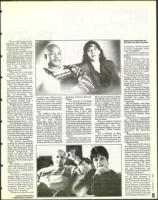
Leonard and Marsha Baron:
"It gets lonely out in Plymouth."
Stepping Stones helped Allan and
Debra Beck meet other area families.
remain, even within a con-
gregation. It's a great way to
step in, to network, to give
and find support. We need to
develop our own Jewish com-
munity out here. But for now,
we're a havurah out of neces-
sity."
Ms. Sadler's hope for a
havurah within a congrega-
tion has been a working con-
cept at Adat Shalom
Synagogue since the mid-
1980s. Rabbi Elliot Pachter,
now of Congregation B'nai
Moshe, stepped in to a pilot
havurah program with Adat
Shalom during his tenure
there. Five havurot had been
created. Each year, three or
four more developed. One-
third to one-half of the groups
remain and are run under the
guidance of Cantor Howard
Glantz.
"The havurot we formed
were to be homogeneous, fo-
cusing on family interest,"
Rabbi Pachter said.
Once each year, Rabbi
Pachter sent a flier and
brochure to families for a
havurah orientation event.
Questionnaires addressed
family make-up, years in De-
troit and needs and desires.
Committees matched families
together in groups of 10 and
asked them to make a one-
year commitment. Members
planned activities and events.
Rabbis and cantors served as
sources.
"Typically, the most suc-
cessful havurot used the syn-
agogue and its events a lot.
The havurah served to create
friendship circles within the
larger congregation and act-
ed as a magnet for larger
events," Rabbi Pachter said.
At B'nai Moshe, a smaller
congregation, there are no
formal havurot. Subgroups
focusing on specific issues,
like education committees
and Hillel Day School fami-
lies, do meet.
"Being a member of both a
synagogue and a special in-
terest group can only
strengthen bonds to the con-
gregation," Rabbi Pachter
said.
"I'm a believer in both
types of havurah. But if a
member says to me, as a rab-
bi, that we need havurot, I
take it to mean that he or she
is looking to find an avenue
to make synagogue bonds
more meaningful."
One issue that divides syn-
agogues and havurot is corn-
petition.
Rabbi Pachter, in his sup-
port of havurah, said he
would have no problem with
such group holding a second
minyan once a month. The
second minyan should differ
from the main by, for exam-
ple, including women.
"I support anything which
brings people into the main
building, as long as it's sepa-
rate, unique and does not
compete on a weekly basis,"
Rabbi Pachter said.
Judy Baumann of Lexing-
ton, Ky., co-chairman of the
National Havurah Commit-
tee, has been a member of a
synagogue and non-affiliated
havurah for years. She
doesn't view the two as in-
compatible.
Ms. Baumann, and other
families like hers, were not
getting all they desired out of
their synagogues. They
formed the Lexington Havu-
rah with five families. They
have 30 now.
"Most of us never dropped
our synagogue affiliation.
Many of us needed the school
component, which the havu-
rah does not provide, or want-
ed to remain a part of a larger
structure," Ms. Baumann
said.
Many daughters have be-
come bat mitzvah in the syn-
agogue on Friday evening
and with the havurah on Sat-
urday morning.
"Right now Jewish renew-
al is big. Havurah is a real
commitment to being Jewish
and expressing spirituality
outside of the normal chan-
nels. In our case, we needed
a place where we could ex-
press ourselves, where every-
one could have a place, where
women counted," Ms. Bau-
mann said. "People think
that's radical. But our havu-
rah has Federation and
Hadassah board members
and past presidents."
To help reach out to havu-
rot of both streams of
thought, the National Havu-
rah Committee formed in
1979 to serve as an educa-
tional resource. It holds three
regional retreats throughout
the year and sends a newslet-
ter to affiliated groups, dis-
cussing the battles of starting
and keeping momentum.
❑