

Why we eat
apples a ny
ioney and other
fascinating facts
about the High
Holy Days.
ELIZABETH APPLEBAUM
ASSISTANT EDITOR
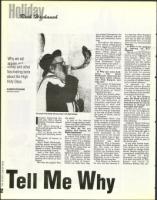
The sound of the shofar will soon usher In the High Holidays.
I
magine beginning the
new year with a hearty
helping of grapes dipped
in honey.
How about donning a
black-and-red gown for Yom
Kippur services?
Sort of gives you the
creeps just thinking about
it.
The point, of course, is
tradition.
Each Rosh Hashanah,
families gather around the
table for a helping of apple
dipped in honey. Everybody
does it; everybody loves it.
And a few days later,
men, women and children
will dress in white before
heading off to daven on Yom
Kippur.
But why the apples? Why
the white?
A look at the reasons
behind longstanding tradi-
tions and other interesting
aspects of the holidays.
1) Why do we eat
apples and honey on
Rosh Hashanah?
Rosh Hashanah is the day
on which God judges the
fate of humanity for the
year to come. It is a holiday
replete with symbols, which
includes eating certain foods
outside the usual fare as
part of the celebration.
Specifically, apples
dipped in honey are intend-
ed to symbolize a sweet
year. Why apples? Apples
were widely grown in the
ancient Land of Israel.
Unlike any other fruit, they
are praised throughout the
Bible, the Talmud, and rab-
binic and kabbalistic litera-
ture.
Throughout the genera-
tions many other fn" d. "
symbolic
hra ,v- for
,u
en incorporated
into the Rosh Hashanah
meal (often based on
Hebrew or Yiddish word
plays). Lately, some ;rn-iuva -
jive Americans have come
up with creative puns for
Rosh Hashanah foods.
Among these is the peach —
afarsek in Hebrew — to
symbolize the plea forsake
us not.
2) Why are some holi-
days, like Rosh
Hashanah, observed for
two days, while others,
like Yom Kippur, are
only one?
The custom of observing
two days of a holiday is
known by the Aramaic term
sfeka di-yoma, or "doubt
regarding the day."
Before the Jewish calen-
dar was fixed (according to
tradition, by Hillel II in 358
C.E.), the Sanhedrin in
Jerusalem announced the
beginning of each new
month based on astronomi-
cal observations. The news
was then sent by messenger
to the rest of Eretz Yisrael,
the Land of Israel, and to
the Diaspora.
Sometimes there was
doubt as to the promptness
of the couriers, so just to be
on the safe side diaspora
communities began observ-
ing holidays for two days.
In Eretz Yisrael, holidays
were presumed to be
announced on the correct
date, so there was no dou-
bling of the holidays. The
exception was Rosh
Hashanah. This is because
long ago the rabbis declared
the two days of Rosh
Hashanah to be a yoma
arichta, an Aramaic term
meaning "extended day."
Thus, technically, Rosh
Hashanah is not a two-day
holiday but one long day.
Yom Kippur is observed
for only one day because it
is a fast day. Even though it
would make sense to double
that day as well, the rabbis
determined that a two-day
fast was an unreasonable
hardship.
3) What is the purpose
of fasting on Yr.-
Kippur?
in Leviticus
The
1.0.ze, 31) states that the
soul is to be "afflicted" on
Yom Kippur. What this
means exactly is not
explained, but the rabbis
interpreted it to include the
following prohibitions: no
eating or drinking, no wash-
ing for pleasure, no anoint-
ing the body (in ancient
times, persons smeared
themselves with aromatic
oils for grooming purposes),
no wearing of leather shoes,
and no sexual relations.
A passage in the
Talmudic tractate Berachot
also states that suffering is
a means of atonement and
more effective than sacrifice
in winning God's favor.
4) If, as the Siddur
says, the Book of Life is
sealed on Yom Kippur,
does this mean we can do
nothing to change our
fate after that day?
Suffice it to say that the
Book of Life, the judgment,
inscription and seal are
images intended to evoke
self-examination, confession
and resolution to improve
one's behavior.
Judaism firmly believes
that God is all-knowing and
fully aware of our thoughts
and actions. Humans, how-
ever, do not have the gift of
omniscience. For all we
know, the fact that one rec-
ognizes his faults and cor-
rects them could be part of
the divine plan.
In any case, Jewish tradi-
tion holds that even after
Yom Kippur we have one
last chance to change God's
decree. Despite popular mis-
conceptions, mankind's fate
is
decided
on Rosh
Hashanah, not Yom Kippur.
It is then inscribed on Yom
Kippur and sealed on
Hoshana Rabba, the sev-