
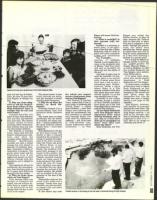

Apples and honey are a symbolic part of the Rosh Hashanah table.
enth and last day of Sukkot.
Thus, we have 12 days after
Yom Kippur to change our
fate.
5) Why are Jews oblig-
ated to ask for forgive-
ness from others at the
High Holidays? Isn't it
enough that we tell God
we're sorry?
Judaism describes two
types of sins: those between
man and God, and between
man and man. The former
usually consist of those
involving ritual observance.
Sins between man and man
are inter-human relations.
The Talmud, in tractate
Yoma, states that God will
forgive interpersonal rela-
tions only when the
wronged party forgives his
offender. Rectification
includes not only a verbal
apology but may extend to
payment of monetary dam-
ages, repayment of debts or
restoration of property. The
guilty party must ask for
forgiveness even if the
aggrieved person at first
refuses (though with few
exceptions, one is obliged to
forgive).
One repents for all sins by
confessing the transgres-
sion, then resolving never to
do it again and following
through with that pledge.
6) Why do Jews wear
white on Yom Kippur?
First, because white was
thought to symbolize the
angels, who are without sin.
Jews dress in angelic garb
in the belief that we will
emerge from the day as free
of sin as the angels.
The second reason is that
burial shrouds are white,
and the thought of death
should inspire repentance.
7) Why do we blow the
shofar on Rosh Ha-
shanah?
Primarily because it is a
commandment from God
(Leviticus 23:24, Numbers
29:1).
The Torah does not state
specifically why the shofar
is sounded, but many rea-
sons — mainly attributed to
the early medieval scholar
Saadia Gaon — have been
suggested.
Rosh Hashanah is the day
we hail God as king. The
shofar is like a trumpet
sounded at the coronation of
a king; it heralds the begin-
ning of the Jews' penance;
when the Torah was given
on Mount Sinai, it was
accompanied by shofar
blasts; the prophets com-
pared their message to the
sound of the shofar; the
armies that destroyed the
Temple sounded trumpet
blasts (an image meant to
evoke penance); God substi-
tuted the ram for Isaac
when Abraham was about
to sacrifice his son (thus
insuring the survival of the
Jewish people); the shofar
will be sounded at the res-
urrection in the time of the
Messiah.
Maimonides believed the
sound of the shofar had a
message: "Awake from your
slumbers, you who have fall-
en asleep in life, and reflect
on your deeds."
8) Are there any sins
for which one cannot
receive forgiveness from
God on Yom Kippur?
The Talmud, in tractate
Yoma, states that if one is
truly guilty of profaning the
Divine Name — called
chilul HaShem — then Yom
Kippur and suffering sus-
pend the punishment, but
full atonement is achieved
only through death. For
every other sin, repentance,
suffering — and, in the case
of inter-personal sins,
human forgiveness and/or
restitution — on Yom
Kippur will secure God's for-
giveness.
9) What is tashlikh? Is
this custom still ob-
served?
Tashlikh is a ceremony in
which Jews, in the after-
noon of the first day of Rosh
Hashanah, walk to a body of
water and recite scriptural
yn ifig and penitential
The Talnligfr•_
mention of tashrzWIP.
Instead, it was inspired by a
verse in the prophetic book
of Micah: "And You (God)
will cast (ve-tashlikh) all
their sins into the depths of
the sea."
Any body of water may be
used for tashlikh. In fact,
where there is no natural
body of water some Jews
have used a well or even a
swimming pool. Others,
however, prefer a place
where there is a fish
because tradition holds that
fish, whose eyes never close,
should remind us of the
ever-watchful eyes of God.
Tashlikh is not widely
observed, though a number
of local Jewish residents
have made use of the Oak
Park High School swimming
pool for this ceremony.
10) Are Rosh Hashanah
and Yom Kippur more
important than other
Jewish holidays and, if
not, why is it that more
Jews go to synagogue on
these days than just
about any other?
Rosh Hashanah and Yom
Kippur are called the
Yomim Noraim, or Days of
Awe, because the Talmud
tells us that this is when
God sits in judgment of the
world. Through the genera-
tions, the rabbis have
exhorted the Jewish people
to regard these days with at
least as much apprehension
as if they were awaiting a
decision in a secular court.
Yet it would be difficult to
i f/y."0pp holiday is more sig-
the maYtIt' another. All
Pesach, Shavuot, glIKA,.. —
as well as Shabbat, in addi-
tion to Rosh Hashanah and
Yom Kippur, were institut-
ed by Divine decree.
It is some Jews them-
selves who ascribe greater
importance to Rosh
Hashanah and Yom Kippur.
In recent years, a number
of Jews have come to regard
Rosh Hashanah as just
another holiday. Perhaps its
meaning as "the Jewish new
year" gives some the
impression that, like the
secular new year, it simply
marks a new page on the
calendar.
Yom Kippur, however,
still retains its powerful
meaning for most Jews. The
fasting and exceptionally
long prayer service — as
well as the thought that
God is handing down His
judgment on each of us —
may add to its image of
solemnity and dread. ❑
o)
cr)
w
CO
2
LLJ
0-
W
Tashlikh services, or the casting of sins into water, is observed during the High Holidays.
63