

A New Jersey lesson is
"overloaded with junk items
from popular culture." A
New York text presents a
distorted view of Hitler's
writings in Mein Kampf,
"creating the impression
that blacks and not Jews
were his primary targets." A
California effort is full of
"errors of basic fact and
interpretation."
Rarely do texts discuss
Christian anti-Semitism,
and more often than not
they prefer general terms
like "prejudice" to "anti-
Semitism" when discussing
the Nazi policy of genocide.
Holocaust curricula usually
fail to note that Hitler's ter-
ror was state-sponsored,
and a number suggest the
Nazi persecution of Jews
bears great resemblance to
the U.S. treatment of
American Indians.
In her article, the late Ms.
Dawidowicz expressed
approval for two available
Holocaust curricula: New
York State's Teaching About
the Holocaust and Genocide
and Life Unworthy of Life,
produced in 1987 in
Farmington Hills by the
Center for the Study of the
Child.
Professor Sidney Bolko-
sky developed the Life cur-
riculum and served as one
of three writers on the pro-
ject. He says ignorance
about the Holocaust is mul-
tifaceted.
One reason is that world
history is no longer a
required course at many
U.S. high schools. And when
it is taught, "it covers every-
thing from the Big Bang to
what happened yesterday,
which means you rarely
even get to World War II,"
he says.
Educators themselves
may know little about the
subject — and teaching the
murder of 6 million human
beings would be difficult for
anyone.
Professor Bolkosky also
notes teachers' hesitancy to
speak about the Holocaust
as a singular, unparalleled
tragedy in history. If they
do make mention of it, the
Holocaust is usually
clumped together with a
whole variety of other hor-
rors: Cambodia, Yugoslavia,
the Turks' campaign
against the Armenians.
What results is a kind of
blurred vision, with "geno-
cide" used with such fre-
quency it's impossible for
students to separate one
tragedy from another, or to
see why the Holocaust is
unique.
A successful course on the
Holocaust,
Professor
Bolkosky says, combines
historical facts with person-
al recollections: Who sup-
plied the Zyklon B gas at
death camps and how large
was Auschwitz, but also
what was it like for Aaron
Goldberg growing up in
Warsaw before the Nazis,
how did he survive on no
more than a piece of bread a
day in Dachau, and how can
he endure knowing that
everyone else in his family
was gassed?
Survivors' testimonies are
one of the most effective
tools in teaching the
Holocaust, Dr. Bolkosky
says. This is especially true
when speakers offer some-
thing students can relate to,
telling a group of 10th-
graders, for example, "When
I was 16 — your age — I
was living in Vienna and
Hitler had just come to
power..."
Professor
Bolkosky
believes Holocaust educa-
tion should begin in high
school, when students are
mature enough to begin con-
templating such a complex
issue. Otherwise, he says,
the Holocaust either is
reduced to a crude simplici-
ty — "The Nazis hated Jews
and they killed 6 million of
them" — or "You end up
telling just
part of the story,
in which case you're lying
about it."
Holocaust classes also
should show the roots of the
tragedy, the history of anti-
Semitism and nations' toler-
ance for suffering. The
Holocaust, he says, "is not
an anomaly. It's an out-
growth of Western civiliza-
tion."
In his own University of
Michigan-Dearborn class on
the Holocaust, Professor
Bolkosky teaches students
"of every age and political
persuasion, men and
women, Arabs, history and
humanities majors. The one
thing they all have in com-
mon is that they don't know
the first thing about the
Holocaust.
"So we start from ground
zero. The first question we
answer is, 'Why aren't we
looking at other mass mur-
ders, as well?' because if I
don't discuss it, somebody
will always ask it.
"By the third week,
there's nobody who doesn't
understand why the
Holocaust was different.
"It's not that we're com-
peting, 'Who had the worst
genocide?'" he says. But no
other tragedy was quite so
methodical, so involving of
every aspect of the nation —
from the high-ranking Nazi
like Eichmann to the com-
panies placing bids to sup-
ply gas for the death camps,
from the man driving the
train headed for Auschwitz
to the father whose daily
work was rounding up Jews
for mass shootings.
Audio tapes of survivors'
testimonies always will be
one of the best methods for
teaching, Professor
Bolkosky says, because stu-
dents are rarely left unaf-
fected by hearing the inti-
mate details of a single
soul's agony. And they will
last long after the last sur-
vivor dies.
"The tapes will continue
what thesurvivors have
begun," he says. "They will
be the witnesses."
he first widely used
Holocaust curricu-
lum was Facing
History and Our-
selves, which Professor
Bolkosky says offered "a
major turnaround" in
Holocaust education.
Previously, the teaching
of Hitler's murder of 6 mil-
lion Jews often was relegat-
ed to a paragraph or two in
a history textbook. To this
day, students who do not
benefit from a special pro-
gram are unlikely to learn
much about the Holocaust
T
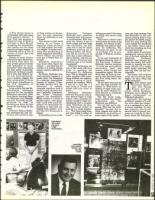
Frank Buford:
"My number-
one goal is
to fight
discrimination."
Loren Willey
and a painting,
"Ghosts," by a
Clio High
student
rn
rn
C/3
CD
53