

Mending The Broken Heart
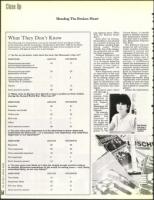
What They Don't Know
The following are results from a survey by Jennifer Golub and Renae Cohen
of the American Jewish. Committee. Conducted in November 1992 by the Roper
Organization, the survey polled 992 adults and high-school students across
the country. All figures below are in percentages.
1) "As far as you know, what does the term 'the Holocaust' refer to?"
ADULTS
STUDENTS
Extermination/murder/
persecucution/treatment of
Jews by Hitler/Nazis/Germans
24
17
Extermination/murder/
persecution of Jews
30
23
Other relevant responses
(includes death camps,
World War II, Germans)
7
Others
10
14
Don't know/no answer
28
39
RESPONSE
2) "Many Jews in Europe were forced to wear a symbol on their clothes
during the Second World War. What was it?"
ADULTS
STUDENTS
Swastika
22
21
Hammer and sickle
4
2
Yellow star
42
42
Red cross
3
4
Other
1
1
Don't know/no answer
29
31
RESPONSE
3) "In your view, how important is it for Americans to know about and
understand the Holocaust — is it essential, very important, only somewhat
important or not important?"
ADULTS
STUDENTS
Essential
33
26
Very important
39
38
Only somewhat important
13
18
Not important
2
3
Don't know/no answer
13
15
T J EWIS H NEWS
RESPONSE
4) "In your view, how likely is it that the Jewish people could be subject
to another Holocaust somewhere in the world in coming years — very likely,
somewhat likely, or not very likely?"
STUDENTS
RESPONSE
ADULTS
Very likely
13
7
Somewhat likely
28
22
Not very likely
43
51
Don't know/no answer
17
21
(see adjacent story, "What
Will the History Books
Say?").
Soon after its release,
Facing History was attacked
by a number of groups and
individuals, including Eagle
Forum leader Phyllis
Schlafly. One of the charges:
the curriculum did not offer
the Nazis' perspective.
Professor Bolkosky's Life
Unworthy of Life, which
includes the option of five,
11 or 18 lessons, depending
on the teacher's time and
interest, is now used in
schools throughout the
United States.
Peter Nagourney served
as supervisor of the Life
project and was responsible
for its editing, design and
production. He now man-
ages its distribution and
helps teachers implement
the curriculum into their
classes.
Educators learn about
Life through a
number of
sources, from
brochures to
mailings to the
U.S. Depart-
ment of
Education's Na-
tional Diffusion
Network.
The network,
which in 1990
Life
added
Unworthy of
Life to its ros-
ter, singles out
exemplary and
innovative
teaching pro-
grams in the
United States. It awards
grants to selected curricula,
then disseminates informa-
tion about each in a publica-
tion, Educational Programs
That Work.
The Diffusion Network
praises the Life curriculum,
which includes textbooks,
instructor's manual and
videotapes of survivors, not-
ing that students are "sig-
nificantly better able to
express in writing conse-
quences of indifference
toward the mistreatment of
others; demonstrate reduced
prejudice toward minority
groups; and show greater
gains in historical knowl-
edge of the Holocaust than
comparison groups."
Teachers also benefit, being
"significantly more inclined
and able to teach the topic
of the Holocaust in depth
than teachers in comparison
groups."
Despite the endorsement,
J
(
Barb Demlow
and some of
her teaching
materials.