

Mending The Broken Heart
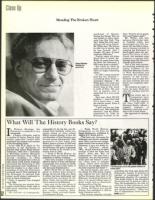
Sidney Bolkosky:
Starting from
ground zero.
southwest of Detroit.
During the Korean War, he
was hooked up with a room-
mate from New York. "One
day I asked him if he want-
ed to go with me to church,"
Mr. Willey says. "He told me
he didn't go to church, that
he was Jewish. And I
thought, 'Oh, okay.' It never
made any difference."
Twelve years old when
World War II ended, Mr.
Willey for years knew noth-
ing about the Holocaust; "I
didn't even know it existed."
But little by little he
began educating himself.
Then he began educating
others.
In 1967, using material
from his own research ---
everything from books to
newspaper clippings — Mr.
Willey gave a two-week unit
on the Holocaust to his U.S.
history class at Clio, which
is north of Flint. The unit
was so popular that it
expanded to a nine-week
course.
Each year, about 250-300
students — more than half
Clio's senior class — take
the elective course. None of
them is Jewish.
"I don't see how any high
school can't offer Holocaust
education," says Mr. Willey,
nominated in 1993 . as
Michigan Teacher of the
Year. "If we're not on guard,
this could happen again."
Mr. Willey, who also
serves as Clio's junior varsi-
ty football coach, has
encouraged not only stu-
dents but his fellow educa-
tors to become involved in
teaching the Holocaust. A
fourth-grade class now per-
forms The Diary of Anne
Frank. Art teachers urge
students to express their
feelings about the Holocaust
through craft projects.
Two of his most success-
ful teaching methods are
taking students to the
Holocaust Memorial Center
in West Bloomfield and
stressing the individual
aspects of the horror.
Students need to hear how
one man survived, how one
family was completely oblit-
erated.
The students are eager to
learn, he says. They just
need the teachers and the
material.
hree years ago in
Commentary, Lucy
Dawidowicz, author
of The War Against
the Jews 1933-1945, A
Holocaust Reader, offered a
lengthy analysis of
Holocaust curricula avail-
able in the United States.
She approved of virtually
none.
T
What Will The History Books Say?
T J EWIS H NEWS
I
n Western Heritage, the
Holocaust is reduced to one
paragraph.
A Legacy of Freedom, used at
a number of metro Detroit high
schools, notes that "critics" have
questioned the purpose and outcome
of the Nuremberg trials.
In her 1980 Ph.D. thesis on "An
Analysis of the Holocaust in
Selected High School World History
Textbooks, 1962-1977," University
of Michigan student Margaret
Silverman Eichner (later head of
Yavneh Academy in West
Bloomfield) concluded that 1) Not all
high school world history textbooks
mentioned the Holocaust; 2) The
data presented were insufficient to
lead the student to a clear under-
standing of how the Holocaust
occurred; and 3) The treatment of
the Holocaust in selected high
school world history textbooks in
print is clearly inadequate.
Little, it appears, has changed
since 1980.
The following are excerpts from
typical world history books used in
high-school classrooms throughout
the country:
The minister of propaganda,
responsible for the big lies, was Dr.
Joseph Paul Goebbels, whose ven-
omous attack on Jews echoed
Hitler's warped ideology. In fact, the
anti-Semitism of Nazi Germany was
its most corrupt characteristic. Nazi
persecution of Jews began with
Hitler's seizure of power in 1933 and
intensified in stages, to culminate in
the Holocaust, the policy of genocide
which resulted in the murder of six
million Jews by 1945.
— From A World History, by
Hariette Flory and Samuel Jenike,
published in 1988 by Longman.
(This book includes a number of
effective photos of Nazi anti-Semitic
propaganda and corpses at death
camps. Unlike most other texts, it
also discusses Kristallnacht.)
Before World War II, there were
about 11 million Jews living in
Europe. By the end of the war, about
6 million had been deliberately and
systematically murdered by the
Nazis. Today, this horrible destruc-
tion is known as the Holocaust.
Jews were not the only victims of
Nazi brutality. About 4 million other
prisoners died in German concentra-
tion camps, including Poles,
Russians, Czechs, and many Gypsies
of southeastern Europe.
— From World History:
Perspectives on the Past, by
Karen Kazarosian, published in
1988 by D.C. Heath and Co.
(This book also discusses the
Holocaust and Israel's establish-
ment. Many nations were sympa-
thetic toward Jews because of the
Holocaust, it says, but Arabs liv-
ing in Palestine asked,
"Why...should Arab land be taken
because of what the Nazis had
done?" After the War of
Independence, "The Jews had a
homeland, but the Palestinian
Arabs were left without a coun-
try...(They went to refugee
camps, where they became)
"pawns in the struggle between "The Holocaust is one of the greatest violations of
the Arab countries and Israel.")
human rights."
The Jewish people, who were
everything the book says about the
the objects of a Nazi policy of geno-
Holocaust, though it devotes a
cide, suffered the most. Nearly six
number of paragraphs to the
million European Jews died in the
Palestinian situation. For example:
Holocaust, murdered by German sol-
"The Arabs living in the Occupied
diers or by special killing teams in
Territories
had no political rights.
death camps such as Auschwitz,
They
felt
frustrated
by the lack of
Buchenwald and Dachau.
solutions
to
their
grievances,
and
— From Living World History by
they
desired
national
independence
T. Walter Wallbank and Arnold
and self-government"; "(After the
Schrier, first published in 1964 by
War
of Independence) Israel refused
Scott, Foresman and Co.
BOOKS
page 57
(This excerpt comprises virtually