
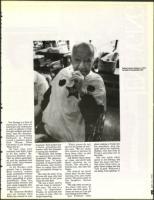

Nathan Feldman displays a T-shirt
he made for his grandson, Bill.
"Art therapy is a form of
expression that uses art
materials and techniques
in order to address or work
through conflicts and prob-
lems," says Ms. Samoray-
Haddad, an artist doing
fieldwork at Prentis
toward a master's degree
from Wayne State
University in art therapy.
"They love it."
"At first, they were
resistant and didn't want
to do the crafts," Ms.
Samoray-Haddad says.
"But as others participat-
ed, and the residents saw
their work, they became
more interested."
In art therapy, each
project has a purpose.
Most recently, seniors
made sweetheart T-shirts
dedicated to a spouse,
child, grandchild or great-
grandchild. They also
made medals of honor, and
pins using magazine pho-
tographs as tributes to
loved ones.
Ms. Samoray-Haddad
says art therapy often
forces the seniors to com-
municate. Each project has
a theme, prompting dis-
cussion with the therapist
or among the residents.
"Physically, this brings
no improvement in their
conditions," Ms. Samoray-
Haddad says. "It helps
mentally. It improves their
self-esteem and allows
them to realize they still
can accomplish things in
life."
She tells the story of an
85-year-old man who had
been married for 50 years
when his wife died.
"He was a loner, and he
did not want to interact,"
she says. "He was in a
state of depression.
Finally, we convinced him
to come to class. Now he
keeps improving.
"Their pieces do not
have to be pieces of art,"
she says. "We are using
this creative process to
keep them vital, to add
sparks to their lives."
Ask Bessie Gantz about
art class, and she'll talk
about growing up in
Toledo. She married a
Detroit boy, the late Sol
Gantz.
She doesn't do much
these days. So she loves
making arts and crafts
pieces. She gives most to
her daughter, Noreen
Stone.
"We talk when we are in
the class," she says. "It
makes me feel good. It
keeps me busy so I am not
just sitting in the lobby."
Ann Feldman talks
about making a T-shirt for
her grandson. And she
talks about her husband,
Nathan, who also lives at
Prentis and joins her in
the class.
She has made other
pieces in art therapy, but
they "go away real fast."
She gives them away as
gifts, which makes her feel
"sort of good. Whatever I
am doing, I am enjoying." El