

ing James Zogby, executive di-
rector of the Arab American In-
stitute, to believe that the Clinton
foreign policy team will have to
look at the broader Mideast pic-
ture if it wants to make the peace
process work.
"If you think Iraq is making lit-
tle tests, the tests coming from
Iran are potentially more dis-
turbing to regional stability," said
Mr. Zogby. "There will be a need
to deal with a number of threats
/— with Iran — not just its rearming
and the nuclear threat, but its ef-
fort to achieve hegemony in the
Gulf region, and its exporting of
terrorism, which it uses as a
weapon to destabilize potential ri-
vals."
The most immediate decision
facing the incoming Clinton team
involves how much attention they
can afford to devote to the tricky
Mideast peace process during the
former Arkansas governor's first
\ days in the White House.
There is widespread agreement
that all participants in the talks
are waiting for a gesture indicat-
ing the new president's intention
to make the peace process a per-
sonal priority. But with U.S.
oops already on the ground in
Somalia, new trouble in Iraq and
the growing clamor for some kind
/ % of military intervention in the ray-
aged remnants of Yugoslavia, Mr.
Clinton and his foreign policy
team will have their hands full
the moment they take over.
Moreover, Mr. Clinton's cam-
paign promised to make domestic
economic concerns his adminis-
tration's top priority. Voters will
be closely watching for signs of
deficit cutting, tax relief and oth-
er promised economic gains — and=
may not take kindly to the new
president becoming too embroiled
in foreign affairs.
"There will be intense compe-
tition for the president's atten-
tion," said Rep. Ben Cardin
(D-Md.). "That will be one of the
first real decisions they have to
make — what priority they place
on the peace process in their for-
eign policy agenda. I hope it will
be a very high priority, one that
will involve the president himself
in trying to promote peace in the
region."
"Involvement in the peace pro-
cess takes considerable energy,"
Mr. Quandt added. "It is difficult,
controversial and time consum-
ing. The single biggest decision
they have to make is deciding
where on their list of priorities the
Mideast peace process fits. That
decision will determine what sig-
nals they send out in the opening
days of the administration."
Some hints of how the Clinton
team is leaning came at two meet-
ings last week between leaders of
the Conference of Presidents of
Major American Jewish Organi-
zations and AIPAC, and the top
members of the Clinton foreign
policy team.
At one closed-door meeting, Mr.
Christopher emphasized — ac-
cording to those who attended —
that the Clinton administration
will make the Mideast peace pro-
high priority on their crowd-
,
"What we learned is that both
the president-elect and the secre-
tary of state regard the peace pro-
cess as having the highest priority
— and that they will give it the nec-
essary time and attention in a
manaer not yetdefined," said one
participant, Lester Pollack, the in-
coming chair of the Presidents'
Conference. "That will be a very
important signal to all the parties
and to the world that this remains
a very important undertaking."
Still, a final decision will de-
pend on how the world chess
board looks on Jan. 21, when Mr.
Clinton punches in for his first full
day in the Oval Office.
A second set of decisions in-
volves the nature of American in-
volvement in the peace process.
The question here is: what is the
precise amount of involvement
that is appropriate to get the
peace talks going again, without
overstepping America's role as
broker?
"There is a real need for mo-
mentum in this business," said
Mr. Quandt, the Brookings
Mideast expert. "If the adminis-
tration doesn't find ways to build
up the momentum again, there is
a very real risk the process could
flounder."
Even before Bill Clinton's
foreign policy lineup was an-
nounced, the new administration
was being tugged in two directions
on this question.
Some Jewish activists say that
the time has come for a more di-
rect and forceful American role.
"He's going to have to rapidly
come to a conclusion about how
active a role the United States
should have in the peace process,"
said Ted Mann, co-founder of Pro-
ject Nishma, a liberal group that
promotes the peace process as a
necessity for Israel's long-term
security interests. "I think he is
going to come down on the side
of strong activity.
"He's going to have to reach
conclusions about what role the
United States should play with
other Mideast states in counter-
ing Islamic fundamentalism,
which I think is probably the last
remaining major roadblock to a
possible Mideast peace."
The Rabin government — at
least through its negotiators at
the peace talks in Washington —
has also dropped hints that it
would like to see a direct Ameri-
can role in helping bridge the big
gaps between participants. How-
ever, these hints have been ex-
traordinarily ambiguous and
©1992 International Copyright by CARTOONEWS Inc.. N.Y.C.. USA L.-.
"Time for my replacement to take over."
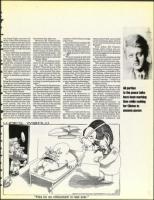
Al parties
to the peace talc
have been marking
time wide waiting
for Chilton to
assume power.