
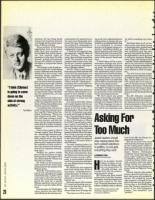

"I think Winton]
is going to come
down on the
side of strong
aclivity."
THE DETROIT J EW ISH NEWS
Ted Mann
16
cautious; the last thing Israel
wants is new American pressure
over things like the recent expul-
sions of llamas activists.
Some members of the Israeli
negotiating team at the peace
talks have even privately ac-
knowledged that a little Ameri-
can "arm twisting" might be
necessary to help move the talks
forward — as long at that pressure
did not fall unfairly on Israel's
shoulders, or compromise Israeli
security.
"The change in the Israeli gov-
ernment allows the United States
to play a different and more facil-
itating role in the process," said
Jonathan Jacoby, president of
Americans for Peace Now.
"Before, the administration's
goal was just to keep the negotia-
tions going long enough until the
Israeli government's position
changed — or the Israeli govern-
ment itself changed. Now, it has
an opportunity to play a facilitat-
ing role substantively, not only
procedurally."
But other Jewish leaders have
urged a continuation of the low-
profile role adopted by former Sec-
retary of State James Baker since
the first sessions in Madrid.
"I would hope they will carry on
much in the same manner as be-
fore," said Mr. Pollack of the Pres-
idents' Conference. "There has
been progress in the talks. I hope
they will keep it going in much
the same manner, and play the
same role the American govern-
ment played in earlier rounds in
trying to be a consultant and a fa-
cilitator."
Others have urged a kind of
"benign neglect" from Washing-
ton — just enough American pres-
ence to keep the parties at the
table, and no more. Any signal
that the Clinton administration
plans to play a more active role in
the substance of talks would re-
duce the incentive of Arab par-
ticipants to negotiate seriously,
they argue.
Finding the perfect middle
ground between those strongly
held positions will require all of
the political skills Mr. Clinton and
his team can muster.
Mr. Clinton is also hearing dif-
ferent points of view on the exact
mechanisms for the conduct of his
Mideast policy.
With Mr. Christopher preoc-
cupied with reshaping the State
Department after 12 years of GOP
control and with crises in other
parts of the world, some have sug-
gested the need for a special
Mideast negotiator who can work
full time to get the talks off the
mark.
In recent days, the Washington
rumor pipeline has been filled
with talk about the imminent an-
nouncement of a special envoy;
the name most frequently men-
tioned has been Tom Pickering,
the current U.S. ambassador to
the United Nations and a former
ambassador to Israel.
"I think he will appoint a spe-
cial negotiator," said Mr. Mann of
Projct Nishma. "There are so
many other problems around the
world. The president will need
someone who is close to him, who
has his ear. It doesn't necessarily
have to be someone with experi-
ence in Mideast affairs."
But Mr. Clinton is also hearing
from some pro-Israel activists who
worry that the appointment of a
special negotiator would signal
that the peace talks will not be a
major, personal priority for Mr.
Clinton and Mr. Christopher —
something that could further de-
plete the negotiations' flagging
momentum.
Beyond those basic decisions,
the Clinton administration is ex-
pected to move rapidly to estab-
lish a good working relationship
with leaders in Israel and the
Arab states.
It is expected that Mr. Clinton
will contact leaders of all the na-
tions participating in the negoti-
ations in the first weeks of his
administration. There is also talk
that Mr. Christopher may make
an early trip through the Mideast
to give the negotiations a boost.
Prime Minister Yitzhak Rabin
is due in Washington in March
for AIPAC's annual policy confer-
ence, and it is expected he will
meet with the new president and
his top foreign policy advisers
then. But outgoing Israeli am-
bassador Zalman Shoval has been
busy trying to arrange an earlier
meeting, which Israel would like
to take place before the planned
resumption of the peace talks in
mid-February.
"An early meeting makes a lot
of sense," said Dan Mariaschin,
director of public, international
and Israel affairs for B'nai B'rith.
"The Bush administration kept
the Shamir government at arm's
length because of policy differ-
ences. A warm political welcome
would be an important indication
of a very different kind of working
relationship."
Mr. Mariaschin also suggested
that Israel needs some words of
reassurance — preferably from in-
coming Secretary of Defense Les
Aspin— about the continuing com-
mitment to strong U.S.-Israeli
military ties.
One more aspect of the complex
U.S.-Israeli relationship may sur-
face in the first days of the Clin-
ton administration — the
always-sticky issue of foreign aid.
"One issue we will be watch-
ing is the new administration's
initial posture on foreign aid, par-
ticularly in an administration that
is so committed to economic
growth and domestic issues as a
priority," said Martin Raffel, as-
sistant executive vice-chair of the
National Jewish Community Re-
lations Advisory Council and di-
rector of the group's Israel task
force.
"I think there will be a reex-
amination of foreign aid, of how
we use it and whether it achieves
our goals," Mr. Raffel continued.
"Obviously, we are concerned that
this examination lead to conclu-
sions that are in Israel's interests,
which are also in the interests of
the United States. An economi-
cally strong Israel is an Israel that
will be able to proceed with confi-
dence in the peace process."
Mr. Clinton will give a "state of
the budget" message to Congress
in late January, which will include
his proposals for the aid budget
for the upcoming fiscal year.
"We don't expect any great
shocks in his foreign aid budget,"
said Rep. Cardin. "But the way he
presents it to Congress will be crit-
ical. What language he uses, in
terms of our commitments to Is-
rael, will be very important, and
we will be watching very close-
ly•"
And then there is oil, yet an-
other touchy point when it comes
to American policy toward Israel
and the Mideast. While the cur-
rent worldwide glut has tem-
porarily decreased the ability of
the Arab states to use oil as a lever
to influence American Mideast
policy, that could change quickly
— and the Clinton administration,
which has promised to address
the issue of energy independence,
could find its foreign policy deci-
sions affected by Arab oil suppli-
ers.
"It's still obvious that nobody
would pay much attention to Sau-
di Arabia if it didn't have oil," said
Rep. Charles Schumer (D-N.Y.).
"It's a given that we do not sup-
port the Saudis because of their
fidelity to democracy. Clinton has
talked about reducing our depen-
dence on foreign oil. The pro-Is-
rael community should get behind
that."
But Mr. Schumer conceded
that with oil relatively plentiful,
it may be difficult to get Congress,
the administration and the pro-
Israel community to focus on the _
long-term dangers of American
dependence on Arab oil. ❑
Asking For
Too Much
Jewish leaders should
stop carping about Clin-
ton's cabinet selections.
In politics, no one gets
everything they want.
LEONARD FEIN
Special to the Jewish News
H
ere we go again. Jewish
leaders, it seems, are up-
set with the Clinton cabi-
net; not enough Jews. Or
— it's really not clear — not
enough Jews who are passion-
ately devoted to Israel.
Bill Clinton may have wanted
a cabinet that looks like America;
the largely unnamed sources who
have been quoted in The New
York Times and elsewhere on the
subject evidently want a cabinet
Leonard Fein comments on the
American Jewish scene from
his home in Boston.
that thinks like the Zionist Or-
ganization of America.
How do we know that those
who have thus far been appoint-
ed are inadequately sanitary?
Here, as nearly as one can discern
from what we're told, is the evi-
dence: Warren Christopher
worked for Cyrus Vance and An-
thon.y Lake worked for Warren
Christopher, and Cyrus Vance
worked for Jimmy Carter, and,
well, you know, don't you, about
Jimmy Carter? You remember,
he's the one who forced peace be-
tween Israel and Egypt at Camp
David.
Tsk tsk. Anyone who prefers
peace to dessert is obviously sus-
pect. And anyone who worked for
anyone, who worked for anyone
who is suspect is himself (or her-
self, as the case may be) suspect.
Carter policy on the Middle East,
says Abe Foxman, executive di-
rector of the Anti-Defamation
League, "was simplistic" and
"preachy."