

Into the Fray
Exit Bush. Enter Clinton. A new adninistration tackles the Mideast.
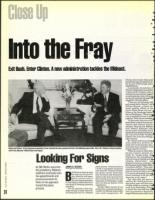
Rabin and Clinton: A big unanswered question is how involved the new president will be in the Mideast peace talks. Here, Mr. Clinton is shown meeting
with Prime Minister Yitzhak Rabin last August.
Looking For Signs
cr)
LU
CC
cn
LLJ
H-
24
As Bill Clinton assumes
the presidency, Mideast
watchers anxiously scan
his appointments and
pronouncements for
hints on his approach
toward the peace
process.
JAMES D. BESSER
Washington Correspondent
B
ill Clinton is about to move
his bags into the Oval Of-
fice, where he will imme-
diately confront some of
the most daunting domes-
tic and foreign problems that have
ever faced an incoming American
president.
How he responds to that chal-
lenge will play a major role in de-
termining the fate of a Mideast
peace process, which has been in
a kind of suspended animation
ever since Mr. Clinton's Novem-
ber election victory. Since then,
both the Israeli and Arab partic-
ipants in the peace process have
been waiting to see how the new
leadership in Washington might
alter the delicate balance of the
negotiations.
Foreign affairs experts do not
predict any sweeping changes in
overall U.S. Mideast policies after
next week's inauguration. Mr.
Clinton drove home that point
himself through his selections fel-
the top tier of the foreign policy
establishment.
In particular, his selection of
Warren Christopher as secretary
of state and W. Anthony Lake as
national security adviser suggest
an administration that will move
slowly and cautiously through the
minefield of foreign affairs.
"These are, by and large, safe
and conservative choices," said
William Quandt, a former na-
tional security official in the -
Carter White House and now a
fellow at the Brookings Institu
lion in Washington. 'There is not
a lot of ideological thrust in their
positions. They are not crusaders.
"In that sense, they are not dif-
ferent from a series of recent sec-
retaries and national security
advisers. They are very different,
from [Henry] Kissinger [who
served under Presidents Nixon
and Ford] and [Zbigniew] Brzezin-
ski [who served under President
Carter]" who were more ideologi-
cally oriented.
Mr. Clinton and his top foreign
policy chiefs have, however, al-
ready laid out broad policy obje,-,
tives that seem consistent with
strong support for Israel.
"There is a sense in which Clin-
ton has created a general um-
brella for foreign policy that
emphasizes the strengthening
and nurturing of existing and de--
veloping democracies," said
Stephen Grossman, president of
the American Israel Public Affairs
Committee (AIPAC). "That state-
ment alone could hardly be better
news for those favoring a strong
U.S.-Israel relationship, because
Israel continues to be the only
democracy in the region."
But when they get down to
specifics, Mr. Clinton and his for-
eign policy team will face some
complex problems requiring a deft -
touch from Washington. Events
in places like Iran and Iraq also
have the potential to disrupt the
fragile Mideast peace talks, lead-