

ENTERTAINMENT
GARY ROSENBLATT
Editor
J
ackie Mason is honest
to a fault. He says he
was "miserable and
hypocritical" as a pul-
pit rabbi before becom-
ing a comedian; acknowl-
edges that he's an "egoma-
niac" who never felt fulfilled
until he became "the top
banana" in show business;
asserts that Jews are the vic-
tim of affirmative action at
the expense of blacks in this
; country; and confides that his
experience on "Chicken
Soup," the ill-fated ABC-TV
show he starred in with Lynn
ti
-
Redgrave, was so awful that
he "hated every second of it."
These are the observations
of one of America's funniest
entertainers?
The truth is, in a one-hour
interview, Mr. Mason
prefers to talk about politics
rather than comedy and
issues of race in particular.
His views spew forth in that
now-familiar, rapid-fire
cadence that is Mr. Mason's
trademark. But while the
delivery is funny, the obser-
vations are dead serious.
After asserting that there
is a double standard regar-
ding racial attitudes in this
country — "a black doesn't
deserve a job over a Jew just
because he's black, and the
Jews are the first to suffer
from affirmative action" —
Mr. Mason adds, "print that
in your article."
He does not seem the least
bit chastened from his expe-
rience several years ago in
the New York mayoral elec-
tion when he was widely
criticized for referring to
David Dinkins as a "well-
dressed shvartze." Mr.
Mason still uses the Yiddish
word for black, seen as a pe-
jorative by many, in an
interview in discussing what
he calls reverse bigotry.
He asserts that while it is
acceptable for blacks to call
all whites bigots, "if a white
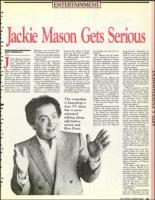
The comedian
is launching a
new TV show
but is more
animated
talking about
affirmative
action and
Ross Perot.
says blacks are tall, he's in
trouble."
Mr. Mason says he chose
not to "conform to these re-
strictions" and as a result,
the press called him a racist
"to get a headline." But he
says he was "an innocent
victim" of those who attack-
ed his views and that the in-
cident "did more good than
harm because people love an
underdog."
What set Mr. Mason off
during our conversation was
his paean to Ross Perot, the
man he hopes will be presi-
dent. He says he "loves
Perot" because the Texas
billionaire opposes affir-
mative action, is pro-choice
on abortion, is prepared to
cut waste from the defense
budget and would "tax mill-
ionaires more than the poor
— the man has simple com-
mon sense."
As for his own views on the
Mideast, Mr. Mason says he
cares very much about Israel
— he closed his successful
Broadway show to visit dur-
ing the Gulf War — and feels
strongly that the Jewish
state can give back territory
and still have security. He
believes that the Shamir
government's insistence on
holding on to the occupied
land is the equivalent of
"America trying to hold on
to Vietnam." Israel needs to
"take a chance on peace," he
says because at present,
"Jewish lives are being lost
to prove a point."
But Mr. Mason saves his
most trenchant comments
for American Jews with
whom he has a distinctly
love-hate relationship. He
notes that the only critics of
his style of humor are Jews
who tell him his material is
"too Jewish.
"Three-quarters of the
Jews get nervous when you
do Jewish material. They
have such an inferiority
complex. They're worried
the gentiles won't under-
stand. Jews have such
paranoia; they can't believe
they're accepted."
Mr. Mason believes that
Jews are more intense than
others about proving them-
selves and, as a result, "we
make ourselves miserable.
But this turbulence helps us
do great things. All this
greed and jealousy, this de-
termination to be the best. It
all comes in one package."
The comedian is quick to
admit that he, too, was a
product of this turbulence,
though he says he has final-
ly outgrown it. As a child
with a brilliant older
brother, Mr. Mason says he
used humor as "my outlet to
attract attention. I was the
clown and I was popular as a
kid."
Growing up in an Or-
thodox home, he went into
the rabbinate to please his
father, receiving ordination
from one of the most revered
rabbis of this century, Rabbi
Moshe Feinstein of Tiferes
Yerushalyim.
(The edge to Mr. Mason is
always there. When I ex-
pressed surprise that he had
received smicha from Rabbi
Feinstein, Mr. Mason asked
in a challenging voice: "Are
you Orthodox?" When I said
yes, he asked, "so how many
kids do you have — seven,
eight?" When I said. three,
he responded, "Oh, that kind
of Orthodox.")
Mr. Mason acknowledges
that the rabbinate was not
for him. "I was nauseous and
THE DETROIT JEWISH NEWS
61
RTR F NTFRTAI
Jackie Mason Gets Serious