

—
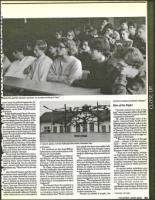
Students at the Josef-Effner Gymnasium near Dachau: You must learn from this part of history.'"
ment camp for political opponents. As
(--, the memorial that now exists on the
\, site documents, during its 12 years of
—vperation • more than 30,000 people
died there.
Today 35,000 people live in the town
.IDachau. Many of the children attend
1 the Josef-Effner Gymnasium. They
cannot escape from the shadow of the
horrors that happened 50 years ago.
1 1
"You can't live here without facing
the Holocaust," says Dr. Franz Zapp,
the school's principal. Students begin
learning about Jewish history in sixth
grade. Formal studies of the Holocaust
come in tenth grade.
The teaching of the Holocaust na-
tionwide began in the 1960s, according
to Gisela Morel-Tiemann of the Edu-
cational and Cultural Affairs Ministry.
"The measure is not only history, reli-
gion and civics, but comes into each
(-subject in school," she says.
But to teach the Holocaust, educa-
tors walk a tightrope between helping
students understand the past without
, making them resent forever being
made to feel guilty. As one educator
says, second and third generations
sometimes say, "What have I to do with
it?"
Mrs. Morel-Tiemann says the stud-
_ ies become most meaningful when stu-
dents can relate historical events to
their own locale. "Groups of young peo-
,,ple are looking up documents in their
town to find out about Jews who lived
there," she says. She tells the story of
the students who were working on such
' a project a few years ago when they dis-
covered a previously unknown Gestapo
cellar where Jews were interrogated
trend is to racism and that's a danger."
Rise of the Right
-
r
Ift t aRN &
i
4
•
\.4
N
‘'&
.\\
•••
•
Zn4X.:n
.s\s‘
N
In 12 years of operation, more than 30,000 people died at Dachau Concentration Camp.
been people who knew but couldn't talk
and beaten.
about it because they thought I alone
For students at the Josef-Effner
can't change it. It tells us we should be
Gymnasium, such confrontations with
careful in believing what powerful men
history are unavoidable.
say."
"It's special because it's our history,"
Florian compares a present day sit-
says Florian, one of the students at the
uation,
wondering how he would react
school "You must learn from this part
if he saw skinheads in Munich abus-
of history." Still he adds, he does not
ing foreigners. If surrounded with his
feel guilty for the country's past crimes.
friends,
he might say something. But
Dr. Zapp, whose parents resisted
if
alone,
he says he is not sure how he
the Nazi onslaught, later explains the
would respond.
difference between guilt and responsi-
Kersten applies her history lessons
bility: "We have a responsibility to an-
to
the
social and political problems the
alyze it honestly and take from the
large immigration wave is causing in
experience. But to be guilty is to have
Germany. "The immigrants who come
helped these circumstances to have
are a political problem but the indi-
happened."
vidual
should be treated hie everyone
The lessons force the students to
else," she says. "We must accept them
think about how they might react in
but we must try to change conditions
similar circumstances. Says Kersten,
in their countries too.
an outspoken young women with dis-
"People are afraid of people, the
tinctive auburn hair, "Mere must have
"German racism has come a long
way," says newspaper editor Josef Joffe.
"Poles and Jews are honorary Aryans
compared to Pakistanis."
Mr. Joffe, the foreign editor of the
highly respected daily Suddeutsche
Zeitung based in Munich, refers to the
250,000 asylum seekers who are flood-
ing Germany from Yugoslavia and oth-
er Eastern European countries. Mr.
Joffe explains these refugees present
a problem because there is no legal im-
migration in Germany.
" The only way to get in is through
a hole — Article 16 [of the constitu-
tion]— which says that political
refugees can be given asylum." Once a
person is in the country, he or she then
becomes a ward of the state.
" They can't work legally, because
we don't have immigration laws," he
says. The influx has been so great that
in Munich the foreigners are being
housed in "containers," tiny, temporary
boxlike structures in which up to four
people sleep.
An asylum seeker undergoes a one
to two year process to determine if he
legitimately needs refuge. In the end,
fewer than three percent who apply
are actually awarded this status.
But those who do not receive asylum
are seldom forcibly kicked out.
"By then the person has been here
and doesn't want to leave. But he's not
allowed to work, so it forces crime and
Continued next page
THE DETROIT JEWISH NEWS
25
CLOS E U P
•