

"You don't need a recession for
anti-immigrant feelings.
.f,
•
stV
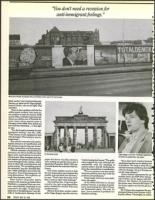
What's left of the wall: Reunification will cost 150 billion marks a year for the next ten years.
black market," says Catarina Kennedy-
Barmier, an editor at Der Tages Spiegel,
based in Berlin, who covers right wing
activities.
There is also a problem with the five
million guest workers, who came un-
der treaties to both the former GDR
and the West, to fill jobs locals shunned.
About one million are of Turkish de-
scent, many whose parents came to
Germany in the 1960s. They still do not
have German citizenship — or the right
to vote.
"You don't need a recession for anti-
immigrant feeling," says Mr. Joffe.
"This country is not equipped to deal
with strangers. This society is very ho-
mogeneous."
But add the economic and psycho-
logical pressures of reunification and
the climate is ripe for the rise of xeno-
phobia, nationalism and hate groups.
Official estimates of extremists in
Germany are about 45,000, but that
figure only counts those involved in
criminal acts. Many foreigners and asy-
lum seekers are spread out in the small
towns throughout the country, where
there is often high unemployment and
social anxiety. "It's a breeding ground
for extremists," says Ms. Kennedy-Ban-
nier. "After unification, the social prob-
lems grew. Fear of becoming poor, it's
a big disturbance. The problems al-
ready there became worse."
Some believe Chancellor Kohl's
meeting with Austrian president Kurt
Waldheim, a suspected Nazi war crim-
inal, was politically motivated as an
outreach to the right. "It did not be-
speak tact or farsightedness," says Mr.
Joffe of Suddeutsche Zeitung. At his
26 FRIDAY, MAY 29, 1992
•
:1W
m*ukst.
The Brandenburg Gate.
paper the theory was that elections
were coming up and the move sent a
signal that Chancellor Kohl's CDU par-
ty would absorb the interests of the ex-
tremes.
"One of the stability secrets is that
the two large parties can integrate the
smaller ones and leash the extremes,"
he says. "That's why there has never
been a serious right wing challenge."
Nevertheless the 11 percent gar-
nered by the right wing Republican
party, headed by a former Nazi, has
caused concern.
Marcus Endrullat, another editor
at Der Tages Spiegel, says the vote was
Stefan Schwarz of the CDU:
Western establishment
will have to be questioned by new people."
"embarrassing but honest." The politi-
cians suggest the vote reflected dis-
satisfaction with the handling of
asylum seekers. But Mr. Endrullat be-
lieves the real problem is reunification.
"This is a protest vote that estab-
lishment politics can't deal with the
problems of reunification."
Surprisingly, there are some politi-
cians who agree.
At 32, Stefan Schwarz is a 10-year
political veteran, a member of parlia-
ment representing the CDU (Christ-
ian Democrats) party. The vote, he
says, "was a reaction to problems we
should be solving.
"It's a short term reaction because
established parties are not taking care
of problems. We need to solve the so-
cial and economic problems, then deal
with the ideology. All over Europe you
see the same dangers."
Heinz Hubner represents the op-
position party, the FDP (Free Democ-
ratic Party), yet he agrees with Mr.
Schwarz. Mr. Hubner, 39, hails from
the former east, where he fell victim to
the Stassi regime and lost his job as a
teacher.
Mr. Hubner also recognizes the psy-
chological factors that hamper reuni-
fication efforts. "Overnight, an entire