

CLOSE-UP
•
Story and Photos by
FRAN ROTHBARD Special to The Jewish News
ermany_
The exhibit "Patterns ofJewish -Life,"
displayed in Berlin from January
through April, presented an elegant
display of artifacts, paintings and pho-
tographs documenting the richness of
Jewish history from ancient times
through the present.
"Most of the people here have nev-
er seen a Jew," says curator Christian
Shutz. "Their picture of Jew is as vic-
tim."
The purpose of the exhibit was to
show the fullness of Jewish life, which
it does splendidly, with room after
room filled with beautiful ritual items,
master paintings depicting life cycle
events, explanations of traditions and
photos documenting the birth of Is-
rael.
Still there was a strange feeling in
viewing the exhibit, like watching zoo
animals who, but for their captivity,
would be extinct.
It's an inescapable feeling when
touring Germany, where the rem-
nants of Jewish life linger in the ar-
chitecture, in culture, in the small
community which still exists. Never-
theless, the effectiveness of the Nazis
is apparent. Today official estimates
place the number of Jews in the coun-
try at about 30,000. So it's not un-
usual, as Ms. Schutz noted, that with
only 30,000 out of a population of 79
million, most Germans have never
met a Jew.
Speaking to journalists, educators,
parliamentarians and other leaders
throughout the country during a two
week tour hosted by the German for-
eign ministry, it was clear that in the
years since the war Germany has
made a conscious effort to face its re-
sponsibility for the past. Since it be-
came a democracy, Germany has
established friendly relations with Is-
rael, instituted Holocaust education
studies in schools, rebuilt synagogues,
24
FRIDAY, MAY 29, 1992
LEARNED
and created memorials to the victims
of the Nazis.
Still it is difficult to travel through
Germany without considering the
question of whether it could happen
again. That's why reports of anti-Semi-
tism, of right wing parties winning
elections and neo-Nazi marches —
while they happen throughout the
world — seem scarier when they hap-
pen in Germany.
The Republican Party, an anti-for-
eign, anti-immigration political par-
ty, won 11 percent of the vote during
elections in the state of Baden Wurt-
tenburg on April 5. The week before,
Chancellor Helmut Kohl met with
Austrian president and suspected
Nazi war criminal Kurt Waldheim.
Also a few weeks ago, hundreds of neo-
Nazis and Skinheads marched
through the streets of Dresden.
The German view on these recent
events varies. Some say the election
results reflected a dissatisfaction with
the political status quo. Others believe
xenophobia is a by-product of bad eco-
nomic times and the stresses of re-
unification. As for me, I was perhaps
too insulated, well-fed and pampered
while a guest of the German govern-
ment to be objective. But impressions
were deeply imbedded:
A half century since the Holocaust,
united Germany is struggling with
many of the same demons it faced
in the 1930s.
In the shadows
The village of Dachau is a quiet en-
clave in the heart of Bavaria. An an-
cient castle, nearly half a century old,
rests atop a picturesque hillside. The
former castle has been transformed
into a museum and restaurant, where
patrons savor rich pastries while
drinking in the panoramic view of the
Alps.
Five kilometers from the heart of
the town is Dachau Concentration
Camp, the first of Hitler's prisons. It
was originally intended as an intern-
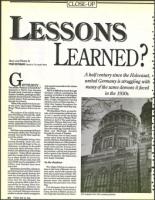
Berlin synagogue, built in 1859, is undergoing restoration.