

rubble of German cities
and neighbors stateside
who hadn't written. He re-
ferred only once to
"souvenirs" he would be
bringing home. It is
unclear whether he was
speaking about the bones.
W
hen Paul Miller
came home, he
was carrying
some extra baggage. True,
he took from Europe the
bones fo the dead. He also
took home the pain of seeing
a concentration camp.
Dr. Emanuel Tanay
knows all about trauma.
The Detroit psychiatrist is
a survivor of the Holocaust,
having lived first in
Krakow under false papers
and then later in
Auschwitz. He has written
books and articles on the
trauma of liberators and
survivors.
"There are two con-
tradictory responses," he
said. "Taking something
like that (the jar) is a way
of holding on to the
memory. Doing nothing
with it for decades is the
other side."
Dr. Tanay, in an analysis
he admits is hypothetical,
said Sgt. Miller took the
bones as a form of healing.
Many concentration camp
liberators suffered for the
experience. "Many have
never recovered," he said.
Sgt. Miller, who ap-
parently never spoke of his
experiences at Nordhausen
once home, fit "perfectly"
into a model for the
traumatized liberator, the
psychiatrist said.
In an introduction to The
Liberation of the Nazi Con-
centration Camps, a 1981
compendium of speeches
and testimony by lib-
erators and survivors,
Miles Lerman writes:
"They (the liberators) were
battle-weary veterans of
fierce military campaigns
— the Normandy Invasion,
the Battle of the Bulge,
Stalingrad, and Kursk —
soldiers who were harden-
28
FRIDAY NOVEMB
ed in battle and thought
they had seen everything
and were beyond shock.
Then they entered man's
worst Hell."
Jack Schwartz, local
commander of the Jewish
War Veterans, said that in
wartime soldiers fre-
quently make light of
death.
One of his friends sent
him, as a wedding present,
a Japanese rifle and a
samurai sword. The sword,
still stained with blood,
was taken off a dead
Japanese soldier. Mr.
Schwartz was shocked, and
his newlywed made him
throw the sword out. To
this day, he still can't ex-
plain his friend's gift.
"Who knows how the
human mind works?" Mr.
Schwartz said. "Why
would somebody want to do
that? I don't know."
Perhaps, Dr. Tanay said,
Sgt. Miller took the bones
to prove — with cold fact —
that the Holocaust
happened. Perhaps he did
it to cope with the trauma.
Because the atrocities in
Europe were so un-
precedented, so large, they
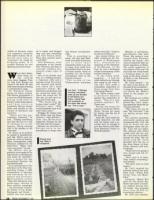
Photos from
Sgt. Miller's
scrapbook.
also became incomprehen-
sible.
That is, according to
many, the logic that Holo-
caust revisionist historians
use to draw their
arguments; there is no way
so many Jews could have
been killed, there is no way
civilized people acted so
boorishly, etc. All of these
assumptions rests on the
premise of reason.
The words of the
Timberwolves' historians
Joe Carli: "If Monday
morning, everybody
woke up and decided
to kill Italians and
Poles, I would hope
that somebody on
the other side would
say, 'This is crazy.' "
echoes ironically: "It has to
be seen to be believed."
Gen. James Collins, in a
1981 conference for lib-
erators in Washington
D.C., recounted his
memories of the liberation
of Nordhausen. At the
time, he was a lieutenant
colonel commanding a field
artillery battalion.
"It was really mind-
boggling . . . I had my
whole battalion go through
that camp to see what it
was like. This made a
tremendous impression on
these young farm boys
from North Dakota."
Sgt. Miller simply acted
to preserve memory
against the compulsion of
reason. "This is a very
common reaction," Dr.
Tanay said.
Saving the bones for
memory was the act of Paul
Miller. Saving the bones
for history was the act of
Mr. Joe Carli.
After Mr. Carli made his
initial discovery, he told
both his father_ and a co-
worker that he wanted to
give the items to the Holo-
caust Memorial Center in
West Bloomfield.
Mr.Carli is part-Italian,
part-German and part-
Polish. His mother's aunt
escaped Nazi Germany
without her family, who
were all killed for their po-
litical opposition to Hitler.
The aunt's sensitivity to
the memory of the war was
such that she would break
a drinking glass in her
hand at the mere mention
of Hitler or the Holocaust,
Mr. Carli said.
Mr. Carli wanted — for
the sake of his family, for
the sake of the murdered —
to keep the discovery quiet
and deliver Mr. Miller's
items to the proper au-
thorities.
But word got out. A Nazi
memorabilia collector
phoned Mr. Carli, inquir-
ing especially about the jar
of bones and teeth.
"The items are not for
sale," Mr. Carli said. "I am
not selling human body
parts."
The collector persisted,
alternately cajoling and
threatening Mr. Carli. He
said he would tell the
newspapers about the jar.
Mr. Carli did not object.
The collector said others
would want the jar, too.
Mr. Carli said he wouldn't
change his mind. The col-
lector said Mr. Carli
shouldn't give the jar, or
the other items, to Jews.
Other collectors said simi-
lar things:
"Those Jews are going to
turn around and sell it,"
one said.
"Don't give it to them.
They control everything,"
said another.
"The Jews want to erase
history."
Mr. Carli received two
business cards in the mail.
Both read: "White Folk
Unite! Join the Mich.
Klan."
Collectors offered $10
each for the photos Sgt.
Miller had taken of Ameri-
can soldiers burying Jew-
ish bodies. One promised
more than $2,000 for
everything in the box.
Mr. Carli was steadfast.