

towns and cities, the
Nordhausen concentration
camp in Germany.
The Germans built their
feared V-2 rockets in Nor-
dhausen and protected
their factories from Allied
observation and air raids
in a vast network of
tunnels. The tunnels had
been dug by Hitler's vic-
tims: political prisoners,
Jews and others.
The official history of
Sgt. Miller's unit, The Five
By Five, describes what the
Americans saw in Nord-
hausen:
"On 12 April the Timber-
wolves advanced slightly
and took over infamous
Nordhausen. Here, in this
city of some 30,000 people,
approximately 180 miles
east of the Rhine, were to
be seen some of the most
amazing sights of our ca-
He agreed to buy the dus-
ty possessions, mainly
dishes, old furniture and
Christmas ornaments. But
what Mr. Carli thought
would be just boxes of old
junk turned out to be an
extraordinary find.
Late on a Friday night,
with nothing else to do, Mr.
Carli began to go through
the boxes with his father
and a friend.
"We were just sitting
around, talking, taking a
look at this stuff," said Mr.
Carli, 29. The chance of
finding something
valuable was slim, but it
kept their interest.
Mr. Carli opened another
box, one that had been
sealed many years before.
In it, he found intricately
wrapped items. Some were
covered in several layers of
tissue paper, with tied
ribbons holding the paper
together.
In one box, the auc-
tioneer found an emptied-
out hand grenade. In an-
other, there was a box of
medals and ribbons from
World War II.
Proceeding slowly, Mr.
Carli opened up a smaller
box. A bayonette. In an-
other box, tissue paper
yielded a bright red Nazi
flag.
Mr. Carli shook another
tissue-wrapped object. It
rattled.
Joe's father thought it
was more medals. Joe's
friend thought it was
bullets.
Mr. Carli peeled the
tissue paper away, reveal-
ing a red jar with white ob-
jects in it.
"Dad," Joe said. "This is
full of bones."
Photo by Glenn Triest
T
he stepfather, Paul
A. Miller, lived on
McClellan Ave. in
Detroit. He also was Sgt.
Paul Miller, artillery
mechanic in Battery D in
555th Anti-aircraft Artil-
lery, known as the Timber-
wolves. The unit liberated,
among many European
reers ... We saw the
emaciated bodies of hun-
dreds and hundreds of po-
litical prisoners scattered
throughout the numerous
three storied barracks .. .
So gruesomely shriveled up
were these skin-covered
skeletons that they ap-
peared to be mummified.
One of the most horrible of
the sights was a great
number of stark-naked
bodies stacked like cord-
wood under a staircase .. .
Never has the narrator of
this history seen a sight
which had more effect on
soldiers. The general con-
sensus of all spectators was
`It has to be seen to be
believed! "
Father Edward P. Doyle,
a chaplain for the Timber-
wolves, paints another pic-
ture of the camp, in The
Liberation of the Nazi Con-
centration Camps, 1945.
"Then our group went
into the town of Nor-
dhausen, and we com-
mandeered all the elderly
German men to come to the
camp and bury the dead .. .
I recall vividly we took
pieces of carpet, and they
became a litter, if you will,
or a sheet or a door, any
way by which we could
carry these bodies and lay
them out and find any liv-
ing among them before we
prepared for the mass
grave. I saw men and wo-
men — some deny it — but
I saw for myself women,
and somewhere in my mind
there is always a picture of
a child, a bloated child,
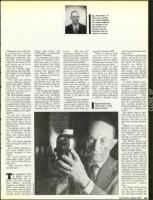
Rabbi Rosenzveig
with the jar: "I was
quite stunned."
which has lived with me all
these years."
As a matter of policy, Sgt.
Miller declared all the
items he was taking home.
He listed 19 coins, two
medals, two metal in-
signias, four cloth in-
signias, one armband, one
belt buckle, one canteen
and one bayonette. He did
not list the grenade, a Nazi
swastika flag, or the jar of
bones.
A 104th Infantry Divi-
sion document, dated
December 5, 1944, explicit-
ly warned soldiers against
"looting, or any wrongful
taking of private property
is prohibited . . . Due
regard must be given to the
protection of private prop-
erty of a non-military na-
ture; namely, glassware,
pictures, clothing, etc., and
— above all — religious ar-
ticles."
Sgt. Miller died in 1967.
Soon after, his family mov-
ed to Plymouth from
Detroit. He told no one
about his wartime memen-
tos.
"Maybe he regretted it.
Maybe it was just a dark
secret he tucked away in
the basement," Mr. Carli
said. "We'll never know
because he died and took
the story with him."
Sgt. Miller's family will
not discuss the matter. Mr.
Carli said they were upset
to learn of their step-
father's hidden objects.
"A lot of people don't
realize that when you die,
you leave your secrets
behind," Mr. Carli said. In
the course of his work, he
has found unregistered
handguns, stolen vehicles,
large collections of por-
nography: all items hidden
by someone long deceased.
Letters, photographs,
books and postcards linked
Paul Miller to a brutal war
that left its combatants —
and survivors — deeply
hurt.
But Miller's letters home
do not refer to death. In
fact, they never discuss the
war. He talks of grub, the
THE DETROIT JEWISH NEWS
27
CLOSE U P
Sgt. Paul Miller: 19
coins, two medals,
two metal insignias,
four cloth insignias,
one armband, one
belt buckle, one
canteen and one
bayonette. But no
mention of bones.