

Y E
E V I E W
IN
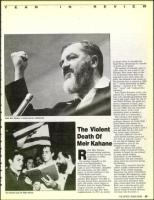
Rabbi Meir Kahane: a violent end to a militant life.
The Violent
Death Of
Meir Kahane
abbi Meir Kahane
aroused strong emotions
in people, be they fervent
supporters or bitter
opponents.
His murder, allegedly at the
hand of an Egyptian-born
American on a cold New York
night in early November, rekindled
the controversy over the rabbi's
legacy of Jewish militancy in the
United States and Israel.
A charismatic man and fiery
speaker, Meir Kahane was able to
tap into Jewish fears, paranoia and
guilt. His public career began in
Brooklyn with his Jewish Defense
League, initially an effort to
protect Jews in tough New York
neighborhoods. In 1971, he moved
R
His followers pray for Rabbi Kahane.
to Israel where he founded the
Kach Party, advocating the transfer
of Arabs out of Israel.
His moment of triumph came in
1984, when he won a- seat in the
Knesset. Four years later, on the
eve of elections when Kach was
expected to gain more seats, the
party was banned in the courts on
the grounds that it violated a 1985
law — aimed specifically at Rabbi
Kahane — because of its "Nazi-
like," "racist" and "undemocratic
positions."
Even Rabbi Kahane's critics, who
labeled him a demagogue, credited
him with identifying problems that
others had swept under the rug. It
was Rabbi Kahane who spoke out
about a response to black, anti-
Semitic militancy in New York in
the late 1960s and who discussed
Israel's choice, as the Arab
population grew, to remain a
Jewish state or a democracy.
His solutions were based on
simple answers to complex
problems. Remove all Arabs from
Israel before they destroy its
Jewish character; rid American
Jewry of self-hating leaders; pack a
gun and take the law into your
own hands when necessary.
His was a Biblical view of a
world divided between good and
evil with no room for nuance — or
for the side of Judaism that
commanded to care for the
stranger in one's midst.
After the 58-year-old rabbi's
death, which touched off violent
protests in Israel, he was praised
by some Jewish leaders,
particularly in the Orthodox
community, who had remained
silent about his activities during
his lifetime.
Some critics maintain that the
rabbi's murder underscores the
danger of his violent message,
deepening the spiral of bloodshed
and revenge. His supporters insist
that his death proves his lifelong
contention that Arabs hate Jews
and want them destroyed. Both
sides would agree that essentially
Kach was a one-man party and
that no successor to the rabbi's
stormy brand of Jewish advocacy
will soon take his place. ❑
THE DETROIT JEWISH NEWS
37