

I N
Y E A
R E V I E
Tragedy At The
Temple Mount
erusalem, the City of
Peace, was the subject of
violent disagreement
between Arabs and Jews
this year, with its holiest
shrines the scene of a fatal
confrontation during the holiday of
Sukkot.
Tens of thousands of Jews had
just prayed at the Western Wall on
a sunny morning in early October,
when rocks and bottles rained
down on the remaining crowd from
the site of Al Aksa Mosque above.
Not surprisingly, the Arab and
Israeli accounts of what
precipitated the violence, which
resulted in the deaths of more than
20 Arabs, differ greatly.
Israelis maintain that the attack
on Jewish worshippers was
premeditated, while Arabs say
Israeli police opened fire
indiscriminately on them as they
defended their mosque from alleged
threats from a small group of
Jewish fundamentalists seeking to
reclaim the Temple Mount.
Several investigations were
subsequently carried out, the last
of which indicated that Israeli
police over-reacted to the Arab rock
throwers. The incident precipitated
an international diplomatic crisis
and underscored a rift between the
United States and Israel regarding
policy over the status of Jerusalem.
J
38
FRIDAY, SEPTEMBER 6, 1991
The United Nations condemned
Israel for its actions during the
Temple Mount event, neglecting
any mention of Arab provocation,
and Israel was sharply criticized
for its refusal to cooperate with a
UN investigation of the incident.
Most painful was Washington's
decision to join in the chorus of
condemnation, particularly at a
time when Saddam Hussein sought
to link the Persian Gulf crisis to
Israel by demanding that the
Jewish state relinquish the
occupied territories. (It was only
the third time the United States
had not vetoed a UN condemnation
of Israel.)
Though the United States
officially dismissed the issue of
linkage, President Bush gave the
matter credibility when, in a
speech to the United Nations, he
referred to the Arab-Israeli conflict
in the context of a diplomatic
solution to the Iraq affair. And
Secretary Baker wrote a letter to
Israeli officials saying that even
though it was unjustified, "some
will compare you to Saddam
Hussein and his rejection of
Security Council decisions?'
In general, pro-Israel supporters
were deeply concerned that the
administration viewed Jerusalem
not as one city but as split
between east and west, Arab and
Jewish, and that in future peace
negotiations there would be no
assurance of Washington's support
for Israel's insistence that
Jerusalem remain undivided.
The Temple Mount tragedy
remained a painful symbol of
Arab-Jewish mistrust and
misunderstanding, suggesting that
two groups claiming the same
piece of land, each fueled by
religious conviction, may be unable
to resolve their differences
peaceably. ❑
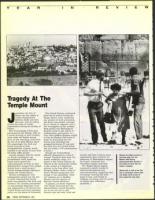
(Above) An elderly woman is
escorted away from the
Western Wall during
disturbances that resulted in
the deaths of more than 20
Arabs in October.
(Above left) A view of the Old
City of Jerusalem, where Jews
and Arabs come to pray at
their respective holy sites.