

'There Can Never Be
A Return To The Past'
Five key questions and answers
about the coup and its implications.
will now have to wield a tremendous
amount of power to keep the people
under
control.
ith all the changes Mikhail
Two:
What would be the best possi-
Gorbachev made as head of
ble response from Washington as far
the Soviet Union, there is one
thing he did not succeed in as Israel is concerned?
For many years, Washington was
altering: that Soviet leaders leave of-
our main ally and a channel for both
fice only by death or by coup.
pressure on and communication
That much may be clear, but a with the Soviet Union on Soviet
great deal remains unclear as the Jewry issues. Recently, the Israeli
situation in the Soviet Union con- government has preferred to talk
tinues to shift, not just from day to directly to the Soviets, avoiding
day but from hour to hour.
Though there is still much room
for speculation on the eventual out-
come, I shall try to formulate the
vital questions and some tentative
responses:
One: Has the coup catapulted us
back to Brezhnev's era, before
glasnost and perestroika?
In many ways, yes. Although
perestroika — restructuring — never
really worked, glasnost — openness
— brought changes to all spheres of
Sovietlife. In one day, glasnost has
ended: There is no more freedom of
expression, the KGB has emerged
from the shadows and the rees-
tablishment of totalitarian control
has been expressed in the most visu-
al of ways, the presence of numerous
tanks in the streets of Moscow.
]This being said, I believe there
can never be a return to the past in
the Soviet Union: Neither can it
handle its internal affairs as it once
did, nor can it again become a
superpower vying with America for
world domination. Eastern Europe
is no longer under Soviet control, for
one, and even inside the Soviet
Union people are infected with the
virus of freedom, both as nation-
alities and as individuals.
During all the years of totalitarian
rule, the KGB acted as if even one
free person was a mortal threat to
the state. But for the past several
years, not only a few dissidents, but
hundreds of millions of people have
tasted freedom. The Soviet regime
NATAN SHARANSKY
W
Natan Sharansky is an editor of the
Jerusalem Report.
34
FRIDAY, AUGUST 23, 1991
American interference. Now there is
no doubt that we must immediately
turn back to Washington.
The problem of the Jews trapped
in the Soviet Union must again
become the focus of world attention.
The immense network of American
and other Western Soviet Jewry ac-
tivist organizations, which had al-
ready begun to be dismantled, must
be revitalized.
President Bush's first reaction to
the news of the coup was that all
economic assistance to the Soviet
Union would be halted. Once the
dust settles, however, there may be
a strong temptation to reestablish
cooperation with the Soviet Union.
It is very important, therefore, that
one of Washington's first messages
to the new regime be that free
emigration will be the best indicator
of Soviet intentions, as it has been
for the past 20 years. Freedom of
emigration is not only important for
Jews; we must remind the West that
it has also served as the prime test of
human rights in the USSR.
Glasnost started with concessions
in this sphere, and if the borders
close once more, it will be a sign that
the Soviet Union is once again turn-
ing into a militant power, dangerous
to the West.
Three: How will the coup affect the
Jews still inside the Soviet Union?
It's an easy guess that the new
leaders don't like Jews or Israel.
They view the Jews as a disloyal and
destabilizing element, and they
have stated that emigration was
causing a brain drain that was
responsible for Soviet economic col-
lapse. Certainly, these arguments
will now be repeated in demagogic
attempts to explain why Gor-
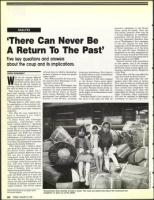
Young Soviet Jews recently arrived in Israel: The coup has raised fears about the continued free
emigration of Jews out of the USSR.
Photo by Doron Bache rIWZPS
ANALYSIS