

KREMLIN
CRISIS*
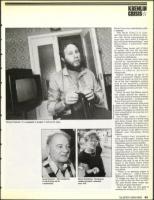
Samuel Vaisman: If a scapegoat is sought, it will be the Jews.
Leonid Soushon: "After Gorbachev,
it's 50-50 there will be
a dictatorship."
Marina Perelshteyn: The Moscow
resident has been a refusenik
since 1976.
Soviet Union may undoubtedly suffer
a setback.
"[The Soviet Union] is so uncer-
tain that [Jews] are afraid to associ-
ate with Jewish organizations be-
cause they don't know if tomorrow
that will cause them problems," said
Shai'ia Gisser, a Lubavitcher rabbi
in Odessa.
Rabbi Gisser knows well of what
he speaks. His own life has been
threatened and he and his wife have
sent their two young children back
to Israel for safekeeping.
Similar threats have also been
received by representatives of the
Jewish Agency and the American
Jewish Joint Distribution Com-
mittee workihg in Odessa, forcing
them to employ personal
bodyguards.
Evgeny Lemberg, at age 21 al-
ready a prominent Odessa Jewish
communal leader as well as a mem-
ber of his city's legislative council,
said he has personally reviewed
KGB reports to Odessa officials that
have labeled Jewish activists "trou-
ble-makers."
So far, he said, the Odessa council
has simply ignored the reports, a
sign of the sense of political freedom
— but also anarchy — existing in the
Soviet Union prior to the coup.
One can only speculate what such
Al reports will mean should the Soviet
Union return to darker days. But
F--
c,, • imagine the degree to which the fear
c that existed before the coup has now
f: been amplified.
One Friday night in Odessa, I
went to a rehearsal of a Jewish song
and dance troupe that calls itself
Migdalor, (Hebrew for Lighthouse.")
In just six months, this group of 15
professional musicians has become a
major success in the effort to revive
Odessa's once flourishing Jewish
culture.
Its concerts have attracted as
many as 800 people, making them
the largest Jewish event of any kind
Odessa has seen in many decades.
Odessa, Migdalor founder Kira
Verkhovsky told me, has a record of
tolerance toward Jews and other
minorities (that is, if you ignore the
1905 pogrom in which over 500 were
killed, and the collaboration of local
Ukrainians during the Nazi era).
Odessa, she said, is one of the last
places in the Soviet Union where
widespread anti-Semitism will sur-
face should the political situation
turn bleak.
"There is no pressing reason to
leave Odessa," added Helen
Mikhailov, a singer with the troupe.
"If things are okay for everybody,
they will be okay for Jews as well,"
she said barely three weeks ago.
"Artists are great optimists."
Let's hope they are also good at
reading the writing on the wall. ❑
THE DETROIT JEWISH NEWS
33