

FIRST-PERSON
two million or so Jews still in the
Soviet Union.
At the very least, this week's coup
is sure to give new urgency to the ex-
isting widespread desire among
Jews to flee the Soviet Union for
Israel and the West.
. Already, the Jewish Agency, the
quasi-official Israeli government
agency in charge of Soviet immigra-
tion, is considering large-scale
airlifts to get tens of thousands of
Jews out of the USSR as quickly as
possible.
Simcha Dinitz, agency chairman,
has predicted that 60,000 Jews,
whose Soviet exit and Israeli entry
documents are already in order, may
try to flee the Soviet Union in the
coming days.
Jewish population of about 69,000.
Baltimore and Odessa, a Black Sea
About a million Soviet Jews in all
port city of about a million people,
have applied to leave for Israel, a
nation most have little regard for
have a sister city arrangement that
other than its status as an immedi-
dates back more than three years.)
The ultimate impact of the coup ate safe haven.
Given the numbers involved, it is
attempt has yet to be determined.
Nonetheless, events in Moscow have clear that only a relative handful of
underscored the precariousness of Soviet Jews will swiftly gain safe
passage should events in the after-
Jewish life in the Soviet Union.
math of the attempted coup conspire
Last week's fears have become this
to drastically slow down the steady
week's reality.
Moreover, given the correctness of flow of Jews who want out of the
USSR.
the apprehension felt by Soviet Jews
For 'those Jews who remain
toward the instability of the Soviet
political system, who can ignoIe their behind, life may become even harder,
dread over what a still very iffy future and fledgling effdrts to revive Jewish
may have in store for the estimated cultural and religious life in the
For Soviet Jews,
Fear Becomes Reality
Unlike Washington, Jews in the Soviet Union foresaw
the coup. The concern now is what next?
IRA RIFKIN
Special to The Jewish News
n an Odessa street named after
Karl Marx, Leonid Soushon, a
60-year-old Ukrainian Jew who
as a child spent more than two
years in a Nazi prison camp, address-
ed his fears about the future of the
Soviet Union.
Two weeks before Monday's
Kremlin coup, he spoke of Mikhail
Gorbachev in the past tense.
"After Gorbachev, it's 50-50 there
will be a dictatorship," he said, his
arms folded defensively across his
chest. "If that happens, it will be bad
for Jews — I'm sure of that — be-
cause anti-Semitism is always just
below the surface here."
In the Moldavian city of Tiraspol,
similar concerns were expressed by
Samuel Vaisman, a member of the
Va'ad, the Soviet Union's national
Jewish communal umbrella organ-
ization given life by the reforms of
perestroika.
Jewish life is again blossoming in
Tiraspol, a city of 200,000 near the
Romanian border, Dr. Vaisman
said. A local Jewish council has been
formed, a Jewish library has been
opened, Jewish sports teams have
been organized, Jewish culture and
Hebrew classes are being taught,
and more than 1,000 of the city's
5,000 Jews have turned out for ser-
vices on the High Holy Days.
But do not be fooled, the 44-year-
old agronomist-turned-Jewish-
activist quickly added. The political
climate could change overnight, he
cautioned, and should the situation
become desperate, a scapegoat will
be sought.
That scapegoat, as has often been
the case in the Soviet Union, will be
the Jews, he warned.
Several days later, while walking
in the shadow of the Kremlin,
Marina Perelshteyn, a Moscow
Ira Rifkin is assistant editor of the
Baltimore Jewish Times.
32
FRIDAY, AUGUST 23, 1991
refusenik since 1976, put it even
more menacingly:
"What today is possible, tomorrow
may be fatal," she said.
Isolated voices of despair? Hardly.
The same fears were expressed to
me by dozens of Jews during an 11-
day visit to the Soviet Union that
ended just one week prior to the
Kremlin power grab by hardline
Communists desperate to stem the
moves toward democratization and a
free market economy backed by
President Mikhail Gorbachev.
(I traveled to the Soviet Union as
part of a joint Baltimore Jewish
Times-Baltimore Jewish Councili
delegation, whose primary task was
to ascertain the needs of Odessa's
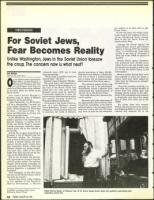
Rabbi Shai'ia Gisser of Odessa: Fear of the future keeps Soviet Jews from publicly associating with
organized Jewish life.