

KREMLIN
CRISIS
I believe there can never
be a return to the past in
the Soviet Union.
government will be totally taken up
with delivering internal economic
aid to the Soviet people. What is
happening in the rest of the world,
including the Middle East, may be of
marginal importance. It's also likely
that they will want to demonstrate
that they are reliable partners for
the West.
Five: How will the coup affect the
300,000 Soviet Jews who arrived
over the past two years?
Ironically, at least here the cloud
has a silver lining. Many new immi-
grants in Israel woke up on August
19, listened to the news and had two
contrary feelings: One, concern for
their family and friends still in the
Soviet Union, and two, tremendous
relief at not being there themselves.
It's easy to imagine the guilt feel-
ings of people who sent messages
back to Russia saying: "Stay where
you are, there are no jobs here."
Now they find that, with all the
problems in Israel, they are at home
here; they feel safe here.
On the other hand, it is important
to remember that if Israel's absorp-
tion program were less of a failure,
there would be at least 100,000 more
Jews here with us, and not in the
Soviet Union.0
Copyright 1991, the Jerusalem
Report Syndicate.
.
Photo by Craig Terkowitz
bachev's policy led to economic
disaster.
But such personal feelings will
probably have no impact on policy.
The new leaders' success in the long
run will be tied to their resolution of
economic problems. And the Soviet
Union is extremely dependent on
Western assistance. The experience
of the past few years has demon-
strated to Soviet leaders that Jewish
emigration brings a high yield from
the West.
As long as the world can keep
delivering this message on emigra-
tion to the Kremlin, Soviet aliyah
may well outlive Gorbachev.
One more point: If there is civil
conflict between any of the republics
and the central government, the
Jews are sure to be caught in the
middle.
Four: How will these events affect the
peace process in the Middle East?
It's by no means clear that they
must affect it. The Soviet Union's
"contributions" in the past have
consisted of giving military and po-
litical support to the dictators in the
region; now, however, there is no
money to start arming the Syrians
again. It's probable that the new
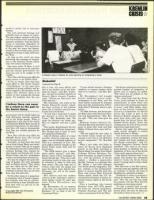
A Hebrew class in Odessa for Jews planning on emigrating to Israel.
Disbelief
Continued from Page 29
this is true, but some official told
this to my brother as he was boar-
ding the plane," said Mrs. Kostin-
sky, who met her brother's family at
Detroit Metro Airport Tuesday
night. "Believe me, they know how
lucky they are."
Mrs. Kostinsky, who works at the
Temple Emanu-El nursery school,
has been writing to her brother
about life in America and how easy
it is for her to be Jewish.
"It took him a long time to make
the decision to leave the Soviet
Union," Mrs. Kostinsky said. "He
made the decision two weeks ago.
He's an engineer and has a good
job."
This month, Resettlement Service
has settled about 60 new Americans.
Mrs. Hyman said at least 14 more
are expected in September.
Luba H. Berton, editor of a local
monthly Russian-language news-
paper, was an exchange professor in
1975 at a university in Kiev. She
said sudden political changes in the
Soviet Union rarely bode well for
Soviet Jews.
"The KGB doesn't give a damn
about public opinion," said Mrs.
Berton, whom a Kiev newspaper la-
beled a Zionist spy. "They are a cold,
calculating bunch of men who may
do whatever it takes to hold onto
their power. The only hope was if
Yeltsin could rally the people and
sway the Soviet army behind him.
Obviously, the will of the people
triumphed."
Mrs. Berton said the sudden
removal of Mr. Gorbachev called to
mind similar events 27 years ago,
when Nikita Khrushchev was
deposed.
Mr. Khrushchev, 70, on vacation
at the time, was replaced by Leonid
Brezhnev, 57, as head of the the
Communist Party.
"It has almost become a Russian
tradition to remove leaders while
they're on vacation," said Mrs. Ber-
ton.
Mr. Khrushchev's fall brought
banner headlines across major
newspapers in the West, and the
stock market sustained its sharpest
drop since the assassination of Pres-
ident John F. Kennedy nearly a year
earlier.
"In 1964, however, the Soviet peo-
ple didn't react with this kind of pro-
test and demonstration," Mrs. Ber-
ton said. "This was what gave me
hope."
Midwest Consul General Dr.
Yitschak Ben-Gad said there was no
panic in Israel this week and that
flights of Soviet Jews were still ar-
riving.
"We just hoped the new order in
the Soviet Union would not have
created a civil war or cut off Soviet
Jewish emigration," Dr. Ben-Gad
said.
What a new order was likely to
mean for Soviet Jews depended
greatly on the West, according to
Wayne State University Law School
Profesgor William Burnham. Pro-
fessor Burnham, an expert in Soviet
law, said the politics of Soviet
leaders — whether a conservative
like Mr. Yanayev or a reformer like
Mr. Yeltsin — has little influence
over Soviet Jewish emigration. The
key, instead, is the Communists'
desire to receive benefits from the
West and retain Most Favored
Nation status, which the U.S. ad-
ministration continues to link to in-
creased human rights in the Soviet
Union.
Even a hardliner like Leonid
Brezhnev from 1977-1979 opened
the doors for Jewish emigration,
Professor Burnham said. The sole
reason was pressure from the West.
The Soviet constitution has always
granted freedom of emigration, of
speech and of religion, he added.
"But these are all subject to the
`greater social good.' "
"We would hope that the Soviet
Union would continue to honor its
committment to allow those who
wish to leave the country permission
to leave," said Ellen Labes, chair-
man of the Jewish Community
Council's Committee on Soviet
Jewry.s Ms. Labes is part of the
Family-to-Family program, which
pairs local Jews with new immi-
grants from the Soviet Union. Her
adopted Soviet family "know the
consequences for Jews if the country
takes three steps backward."
Earlier this week, the JCCouncil
made several attempts to contact
Jewish families in Minsk.
"Our worst fear would be realized
if the emigration process did cease
and violence did erupt targeted at
the Jewish community," said JC-
Council Executive Director David
Gad-Harf. "We want to do every-
thing possible to facilitate the em-
migration of Jews out of the Soviet
Union while opportunities exist."
Luba Berton believes most of the
people who backed the attempted
takeover think the Soviet Union
needs "a strong hand to whip it back
into shape."
She said even in the 9th century,
warring tribes got together and sent
an emissary to Rurik, the king of
Scandinavia, asking for a leader.
"Gorbachev's return is certainly a
victory for democracy," Mrs. Berton
said. "He's the one who has made
the contacts with the West. But the
problems are more deep-rooted.
"It's like a painful tooth you get
checked by the dentist. The more the
dentist drills, the more he discovers
the tooth is rotten to the core."
❑
THE DETROIT JEWISH NEWS
35