

INTERNATIONAL
How Will Coup Impact
Emigration And Peace.
Kremlin chaos has the experts and politicians
scrambling for answers to still•unresolved questions.
JAMES BESSER and IRA RIFKIN
I
his week's apparently failed Mos-
cow coup attempt raised serious
questions about the future of
Soviet Jewish emigration and
Kremlin participation in the Middle
East peace process.
The initial reaction of officials and
Soviet-Middle East specialists in
Israel and the United States to the
power-grab by Communist
hardliners upset by the reforms of
the Gorbachev era was one of deep
concern.
"This was one of .our major fears —
that chaos would break out in the
Soviet Union," Rep Benjamin Car-
din (D-Md.) said early in the week.
"This is very bad news for us. Our
first goal is to figure out who's in
control, and if there's any change in
policy relating to emigration.
"We need to think about ac-
celerating the emigration process —
getting as many Jews out as quickly
as possible," he said.
But by Wednesday, with the coup
seemingly failed, according to all ac-
counts, comments became decidedly
more upbeat.
There was even speculation that
the coup's outcome could usher in an
unprecedented era of stability for
Soviet Jews, whose precarious situa-
tion was underscored by the
Kremlin power-grab.
In the past, this line of thinking
went, President Mikhail Gorbachev
was forced to walk a tightrope bet-
ween reformists and hardliners.
That was one reason why the Soviet
government did not crackdown on
the rising tide of anti-Semitism in
the USSR. Mr. Gorbachev simply
could not afford to further alienate
the conservative forces roiling just
below the surface of Soviet society.
Now, however, the Soviet reform
James D. Besser and Ira Rifkin are,
respectively, Washington correspondent
and assistant editor of the Baltimore
Jewish Times. Foreign Correspondent
Helen Davis also contributed to this
report.
30
FRIDAY, AUGUST 23, 1991
movement appears immeasurably
strengthened. The coup may well
have been the last gasp of a dying
old-guard, leaving the reformers free
to further loosen the reigns on
emigration and other aspects of
Soviet society.
In addition, Washington insiders
noted that the still-unpredictable
nature of Soviet politics may make
Congress more sympathetic to
Soviet Jewish resettlement in Israel.
What if anti-Semitism increases as
a result of newly strengthened na-
tionalist passions in various Soviet
republics, including Moldavia, for
example, where officials have re-
portedly supported Jewish emigra-
tion in large part only because they
see it as a way of freeing up addi-
tional housing for Moldavians.
among Soviet Jews, Agency Chair-
man Simcha Dinitz said minorities
are always the first to be concerned
when there is instability, "and this
includes the Jews, of course."
If there is a sharp increase in the
number of refugees, it could also put
new pressure on American Jewish
leaders to re-open the sensitive
question of U.S. refugee quotas, ac-
tivists noted.
Adding to the initial concern was
the well-publicized assessment of
Galia Golan, Israel's foremost spe-
cialist on Soviet-Middle East rela-
tions, who said the Kremlin
hardliners behind the coup probably
favored a cut in the steady flow of
Jewish emigration, which has seen
nearly 300,000 Soviet Jews leave for
Israel since late 1989.
"It is not in the nature of anti-
Semites or ultra-nationalists to say,
`Well, we don't like the Jews
anyway, so let them all go.' They see
This scenario holds that the
week's crisis could provide a boost to
efforts to provide Israel with $10
billion in absorption loan guar-
antees, which may be even more
crucial now that advocates for Soviet
Jewry, and most Israeli officials, The still-unpredictable
believe there will be an immediate nature of Soviet politics
surge in the number of Jews seeking may make Congress
to leave the USSR.
more sympathetic to
Continued Soviet chaos, should
Soviet
Jewish
that occur, could turn that surge
resettlement
in Israel.
into a full-blown panic.
An emergency meeting of the Jew- emigration as Jews demanding
ish Agency was held in Jerusalem privileges that are denied to others.
Monday to consider a possible airlift They also see it as a means of
of the 100,000 Jews who hold Soviet strengthening Israel," she said.
exit visas but have not yet left (some
Robert 0. Freedman, a Soviet and
60,000 of them also possess Israeli Middle East expert at Baltimore
entry documents).
Hebrew University, voiced an oppos-
Hinting at the growing unease ing view, however.
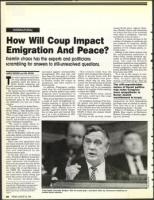
Coup leader Gennady Yanayev: Was the power-grab a last-ditch effort by Communist hardliners to
scuttle Soviet reforms?