

Photo by Craig Te rkow itz
KREMLIN
CRISIS*
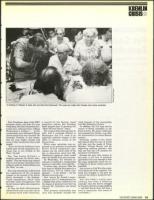
A meeting in Odessa of Jews who survived the Holocaust: The coup has made their futures even more uncertain.
Prof. Freedman, dean of the BHU
graduate school, said that the coup
leadership, had they retained power,
would have refrained from ruffling
Washington's feathers — which
would surely have followed if Soviet
Jewish emigration was curtailed. He
reasoned, correctly, it now seems,
that the coup leaders already had
more on their hands than they could
handle.
"Even the Soviet hardliners have
looked upon Jewish emigration as a
cheap way to win friends in the
West," he said.
Rep. Tom Lantos (D-Calif.), a
longtime advocate for Soviet Jews,
agreed. "The last thing (coup leaders)
want to do is further exacerbate their
relations with the United States and
the West," he said.
The coup attempt also underscored
the importance of the strongest
weapon in the arsenal of the Soviet
Jewry movement — the Jackson-
Vanik amendment, which links
favorable trade arrangements with
Soviet human rights and emigration
policies.
In June, the Bush Administration
offered the Soviets a one-year waiver
of Jackson-Vanik trade restrictions,
a reward for the Soviets' eased
emigration policies. But President
Bush stopped short of granting full
"Most Favored Nation" status.
The coup put that entire process on
hold. And it reminded officials in
Washington that U.S. trade is an
important political weapon in the
effort to influence events in the
Soviet Union.
While some optimism was ex-
pressed on the question of continued
Soviet Jewish emigration, pes-
simism was the initial order of the
day in discussions about how Mr.
Gorbachev's apparent ouster would
affect the Middle East peace process.
By Wednesday, the situation re-
mained too confused to categorically
state just what affect that might be.
It seems clear, however, that the
best hope for Middle East peace in a
half-century will be vastly com-
plicated — if not stalled — by the
Monday morning coup.
One reason for Israel's acqui-
escence to the U.S.-brokered plan for
a Middle East peace conference was
the degree of personal trust built up
between Mr. Gorbachev and Israeli
leaders.
That personal relationship may
have been decidedly changed this
week because of the uncertainty
over Mr. Gorbachev's future.
In addition, the U.S. may now be
unsure of Soviet reliability in the
peace process. The peace conference
now proposed for October, was after
all, announced at the recent Moscow
summit.
Ironically, leaders of the Israeli
left contend that the turn of events
will play into the hands of Prime
Minister Yitzhak Shamir and his
right-wing coalition partners, who
may now face less U.S. pressure for
territorial concessions.
Perhaps the only clear answer at
this point to the host of questions
spawned by the coup attempt is that
the many predictions about the in-
evitability of Soviet reform must be
qualified.
Any return to Cold War-like condi-
tions seems out of the question. Too
much has changed in the past six
years for the clock to simply be turn-
ed back.
But this week's events were
nothing less than a sobering
reminder that the Soviet struggle
for freedom still faces tough sledding
— and that Soviet Jews still face a
level of uncertainty that cannot be
overlooked.0
THE DETROIT JEWISH NEWS
31