

'r
kok
. 'Jr
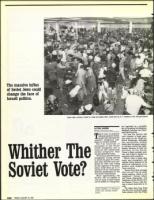
The massive influx
of Soviet Jews could
change the face of
Israeli politics.
Soviet Jews, arriving in Israel in a large and steady influx, could elect up to 17 members of the 120-seat Knesset.
ALYSSA GABBAY
Special to The Jewish News
hey're seen as immense
cultural assets for Israel,
people who will raise the
country's intellectual stan-
dards by several notches.
But the hundreds of
thousands of new Soviet
Jewish immigrants now in
Israel are also viewed from
another perspective: They
are also potential votes.
With about 250,000 Soviet
immigrants having arrived
in Israel the past two years,
and some 200,000 more pre-
dicted for 1991, bloc voting
by this segment of the popu-
lation could elect up to 17
members of the 120-member
Knesset (parliament) in the
November 1992 election.
Most significantly, the
Soviets, who are eligible to
vote as soon as their names
can be added to voting lists,
T
Whither h
Soviet Vote.
Alyssa Gabbay is a freelance
writer who recently visited
Israel.
100 FRIDAY, AUGUST 16, 1991
are regarded as a possible
key to breaking the longtime
deadlock between the Labor
and Likud parties.
Yet how the Soviets will
vote remains a large ques-
tion mark on the Israeli po-
litical landscape, although
the conventional wisdom
holds that the great majori-
ty will lean toward the right,
largely because of their ab-
horrence of the Soviet
Union's failed socialist poli-
cies and Labor's classic as-
sociation with socialism.
There's also a sense that
many new immigrants will
oppose Labor because of its
perceived willingness to ne-
gotiate with neighboring
Arab countries.
"Soviet Jews feel strongly
that you can't rely on totali-
tarian regimes, which is our
neighbors," former refuse-
nik Natan Sharansky, now
chairman of the Soviet Jew-
ish Zionist Forum, said dur-
ing a recent interview in Is-
rael.
"So when they hear from
the left that we should nego-
tiate almost with the Pales-