

FINE ARTS
PAPER PROFITS
-LESLEY PEARL
Jewish News Intern
oree - Schwartz was a
1S closet artist of sorts.
Although always
artistic, the one-time
Eastern Michigan
University business
student didn't enroll
in her first art class
until she was 28-years-old.
Businesswoman
breaks into
the local
art scene.
Seven years later, Ms.
Schwartz creates and sells
handmade paper and is the
co-owner of Route 10 Gallery
in Farmington Hills. The
transition from dress-for-
success businesswoman to
moccasin-clad artisan was
easier than one might guess.
In 1984, Ms. Schwartz
enrolled in a papermaking
class at the Birmingham
Bloomfield Art Association.
She kept her creations in a
shoe box tucked away in her
closet.
"I didn't know what to do
with them," Ms. Schwartz
said.
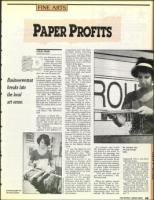
Choosing paper for
the final product.
Photos by Mars ha Sundq u ist
However, a friend did —
she rolled, tied and crumpled
the paper and laid it on a
board. The artist did not
even recognize her efforts in
their new form.
Ms. Schwartz then put
together a few different ar-
rangements and sold them
promptly before receiving
her first commission
assignment with Saks Fifth
Avenue in: Troy.. Her art was
displayed in the lingerie
department and in the front
window of the store.
But before Ms. Schwartz
could scream success, her
front-window display had
faded from pink and peach
pastels to pallor.
"That's when I decided I
had to learn the correct way
to do this," Ms. Schwartz
said. "So far, I had been
pretty much winging it."
Through the assistance of
University of Michigan art
instructor Ted Ramsey, Ms.
Schwartz switched from
watercolor to non-fading
pigment and learned how to
actually "create" paper
rather than "recycle" it. "I
had been tearing up water-
color paper, putting it in a
blender and turning it into
pulp," Ms. Schwartz said.
"Ted showed me how to
work with pulp created from
cotton rags." In addition to
her own work, Ms. Schwartz
is teaching small groups of
people the 2,000-year-old
technique of suspending
pulp in water, dragging it up
on a screen and drying it on
various surfaces for texture.
Ms. Schwartz will help ex-
pose children to art this
summer by acting as an ar-
tist in residence at Olin
Sang Ruby Union Institute
in Wisconsin. For 10 days
she will work with other ar-
tists at the Reform Jewish
camp.
"I was the deprived kid
who never went to camp,"
Ms. Schwartz said. "This
will be a new experience for
me as well as the kids."
Ms. Schwartz is no
stranger to change. And
although the switch from
corporate 9 to 5 to the art
world may seem drastic, it
has been enhanced rather
than hampered by her busi-
ness background.
A former full-time
employee in her parents'
import business, Ms.
Schwartz said her experi-
ences have helped her in
securing corporate and
commission accounts, new
artists for the gallery and
running the financial end of
the business.
For example, each month
Ms. Schwartz and her part-
ner feature a new artist. To
publicize the openings, the
partners contact different
foundations and associations
to sponsor the events. In ad-
dition to receiving a percen-
tage of sales for the evening,
the sponsoring organization
is given 1,000 invitations
from the gallery to send to
patrons of its choice.
"They get money and we
get new customers," Ms.
Schwartz said.
When the gallery moved
from Walled Lake to Nor-
thwestern Highway two
years ago — due in part to
rent increases — the owners
experienced their first big
setback. Ms. Schwartz was
Ms. Schwartz sifts
the pulp through
water.
diagnosed with a rare form
of breast cancer.
Ms. Schwartz then dropped
the dual role of business-
woman and weekend artist
to gallery owner — desiring
a slower pace and an oppor-
tunity to fully enjoy her new
endeavor. Twenty-four mon-
ths later,. she is feeling
healthy and working hard.
"I really like what I'm do-
ing now," Ms. Schwartz said.
"When you go through a life-
threatening illness, you
realize life is short and you
need to be doing what you en-
joy." 0
THE DETROIT JEWISH NEWS
65