

BACKGROUND
4
Beneath Syria's Slick
Mask: Another Saddam?
41/
*
Syrian President Hafez al-Assad
is stockpiling arms and appears ready
to threaten Israel on three sides.
HELEN DAVIS
Foreign Correspondent
ersistent tension bet-
ween Israel and Syria
reached new heights
this week when Lebanon
and Syria signed a formal
treaty of cooperation in
Damascus.
The decision to ratify the
treaty was taken by the
Lebanese cabinet last week
and has provoked a storm of
protest in Jerusalem, which
regards the pact as a direct
threat to Israel's security.
Israeli leaders regard the
cabinet of Lebanon's Presi-
dent Elias Hrawi as a puppet
of Damascus and the treaty
as the consolidation of
p
Syrian hegemony over its
war-ravaged neighbor.
The treaty calls for "pre-
consultation" and "total co-
ordination" with Syria on
Lebanon's foreign, military
and economic policies.
The newspaper of Syria's
ruling Ba'ath Party said the
treaty had confirmed "the
single destiny of Syria and
Lebanon" and had "foiled
Israel's plan to make Leb-
anon its own protectorate."
According to analysts, the
treaty will create a strategic
alliance between Damascus
and Beirut that will result in
the effective absorption of
Lebanon by Syria.
As Israeli jets mounted air
raids on pro-Syrian militia
bases in Lebanon this week,
•
+Now.
F
and he — or, at least, his
image — must change
with it.
The image of an Israel
which simply said "no" —
no to an international
peace conference; no to
UN participation; no to
negotiations with the
PLO; no to a Palestinian
state; no to territorial
concessions —was quite
simply untenable in the
new political order.
There must be a change,
albeit cosmetic change,
that would allow Israel to
break out of its perceived
intransigence. Despite
the shock of the Gulf war,
efforts to convene a peace
conference would in-
evitably fail, but Israel
could not afford to be seen
as the cause of that
failure.
Israel must change its
defensive, back-to-the-
wall posture; it must
bounce the ball into the
Arab court so that it is
they who are forced to
retreat into the shell of re-
jectionism. Israel must
stop saying "no" and in-
stead learn to say "yes,
but . . ."
It is a tactic that ap-
pears to have been used to
some effect.
When James Baker and
Yitzhak Shamir emerged
■•■■•
■
yi
- 7 _
1,4
Anwar! hom New., by Gary Viskup, Caprighl• 1389. Newsday. Datribvted by Los An.. nrflUlSle.
Israeli leaders vented their
anger and anxiety over the
latest development.
Housing Minister Ariel
Sharon raised the
temperature Tuesday when
he announced Israel's inten-
tion of doubling the number
of Jewish settlers in the
Golan Heights, which was
conquered from Syria in the
1967 Six Day War.
High Stakes Image Building
ollowing a marathon
nine hours of discus-
sions over two days
last week, both Secretary
of State James Baker and
Israeli Prime Minister Yit-
zhak Shamir said some
progress had been made
toward narrowing differ-
ences, but they conceded
that procedural obstacles
to full negotiations
remain.
On Friday, Mr. Shamir
told an Israel Television
interviewer that he had
reached "secret
agreements" with Mr.
Baker which would allow
the secretary to pursue
"close and positive con-
tacts with other parties,"
but he remained firmly
opposed to UN participa-
tion in a peace conference.
He would not give any
hint of his tantalizing
"secret agreements," but
they are thought to con-
cern the eligibility of Pa-
lestinians living in East
Jerusalem to participate
in talks with a Palestin-
ian delegation.
Some time over the past
few months, a savvy p.r.
expert has obviously sat
down with the Israeli
prime minister and given
him a crash course in the
arts of Madison Avenue.
The world had changed
!;e.-
to face the TV cameras
outside the Prime Min-
ister's Office in Jerusalem
at the end of their talks
last week, the Israeli
leader allowed himself to
savor the word "success"
when describing their
meetings — before he
went on to concede their
very considerable failure.
But political policy, as
the Israelis themselves
argue with great intensi-
ty, is not made up of
public relations. It does
indeed have a limited
utility, but when it comes
to the bottom line, only
straight answers will
ultimately count.
Whether, and to what
extent, Israel is able to
escape Washington's
retribution for its
perceived intransigence
— ameliorated only by a
greater Syrian intran-
sigence — is still an open
question.
But there is no doubt
that, sooner or later, Sec-
retary Baker will put
some hard questions to
the Israelis and that he
will demand some une-
quivocal answers. At that
point, Madison Avenue
will have little to offer
and much will be riding
on Israel's response. 1=1
— Helen Davis
He said his assurances to
Washington that
U.S.-guaranteed loans would
not be used to settle Soviet
immigrants in the occupied
territories did not apply to
the mountain range, which
was effectively annexed by
Israel 10 years ago.
The Golan Heights have
been regarded as the center-
piece of a future settlement
between the two countries,
but Mr. Sharon's declaration
was intended to signal
Israel's resolve to retain
permanent control over the
inhospitable but strate-
gically vital territory, where
12,400 Jews have already
been settled.
Earlier, Israeli Defense
Minister Moshe Arens de-
scribed the treaty between
Syria and Lebanon as "a
dangerous process" and said
it posed a threat to Israel's
security.
In an interview on Israel
Radio, Mr. Arens said that
while international atten-
tion had been focused on
the Gulf crisis, Syrian Presi-
dent Hafez Assad had em-
barked on a systematic cam-
paign of unobtrusively
"swallowing up" Lebanon.
Mr. Arens warned Israel's
parliamentary Foreign Af-
fairs and Defense Com-
mittee Tuesday that Syria
might attempt to station
heavy weapons and ground-
to-air missiles close to the
Lebanese- Israeli border.
Israel's security forces, he
added, would closely monitor
Syria's intentions and ac-
tions and would be prepared
for "all eventualities."
Israel clearly sees a securi-
ty threat in the new strate-
gic reality, but Mr. Arens'
attack was also designed to
focus attention on Syrian
ambitions at a time when
the Bush administration is
contemplating the next steps
in its attempts to resolve the
Arab-Israeli dispute.
Israel first sounded the
alarm about Syria earlier
this month when it warned
that President Assad was
engaged in a massive arms
build up following a $2
billion cash infusion from
Gulf states as a reward for
participating in the military
alliance against Iraq.
According to Israeli
sources, Syria has placed
large orders for weapons
with the Soviet Union,
China, North Korea and
Czechoslovakia. Since the
Gulf war it has taken
delivery of three shipments
of weapons to swell its al-
ready formidable arsenal.
In addition to acquiring
advanced Scud missiles and
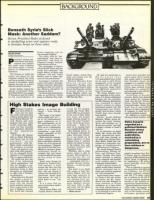
Hafez Assad is
regarded as a
polished Saddam
Hussein whose
ambitions and
aspirations,
masked by a
calculating
pragmatism, are no
less ruthless or
dangerous.
missile launchers from Nor-
th Korea, plus an unknown
quantity of M9 missiles from
China, Syria is reported to
be negotiating a $2 billion
arms package with the
Soviet Union.
This is expected to involve
the acquisition of 30 MiG-29
jet fighters, 24 SU-24
bombers, ballistic missiles
and 300 T-72 tanks, which
are in addition to the 300 T-
72s and armored personnel
carriers it has recently ac-
quired from Czechoslovakia.
Syria already has a force of
4,000 tanks, one-quarter of
which are top-line T-72s, as
well as 500 combat aircraft,
helicopter gunships and
THE DETROIT JEWISH NEWS
31
pown