
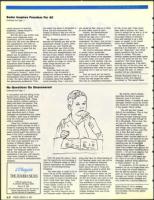

Seder Inspires Freedom For All
Continued from Page L-1
needs because of learning
disabilities, mental illness or
emotional problems.
But this story was written long
before such diagnoses were
understood, and its message still
holds true. We must rise above our
own expectations, and help our
children find the answers to their
own questions, in ways that are
meaningful to them.
This is sound advice for any
parent, but, for parents of
handicapped children, it's even
more important. And it's no easy
feat. There are days when the
frustrations seem endless, the
disappointments too crushing to
endure.
In a wonderful essay called
"Welcome to Holland," author Emily
Pearl Kingsley compares having a
handicapped child to planning a trip
to Italy. You learn Italian and buy all
the appropriate guidebooks. Then,
just before the plane is scheduled to
arrive, the pilot announces that
instead of going to Italy you will be
landing in Holland, where you must
stay.
Ms. Kingsley goes on to
describe the dismay you feel at this
unexpected change in plans, while,
all around you, your friends are
busy taking their own trips to Italy.
But, she writes, after you come to
terms with your disappointment and
the loss of your dream, Holland no
longer seems like such a terrible
place, just a different kind of place.
After awhile you begin to notice the
lovely things around you: the
windmills, the tulips, the
Rembrandts.
Such has been my own
experience. Like all parents, I
wanted my children to have all of
my talents, none of my flaws. I used
to fantasize about the daughter I
would someday have. I was sure
she would be like I was as a child;
an early talker, quick to learn.
Instead, her developmental
skills lag far behind "normal"
children her age, and I know that
there is much she doesn't
understand. Yet when I look at her, I
don't see my own disappointments;
instead I see her beauty and that of
the world around her.
Her mind is extremely efficient
in certain areas, sometimes
amazingly so. At 18 months she
knew all the letters of the alphabet,
in random order, and could name
every color in the rainbow. Like me,
she loves to read, not just picture
books, but full-length "epics" which
she memorizes from cover to cover,
correcting me if I skip so much as a
word.
And, as much as I've tried to
teach her in our four years together,
I know she has taught me more.
She has an unabashed enthusiasm
for life, a true zest I have never
been able to achieve. As I have
come to accept her as she is, to let
her develop at her own pace, to
encourage instead of demand, I
have also learned to go a little
easier on myself, to cut myself
some much needed slack.
As Jewish parents, to whom
learning is so important, it's easy to
favor our "wise sons" over those
whose questions may be more
difficult to answer. This year,
children seated around seder tables
all over the world will ask the "four
questions," their faces eagerly
awaiting our response. If we learn
from the story of the four sons, we
can make sure that this Pesach, and
all through the year, no child's
question will go unanswered.
Ronelle Rosenthal Grier is a
freelance writer and frequent
contributor to The Jewish News.
No Questions Go Unanswered
Continued from Page L-1
in connection with the telling of the
Exodus story, (Exodus 12:26; 13:8;
13:14; Deuteronomy 6:20). These
verses mention children asking or
being told about the exodus. The
biblical text reveals nothing about
the character of the children.
However, the rabbis in the Midrash
have described each of these
passages as representing four types
of children. Each type is reflected in
what the child says and how the
child is answered.
These four children represent
archetypes which provide us with a
model for teaching the Pesach story.
In the Talmud (Pesahim 116A), "The
parent should teach the child on the
level of the child's understanding."
I would like to examine the
child who is unable to ask. Although
this child could represent any of a
number of different types of
characters, I would like us to look at
this child as one who has special
needs. The Passover seder is to be
told so that each person can
understand it and yet, until recently,
I had never thought of telling the
seder to one who is developmentally
disabled.
etehtl6a/
THE JEWISH NEWS
27676 Franklin Road
Southfield, Michigan 48034
March 15, 1991
Associate Publisher Arthur M. Horwitz
Jewish Experiences for Families
Adviser Harlene W Appelman
L-2
FRIDAY, MARCH 15, 1991
My teacher, Danny Siegel,
describes his father's personal
Passover ritual in his book,
Unlocked Doors. A number of brain
damaged children would be invited
who would sit in between each one
of the guests. Danny writes.
ismm■
+no
it
.
h.
•••.-
Over the past few years, I have
had the opportunity and privilege to
share in a Passover seder at JARC
(Jewish Association for Residential
Care for the Developmentally
Disabled).
Two years ago, in order to try to
teach the joy of the celebration of
freedom, I asked those assembled
at the seder to share a favorite song
which made them feel happy. One
of the residents began to sing
"Hava Nagila, Come Let Us Be
Happy." I was moved by this
expression of joy and "Hava
Nagila" has since become part of
our Passover seder. Although this
song may have no direct bearing on
the Passover seder and may not be
one of our traditional Passover
songs, it was an opportunity to
teach about the joy of living and
was certainly a song to which this
particular resident could relate.
At our Passover seder, we are
charged to open our doors so that
all who are hungry can come in and
eat. I urge all of us to think about
how wonderful it would be to invite
someone with special needs to our
Passover seder. Many of us invite
newcomers in the community or
college students from one of the
local universities.
"You will say their noises
disturb the recitations. That is true.
You will say my mother was
burdened enough cleaning house
and cooking the week through for
50 or 60 people. That is true. You
will say the children needed
watching every minute: they would
spill things; they would throw up;
they might start to shout, and that,
too, is true. But next to each
member of my family and in
between other couples was one of
these children, and eachof us was
charged with caring for - tht_child,
watching over all of thenrOhd
treating them as best as tlbses
might have treated them,ainong the
masses being taken fromrharaoh's
slavery — for we must assume that
there were palsied and polioed
children 3,000 or 4,000 years ago,
too. Each of us was to bring the
message, however dimly perceived,
to these children." (p. 3).
In conclusion, at this holiday of
freedom, let us not forget those who
do not enjoy the simple freedoms
that we take for granted. Let us
open our hearts and if we have the
courage, our homes, to those who
are developmentally disabled and
truly make this a special Passover.
Rabbi Bruce D. Aft is director,
Midrasha-College of Jewish Studies
and principal, Community Jewish
High School.