
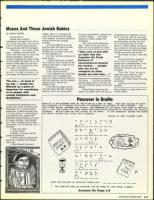

Moses And Those Jewish Babies
By DANNY SIEGEL
We all know it.
Moses had a speech
impediment. He wasn't born with it,
but, as the story goes, he put a hot
coal in his mouth, causing burns
that would have left him damaged.
That story — too long to re-tell
here — seems to be one of the
three most well-known in most kids'
Jewish education, along with
Abraham breaking his father's idols
and the angel that slaps you on the
mouth at birth when you are born
and makes you forget all the Torah
you knew in the womb.
And yet, something is wrong.
No one — at least in my day — no
one taught the Midrash as a point
"No one — at least in
my day — taught the
Midrash as a point of
departure for sensitizing
us to people with
certain limitations and
disabilities."
of departure for sensitizing us to
people with certain limitations and
disabilities. It is a sorely missed
opportunity. It seems strange now,
in my 40s, that as I review biblical
and talmudic texts, people with
disabilities keep popping up all over
the place, whereas I had thought
(or, I think I thought) that all Jews
were whole, fully functioning. But, in
the Bible:
1. Isaac was blind.
2. Jacob limped.
3. Moses, of course, had his
speech impediment.
4. Miriam had to contend with
leprosy (or whatever the disease
was), and
5. One Midrash (Numbers
Rabba, Naso 7:1) indicates that
talmudic personalities, suffered from
a similar malady . . . and Rabbi
Chiyya and others helped him
remember.
Rav Yosef taught (Menachot
99a), "Take care of and with an
elder who has forgotten his Torah
most of the Jews that left Egypt
were disabled. (Industrial accidents
through all the ugly building
projects.)
Job was disfigured and ugly
from the boils with which he was
stricken early on in the book
(Chapter 3), not being cured until
the end (Chapter 42).
And then, talmudic literature (to
name a few):
1. Rabbi Preda had a student
with whom he had to review all the
material 400 times in order for him
to understand it.
2. Rav Sheshet was blind.
3. Rav Yosef was blind.
4 The selfsame Rav Yosef also
had some kind of disability that
made him forget whatever Torah he
had been learning, and his student,
Abayye, had to remind him.
(Nedarim 41a)
5. On that very page, we are
told that Rabbi Yehudah HaNassi,
certainly one of the pre-eminent
"Take care of and with
an elder who has
forgotten his Torah
because of
circumstances beyond
his control . . . people
who are not as
complete as other
people are also holy ..
because of circumstances beyond
his control . . . Not only the second
(whole) tablets were in the Ark, but
also the shattered pieces of the first
tablets."
When Moses broke the first
tablets, the pieces were still holy, so
he gathered the fragments and put
them in the Ark with the new ones.
People-who-are-not-as-complete-
as-other-people are also holy and
are to be treated with the same
sense of kavod, dignity, as anyone
else, entitled to the same privileges
and same entree to everything the
Jewish community has to offer.
Who better to teach it than Rav
Yosef?
And one last point, taught to
me by one of my students: The
Levites had a double-burden in the
desert: the Ark was that much
heavier for having to carry two sets
of tablets.
That is the "price" we pay to
make sure that everyone ("Klal
Yisrael") remains part of Klal
Yisrael. Klal Yisrael means All Jews,
all of them.
Including me with my learning
disability.
Danny Siegel is a poet, author and
mitzvah expert.
Passover In Braille
BRAILLE IS AN ALPHABET USED BY THE BLIND AS A WAY TO READ. DOTS ARE RAISED ON PAPER
AND ARRANGED IN DIFFERENT POSITIONS TO REPRESENT THE LETTERS OF THE ALPHABET. THE
DOTS FOUND BELOW, ALTHOUGH NOT RAISED, ARE ARRANGED AS YOU WOULD FIND THEM IN BRAILLE.
SEE IF YOU CAN FIGURE OUT THESE WORDS ASSOCIATED WITH PASSOVER BY DECODING THE BRAILLE
ALPHABET. WE'VE GIVEN YOU THE LETTER "A" TO START. IF YOU CORRECTLY DECODE THE WORDS
THE BOXED LETTERS WILL SPELL OUT A MESSAGE.
PUZZLE BY JUDY SILBERG LOEBL
• • • • •
•
1_O
••
• • ••
•
•
•
•
•
•
APO
•
• •
• ••
•
•
•
• • ••
•• •
•
•
• • •
s•
•• •
• •
• •
•
•
• •
••
• •
• ••
•
OS
•
SO
••
••
40 •
•• •
••
•
•
• •
• • •
• •
• o •
•
• •
•
• • •
•
.1•• ■■•■
••
•
•
El
• • •
Se
•
••
0
• •
01•■■■■••■•
WHAT THE HOLIDAY OF PASSOVER STANDS FOR:
* THE COMPLETE BRAILLE ALPHABET CAN BE FOUND AT YOUR LOCAL LIBRARY.
Answers On Page L-9
THE DETROIT JEWISH NEWS
L-3