

trade. I hear they picked a bride
for me: I hope she's pretty." The
daughter declares, "Who does
mama teach to mend and tend
and fix, preparing me to marry
whoever papa picks." But those
songs are not all in the family
today.
The Papa
lbday's Papa is not the master
of the house nor does he want to
be. We hear his complaints. He
has been sucked into the vortex
of career, profession or business.
Papa feels driven by some ubiqui-
tous force that makes him ex-
pand in order to stay alive,
because if not, his murderous
competitors will "eat him up
alive." Demands upon the middle
class father are limitless. There
are no price and wage controls on
his aspirations because there is
no accepted ceiling on his stan-
dard of living. There is no God in
Papa's life who declares "enough."
Papa is not Thvye, and certainly
not Hayim Topol. There is little
song or dance in him. He does
not speak with God. He is too
spent for poetry, too drained for
that intense dialogue. His life has
been taken over by the values
and ideals of the marektplace.
Papa is no ogre. He simply
knows no other way to express
his fidelities, his Jewish loyalties,
except to buy. And so he buys
tickets, scholarships; he buys his
belonging, his believing, and his
behaving. He is defined by the
quip "alimony Jew," a Jew willing
to support Judaism but refusing
to live with it.
Can it be expected that upon
seeing the mezuzah on his
lintel, Papa will sudden-
ly be transformed into
a playful, warm, coop-
erative, poetic hus-
band and father? The
home and the job make
contradictory claims
upon him. With all his
gifts for compartmentali-
zation, he cannot leave
his business or career
back in the office.
In truth he does not want
the final word at home.
He may play the games of
"pater familis," bark out some
orders but nobody is listening.
lb be listened to you have to
invest time and patience, and
Papa has neither time nor pa-
tience. So, like the comic, he mut-
ters half-seriously that he gets no
respect at home.
Arnold Green, the social psy-
chologist maintains that the mid-
dle class child knows that he is
unwanted and senses that he is
an economic and psychic drain
upon the family. Part of the scen-
ario of the dying of the family is
the missing father.
The Mama
If Papa is too absent, Mama is
too present. If Papa is too
passive, Mama is too aggressive.
How has the Jewish Mama be-
come the domineering, protective,
semi-hysterical bearer of children,
chicken soup, and the extra
sweater? How is it that she, freer
now than ever before, gifted with
more labor-saving devices, more
leisure and affluence than ever
before, has become so subject to
brooding depressions?
Consider the built-in contradic-
tions of the middle class female.
For 15 years, from kindergarten
through college, she has been ex-
posed to the same intellectual ex-
perience to which the boys have
been exposed. With matrimony, it
all fades away. She is expected to
surrender her talents, her dreams,
her unfulfilled potentiality
because she is married. Every
once in a while it may gnaw at
her. What could she have been
before she settled for Marjorie
Morningstar?
Now that she is married, she is
expected to find her contented-
ness through someone else. At
the end of the day when her hus-
band comes home, she is to be
dressed cheerfully, answering the
door chimes, skirt swirling,
greeting her Garcia who comes
with a message from the outer
She is expected to surrender her
talents, her dreams, her
unfulfilled potentiality because
she is married. Every once in a
while it may gnaw at her.
world. But Garcia is too tired. He
wants only a cigar and slippers.
Unmarried, she is a failure;
married she has at best fulfilled
Mama's expectation. Mama says,
"My son — the doctor," but "My
daughter — the doctor's wife."
Her glory years will be in preg-
nancy or when the children are
two or three years old because
then she is needed. When the
children grow older and enter
school years, she becomes the
great family teamster. The peren-
nial chauffeur, she is ever driving
for the growth of others.
When the children turn adol-
escent, a new crisis sets in. The
adolescent child wants autonomy
while Mama needs purpose. The
adolescent cries, "Please mother,
I'd rather do it myself. The
mother is petrified because she is
psychologically unemployed. She
feels herself a mutilated self.
When the children outgrow her,
she turns once again to the hus-
band. But his world is strictly off
limits. It is like living with an
atomic scientist, working at
secret projects at Los Alamos.
He will tell her nothing and she
knows nothing.
In the 60's and 70's, Mama's
critical years were between ages
39 to 59. If one can speak of
postpartum depression, one may
speak of postparental depression.
Without child care, what could
she do? You cannot expose a girl
to her intellectual, aesthetic, and
idealistic potentialities and then
condemn her to a life of vicarious
existence.
Mama had to live for every-
body except herself. What was
her success? Her success was the
success of others. And so she
became a nagging, demanding,
driving woman. She became
Minority Whip of the House. The
middle-class Papa and Mama of
recent times were less and less
happy with their roles. The
change was in the wind. The cen-
trifugal pull was away from the
home.
The Son
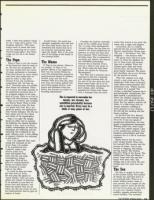
Art by Barry Fitzgerald
The Son is caught in the trap
of the nuclear family. The extend-
ed family has shriveled down to
two parental gods. There is no
zayda, bubba, cousin, uncle, or
aunt around. He is caught by the
family's need to move up the lad-
der; but if you move up, you have
to move out. Upward vertical
mobility requires outward hori-
zontal mobility. The extended
THE DETROIT ,IFWIRI-1 NFINS
27