

CLOSE-UP
woman whose husband had
abandoned her went to a
Rebbe to find out whether
he would return. Since the Rebbe
was busy elsewhere, she spoke to
the Shamus (sexton) who wrote a
kvitel, a note describing her prob-
lem. The Shamus disappeared,
showed the kvitel to the Rebbe
and the Rebbe wrote his response.
The Shamus returned and told
the woman, "The Rebbe says that
your husband will return, but I
assure you he will not return."
She replied angrily, "Who are you
to tell me that he will not return
when the Rebbe says he is going
to return?" The Shamus
answered, "The Rebbe sees only
the kvitel. I see the face."
The evidence sustaining our
analysis is not derived from the
kvitel, from statistical and
sociological accounts of anomie
and alienation. The data is de-
rived from reading the joyless
face of the abandoned woman.
The well-dressed, externally
successful are mostly too proud
to admit to the crumbling char-
acter of their family. They put on
a wonderful face. Everything is
fine. The family is thriving. But
beneath the appearance of well-
being, the family is hemorrhag-
ing. The kvitel of statistics is
frightening enough.
In a 70-year period in America,
from 1870 to 1940, the popula-
tion in America increased two-
fold; marriages increased
threefold; and divorces increased
20 fold. The statistics of the 80's
are no more comforting. The sex-
ton was right. He/she will not
return.
However persuasive the theo-
logical and ideological arguments
in praise of Jewish love and mar-
riage may be, the trend of family
disintegration in our society
mocks the noblest ideas. In its
wake a cynical wag proposes that
marriage is the major cause of
divorce.
No statistics are required to be
reminded of the tragedies about
us. She who was married less
than a dozen years comes to the
rabbi facing her imminent div-
orce. What concerned her were
her two daughters. the eldest of
whom, hearing of the pending
divorce, threatened to do away
with her life. She has asked her
mother, "'Ill daddy I promise I
A
Harold Schulweis is the rabbi of Valley
Beth Shalom congregation in Encino,
California. He is a leading expert and
author on the Jewish family.
26
FRIDAY, MAY 18, 1990
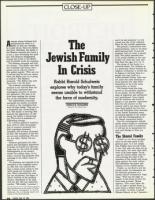
The
Jewish Ftunil
In Crisis
Rabbi Harold Schulweis
explores why today's family
seems unable to withstand
the force of modernity.
HAROLD M. SCHULWEIS
Special to The Jewish News
won't be bad anymore," so con-
vinced was she of her responsi-
bility for the terrible separation.
lkvo parents, stammering their
embarrassment, came to see their
rabbi because their 12-year-old
daughter had run away a second
time. The police reported that
2,723 young children in the com-
munity ran away last year, chil-
dren from the ages of 11 to 17.
The dying of the family is a
universal threat. For Judaism it
is a particular threat because its
religious civilization is rooted less
in dogma or doctrine than in a
people who sees itself as a
world-extended family. Jews may
not share the same theology or
ritual practice but they know
themselves to be of the same
mishpachah, or family.
The Jewish home has long
served as the portable sanctuary
of our people. All the Biblical
tales of migration and settlement
and resettlement, from Joseph
and the brethren and Jacob in
Egypt, to our parents' experience
from the old country to this
country and in our times, Soviet
Jews from behind the Iron Cur-
tain and Ethiopian Jews returned
to the Jewish homeland weave
sustaining legends of the solidar-
ity and the interdependence of
the Jewish communal family.
But the contemporary Jewish
family seems unable to withstand
the corrosive acids of modernity.
It will not do to romanticize its
past and indulge in false nos-
talgia.
The Shtetel Family
Fiddler on the Roof nostalgia
rests on the lean myth of the
glorious past. It is not simply
that Fiddler does not tell it like
it was. Not only can Jews not go
home again, but most Jews don't
want to go home again. lb sal-
vage the Jewish family calls for
restructuring the roles of the
members of the family and strug-
gling against the mass culture
that threatens the power and
idealism of the Jewish family.
Fiddler on the Roof is not the
Jewish world. Its characters are
the dramatis personae of a
mythic shtetel mishpachah. Papa
sings, "Who has the right as
master of the house to have the
final word at home." Mama
reprises, "Who must know the
way to make a proper home, a
quiet home, a kosher home." The
son recalls, "at three I started
Hebrew School, at ten I learned a