

CLOSE-UP
The Jewish Family
Continued from preceding page
family has become excessive bag-
gage. Americans move a lot — an
average of 14 times in a lifetime.
With Papa away most of the
time, Mama becomes the sole
companion of the single child
exercising her control. But the
control is not that of other ethnic
families from abroad. There is no
beating, no smacking of the
Jewish child. In its place is
something more intimidating. No
physical punishment is as power-
ful as the implicit threat of the
withdrawal of love, the dread of
"disappointing" the parental
gods.
The son is born into a competi-
tive meritocracy. Everything is
measured and tested. Everything
is compared from birth to death;
weight, height, intake, Silver Star,
Gold Star, IQ, SAT, 3.5, 3.8, 4.0.
From that innocent remark. "Let
my son play something for you,"
to the bribery of a dollar for
every "A" that you bring home,
the relentless pressure to perform,
achieve, to excel persists. The
child of the middle class has
become precisely what Marshall
Sklare called "a nachas-producing
machine."
David Reissman writes of the
anguish of students who because
they cannot be brilliant, deliber-
ately or unconsciously fail so as
to be relieved of the pressure.
There is pathos here. What if
the son is not brilliant? Is
quantitative measurement of
his school achievement the
criterion of his worth?
What of his kind-
ness, spontaneity,
unselfishness,
gentility? It is
rare to hear par-
ents boast, "my
child is kind," unless
the child is an academic
failure. Praise for his char-
acter is the loser's compen-
sation.
But a severe price for the per-
formance of our children is paid.
Success drivenness is no small
factor in the increased drop-outs
of Jewish young people from col-
lege, or the appeal of cults. They
are elements in the revolt against
the exaggerated pressures upon
the young to perform. They ex-
plain youth's "affective revolu-
tion" that prefers feeling to
performance, feeling to achieve-
ment, feeling to winning. For
many, anti-intellectualism is not
against books and ideas but an
opposition to academic and voca-
28
FRIDAY. MAY 18, 1990
tional pressures that are oblivious
to the idealism and sensibilities
of the young.
The Daughter
If the Son who is not smart is
doomed in the pressure-filled en-
vironment of the upwardly
mobile, pity the Daughter who is
not pretty or popular. What does
the daughter absorb from the
atmosphere of the suburban
matriarchy we have described?
In suburbia, Jewish girls are
called JAPS, Jewish-American
Princesses. It means a girl who is
spoiled, narcissistic, a demanding
replica of her mother. Is this a
true characterization? Is she a
correlate of the pressurized son?
Professor Werner Cahnman,
writing on the issue of inter-mar-
riage, reports that young Jewish
men "feel oppressed by the expec-
tations of the relentless pressure
of obligations to which they will
be subjected in the families of
prospective Jewish spouses." He
finds that they have a preference
for gentile girls because with
them they do not feel the great
pressure to achieve in the mar-
ketplace and to remain docile at
home. Professor Cahnman sounds
a warning that Jewish girls
should learn to compete more
efficiently. In conversation with
young people, Jewish boys com-
plain that Jewish girls are mater-
ialistic and demanding, and Jew-
ish girls in turn complain that
Jewish boys lack poetry.
A Second Look
The family is an interdependent
unit. The family is so linked
together that if there is a stress
upon one member of the family it
places a strain upon the other.
Let us return to the super-
mother. Children of my genera-
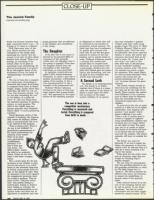
The son is born into a
competitive meritocracy.
Everything is measured and
tested. Everything is compared
from birth to death .. .
tion may remember a popular
Yiddish song that made young
people cringe. The lyrics of "Mein
Yiddisha Momme" filled us with
unspoken guilt. "How few were
her pleasures. She never cared for
fashion or styles. Her jewels and
treasures, she found them in her
baby's smile. Oh, I know that I
owe what I am today to that
dear little lady so old and gray,
to that wonderful Yiddisha
momme, momme mine." We loved
our mothers too much to deny
her pleasures. Who asked Mama
for such an awful altruism? That
martyr role turned into the
anxiety-producing love. To say
"no" to mama became the great
betrayal.
The Jewish woman should be
freed from her confining role for
her sake and for the sake of her
family. Those women who cannot
find fulfillment in the vicarious
joys of others must be liberated
from the household and the
obsessional supervision of her
children.
lb restructure her role as super-
mother is a task not to be lightly
undertaken. Love requires com-
passion, "cum passio," which
means suffering. Love costs.
When a wife or mother goes to
school or engages in organiza-
tional commitments, children and
husband may not expect dinner
on the table on time. The menu
may not be as varied as before.
The chores of the home will have
to be shared with the husband
and with the children. The family
calendar will have to consider her
life.
The father, too, must be
liberated. If we are to regain the
father, the pressures to have him
achieve must be reduced even if it
calls for a lower standard of liv-
ing for the family.
What good are the stolen mom-
ents of vacations when they are
bought by draining Papa's
psychic energy?
The son must be emancipated
from the grinding pressure to get
into prestige universities, to carry
his Phi Beta Kappa key, to
"make it." We have to protect his
affective life, honor his character,
to respect his sensibilities, to
become aware of his spiritual
needs.
Basic cultural factors lie at the
root of the changing Jewish fam-
ily and its future. In our times,
"goodness" has lost its moral
connotation and has been supple-
mented by amoral success. To be