

NEW LOCATION
OPENING SOON
WEST BLOOMFIELD
PLAZA
NS
t
S
WAFFLE
WAFFLE
OMELETTE
OMELETTE
.4 Z ::oe\\C' e \e5
k \e
THREE
GREAT
LOCATIONS
( 1
Open
7 Days
11 a.m.-12 Mid.
RACE
FOR
RIBS
r
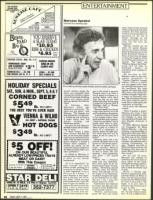
Marceau Speaks!
FREE
Lund t coupon
2 persons
rand Monday ltuoUOn Friday onlY
No subslorutfonS Exp.
on
9-30-87
YOU DESERVE
A SLAB TODAY
$10.95
RIBS & CHICKEN
$6.952Tppr:s
9-11-87
LUNCHEON SPECIAL—MON.-FRI. 11-4
COUPON ORDERS
DINE-IN OR
CARRY-OUT
HOMEMADE SOUP
AND SANDWICH $375
(Except Bar-B-Q Rib)
FARMINGTON HILLS — 851-1000
31006 ORCHARD LAKE RD. AT 14
I
LIVONIA — 421-6500
38043 PLYMOUTH RD.
00000000000000000000000 00 00000000
I HOLIDAY SPECIALS
SAT., SUN. & MON., SEPT. 5, 6 & 7
CORNED BEEF
$549 „.
1".
8
§
8
8
THE BEST YOU'VE EVER HAD!
8
O
8
0
VIENNA & WILNO/
ALL BEEF • NATURAL CASING
HOT DOGS§ 0
8
$349 ,h
®
NO LIMIT!
0
8
I
NO LIMIT!
8
8
0
rormriormurimirmarunmunno
I
$5 OFF!
le
1°
ON OUR BEAUTIFUL
EADY LOW-PRICED TRAYS
IIALR
II
MEAT OR DAIRY
81
With This Coup?g rid day before
18
©,
Expires
9-19-87
J N
DEUVERY
O
OI •
One Per Person
0
8 0
8
AVAILABLE
•
or day of the holiday
10 Minimum Order
0
STAR DELI g
24555 W. 12 MILE, Just West of Telegraph. Southfield
7 DAYS I
352_7377 0 6
1 OI l OPEN
am to 10 p.m.
o
0
00000000000000000000000000000000
60 f fil- P AY.,, §1
,
r"--
Continued from preceding page
Buy one plain waffle or omelette
with toast and jelly ... get one
15600 W. 10 Mile Rd.
Southfield • 552-1100
28505 Northwestern • Southfield • 357-2009
29556 Orchard Lake • Farmington Hills • 626,11804
ENE
vm YA R D
BARB
ENTERTAINMENT
rt
\C)‘•
o\
0 7 1
C A
Out of make-up, Marceau speaks honestly about his Jewish upbringing.
Jewish children escape the
Nazis and smuggled them
through the frontiers to Spain
and to Switzerland, falsifying
papers and making people
patriots against the German
Nazis."
In
February
1944,
Marceau's father was
deported to Auschwitz. "We
never saw him again," said
Marceau. "The Gestapo was
also looking for us. Eventual-
ly I made my way to Paris to
a home where they hid
Jewish children and
Resistance people:
But after the war, Marceau
decided to focus all his atten-
tion on mime.
"I know where I come
from," he says. "But after the
war, as we were free people
again and everything was in
order, I did not open a Jewish
mime company. I opened a
French mime company. I
started my career in the
world like Charlie Chaplin or
the Marx brothers did or any
other performer."
In talking to Marceau, it
becomes clear he does not like
to dwell on his Jewish
background.
"Is it so important?" he
asks through his thick
French accent, pausing as if
he expects an answer. "What
is more important, to be a
Jew or to be a human — a
man? Perhaps it was impor-
tant in the past, but not to-
day. Today I think we need
world brotherhood. Viola! We
have to have our beliefs, our
culture. We have to know the
Bible. I have to know about
my ancestors. But to be very
honest, I'm much more con-
cerned what's going to hap-
pen to the world in general.
Because, Jews or no Jews, if
you're going to collapse in a
nuclear threat, what then?
And the day we are dead
before God, what God is going
to judge us? A Jewish God? A
Christian God? A Muslim
God? What God?"
Marceau speaks in a strong,
wispy voice, moving his arms
as if conducting a symphony.
"I think it is great to think
of big temples where Chris-
tians and Jews pray together.
I think it is wonderful. Arid if
people don't want to pray,
they don't have to. And if they
want to pray in a forest in-
stead of a synagogue or
church, that's all right also.
You think that God will be
angry at me if I pray in a
forest?"
Marceau never had a bar
mitzvah. He hopes never to be
known as "the Jewish mime."
He has no special ties to
Israel. Actually, Marceau
feels closer to America than
he does to Israel. (He calls
America — more specifically
Ann Arbor — his "second
home.")
"Israel, was a necessary
home and very important.
But I don't agree on all the
Israeli policy today," he says,
adding, "Something should
be done about the Palesti-
nians. Just because we are
the people of the Holocaust,
we need to recognize the right
of the Palestinians to exist.
You see, I am a man who
thinks about the world."
If politicians were replaced
by artists, says Marceau, the
situation in the Middle East
would quickly improve.
"Politics, unfortunately,
break the Jews and Arabs
apart. Israeli artists and Arab
artists understand each other
perfectly. But their political
world is torn by prejudice, by
ignorance, it's the way of
history. Through art, the
Arabs and Israelis are very
close, but the wars are
dangerous."
Marceau studied his art
under the master Etienne
Decroux in Charles Dullin's
School of Dramatic Art in the
Sarah Bernhardt Theater in
Paris. At that time, he began
to create the images for which
he would become famous, in-
cluding: "The Cage" and
"Walking Against the Wind."
Using only his body, he
developed satires on
everything from sculptors to
matadors.
Bip was born in 1947.
Marceau refers to this pan-
tomime personality as
"Charlie Chaplin's younger
brother." Clad in a sailor's
suit and topped with a beat
up and beflowered opera hat,
the bewildered Bip leans
against the lamp post, skips
off to tame a lion, collect but-
terflies or attend a high socie-
ty party. As Marceau's alter
ego, "Bip has mixed with men
of all races, religions and na-
tions. Bip is a free spirit who
recognizes no frontiers."
He is much like Marceau
himself.
"Since I became a mime,"
Marceau once wrote, "I have
not found it possible to iden-
tify laughter or tears that
were specifically French, Ger-
man, English, American or
Russian."
In 1949, Marceau formed
his Compagnie De Mime
Marcel Marceau — the only
company of pantomimi.s in
the world at that time. And in
1955, the mastermime began
his first tour of the United
States. "I arrived with black
curtains, one assistant and a
scratchy Gramophone," he
says. "America was first in
Hollywood films, in dance and
Broadway. But there was no
mime. Mime had no roots in
this country."
For the last 40 years,
Marceau has worked on
spreading the art of mime to
every corner of the world,
touring 65 countries, perform-
ing more than 300 times a
year in both the theater and
on film.
Nearly a decade ago,
Marceau reopened his Inter-
national School of Mime in
Paris. And next year, he plans
to open his new World Center
for mime in Ann Arbor. "My
legacy is to give back to
America what America gave
to me," he says.
Why Ann Arbor? "Why
not," he says without hesita-
tion. "It was a difficult deci-