

Holocaust Center
Retrospective
Two years after its opening,
the Holocaust Memorial Center
is a sparkling community jewel...
with a few nagging flaws
SUSAN WELCH
Special to The Jewish News
few months ago, a young
man from Los Angeles
visited the Holocaust _
Memorial Center. He
had come to Detroit, he
told Rabbi Charles Rosenzveig, spec-
ifically for that purpose and had
paid his own way.
"Was it worth it?" asked
Rosenzveig, the HMC's director.
It was worth every penny,"
plied the young man.
Asked the same question, the
founding members of the $3 million
Holocaust Memorial Center in West
Bloomfield would probably give the
same reply. For them, the impact of
the museum on its approximately
200,000 visitors is ample compensa-
tion for their financial and emo-
tional expenditure during the two
decades of planning and persuasion,
controversy and debate which pre-
ceded its opening in October 1984.
Some 122,000 people visited the
HMC in its first year. 80 percent of
them came with school groups from
throughout Michigan. 82 percent of
them were not Jewish.
Most learned a great deal. the
HMC staff have found a sometimes
staggering ignorance, not only about
the Holocaust but about Jewish his-
tory and identity in general. One
man, recalls docent Judith Miller, of-
fered "good Christians" as his defini-
tion of Jews.
All but the very insensitive few
were extremely moved. "Visitors
react with visible emotion," says
Gloria Ruskin, who like her fellow
guides, is able to observe the "enor-
mous emotional impact" of the
museum; an impact which can be
clearly seen in the survivor theater,
for example, where a recent group of
15 visitors sat riveted, their only
movements the small, spontaneous
frowns or indrawn breath in reaction
A
to the survivors' recorded account of
their experiences.In the meetings
with survivors which conclude each
group tour, emotion is often physi-
cally expressed in hugs and kisses.
"People seem to need to touch," says
Miller, not only to show their sym-
pathy and affection, but to make a
physical connection with the past
and so affirm its reality.
For the founding Shaarit Hap-
laytah, the reality of the museum
two years later is "beyond anything
we ever hoped or dreamed," says
Abe Pasternak. It is, he says, not
only a place where he can honor his
dead, but the means by which, be-
yond his "wildest imagination," he
can help to take the lessons of the
Holocaust to "people of different be-
liefs and from all walks of life."
To remember, to move to under-
standing as well as sorrow, and to
educate future generations away
from prejudice and persecution re-
main foremost among the HMC's ob-
jectives. Conceived at a time when
few people in the community, or in-
deed the nation, wanted to talk
about the Holocaust, much less pay
for a memorial, it was, and still is,
asserts Rosenzveig, unique, in that it
is the only Holocaust center in the
country exclusively designed to
commemorate the six million Jewish
victims of the Nazis.
Determination to preserve the
concept and definition of the
Holocaust as a uniquely Jewish ex-
perience is one of Rosenzveig's major
concerns, one which he pursues with
the tenacity and perseverance with-
out which, even his critics allow, the
HMC would never have been built.
Rosenzveig is not, he admits, a
stranger to criticism. He met it head
on during the arguments over cost,
size, location and purpose in the
HMC's planning stage; he is moving
into the forefront of the growing con-
troversy over the proposed National
Holocaust Memorial Museum; and
he is aware now that, among those
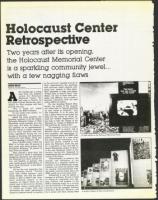
A video exhibit at the Holocaust Memorial Center.
A graphic display of Nazi anti-Semitism.