
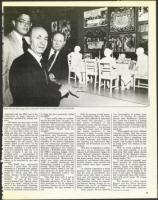

Rabbi Charles Rosenzveig, front, with board members Larry Jackier and Abe Pasternak.
associated with the HMC and in the
community at large, approval is
sometimes qualified by critical con-
cern.
He knows too that some of that
criticism concerns his own, strong
control over the HMC's administra-
tion. "I have been criticized for that,
and it is true that I don't let any-
thing get past me," he agrees. And
while he might regret that it has led
to the alienation of volunteer work-
ers with valuable expertise, he is
unapologetic for his stance. "We
cannot afford to fail here," he de-
clares. "The subject is too important
to permit mistakes. I would rather
close the institution than see it do
things wrongly. I am my own
greatest critic ... Commitment to
excellence has made the Holocaust
----Memorial Center a standard for all
others, to be emulated by any com-
munity."
The HMC has undeniably
achieved a great deal. Its sheer
existence is a triumph over apathy,
revisionism and the chorus of "Let's
forget it," which, says Rev. Jim
Lyons, director of the Ecumenical
Institute for Jewish-Christian
Studies, "is one of the most
narrow-minded and bigoted state-
ments ever made." Among the vis-
itors to the Ecumenical Institute,
Lyons has noted a "discernible dif-
ference in attitudes toward prejudice
1,
in those who have previously visited
the HMC."
"I have really seen an awaken-
ing for the tirst time,"- he says, "be-
cause the exposure to a combined in-
tellectual and emotional sense of
what happened really makes the les-
son go home. People walk out
changed."
Its achievements are even more
impressive, says Pasternak, "when
you remember that it was built for
nothing" but the vision and deter-
mination of the Shaarit Haplaytah
and the community goodwill they
were eventually able to harness. The
Michigan legislature has recently
approved a $100,000 grant towards
the HMC's operating budget, which
for 1986 was $600,000, but most of
its funds continue to come from pri-
vate contributions. Membership,
which now totals approximately
1,500, is steadily increasing, but
fundraising remains a continuous
priority. Given funds and time, its
executives believe, there is "an infi-
nite spectrum of good" that the
Holocaust Memorial Center can
achieve in the community.
Time, they know well, is not on
the side of those involved in
Holocaust education. It is hard to
allot priorities to all its necessary
activities, because for all of them,
unfortunately, the ripe moment is
now.
With the passing of each gener-
ation, researchers report, the truth
becomes more difficult to document
and record. The survivors — the
most potent reminders of the
Holocaust's reality and the source of
valuable information — are growing
older. The recent wave of interest
and media attention to the
Holocaust is likely to recede, taking
with it the publicity valuable to fun-
draising as well as to the promotion
of public awareness. And adding to
the urgency are indications that
prejudice and revisionism are on the
increase.
"The face of prejudice is chang-
ing, but I see no diminution," says
regional Anti-Defamation League di-
rector Richard Lobenthal. Member-
ship in the Ku Klux Klan is down,
but there remain newer groups," a
plethora of anti-Semitic hate organ-
izations, meaner, more vitriolic and
more violent than their predeces-
sors."
"A constant component of social
malaise," says Lobenthal ensures
that the level of anti-Semitic van-
dalism never falls below a certain
level and will probably balloon in
Michigan this year. And in social
and business circles he asserts,
anti-Semitic feeling, though its ex-
pression may not be as blatant as
before, emphatically still exists.
Lyons concurs. He has observed
"an unwrapping of hidden prej-
udice." In Vienna, for example,
shortly after Waldheim's election,
Rev. Lyons saw a letter in a leading
newspaper, expressing satisfaction
that after 40 years of having to keep
quiet about Jews, it was now OK to
speak out.
"When people can hear, without
noticable outrage, that one person
under the age of 16 is shot every day
in Detroit, there's something very
wrong with the moral fiber of that
society, and as great a need as ever
to bring home the lessons of the
Holocaust."
With so much needing to be
done, and done urgently, it is not
surprising that some people should
be asking "Is the Memorial Center
doing enough?", or that its executive
should answer "No."
"It will never be enough," says
board member Dr. John Mames.
"Since there is no vaccine against
violence, bigotry and prejudice, we
will always have to do what we can
to encourage young people to be
alert to the signs of degeneration
and to galvanize them into involve-
ment with moral issues. We cannot
overdo it."
The decades of effort which
Mames and his fellow founding
HMC members have already spent,
working with community organiza-
Continued on next page
15