
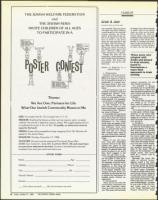

THE JEWISH WELFARE FEDERATION
and
THE JEWISH NEWS
INVITE CHILDREN OF ALL AGES
TO PARTICIPATE IN A
RESH M 40C.
ALMEW FREE LOAN
311TED fl e'
c-,4.14-0cL5
M)1414 PM L' Sezvitz
5iNa4 HiSP,117eL
CLOSE-UP
Arab & Jew
Continued from preceding page
can be ended., There are those
who offer very bitter coffee in
a small quantity in a cup that
passes among all those
seated. If the taste of the cof-
fee is too bitter, you do not
have to drink it, but don't
clean the cup and don't ask
for sugar. After the bitter cof-
fee comes the sweet coffee.
When you return the cup to
the platter (tray) say to the
host, "Daiman" (May your
house always have it good).
Thank the host for the
hospitality, shake hands, and
don't forget to invite them to
your house. The hosts will
accompany you up to your
final exit.
Modes of Behavior in a
Jewish House
Theme:
We Are One: Partners for Life
What Our Jewish Community Means to Me
. SIZE: No smaller than 8 x 10; no larger than 1 1 x 14.
MEDIUM: Anything that shows up bold, such as crayons, paint, cut paper,
material. No pencils or light blue crayons, please. We suggest taping work on
to cardboard to protect it. Do not fold. To qualify, an entry form must be
taped to the back!
PRIZES: Prizes will be awarded in all age categories (5 to 18). Winners-will
appear in The Jewish News.
DEADLINE: Monday, December 15, 1986.
TO ENTER: All work must be received at The Jewish News office,
20300 Civic Center Dr., Suite 240, Southfield 48076. All work must have
an entry form attached to the back. Enclose a self-addressed, stamped
envelope if you want your work returned to you
ENTRY FORM
Name
Age
Address
Phone
City
State
Zip
Parents' Names
School
Yes, return my work
No, do not return my work
1. Preparations
Dress in a nice, but not ex-
aggerated, way. For instance,
there is no need for a suit or
tie. It's possible to dress in a
traditional or modern way.
The main thing is that you
feel comfortable with your
dress.
It's not necessary, but it's
possible, to bring a small, not
exaggerated present. They
will surely be happy to
receive it, especially if it's a
home product. For example,
a jar of olives or baked goods.
2. Entrance and Seating
In the entrance to the
host's house, hold out your
hand and present yourself in
a formulation like, "Shalom,
my name is Hassan."
It is possible that the house
you enter may be different in
some ways from the houses
you know. Don't be afraid of
difference—in the whole
world there are people of dif-
ferent cultures whose houses
are different from each
other's, and the best way to
deal with this is to accept
with respect both ways of
life, yours and theirs, without
assigning grades to these and
those.
Many—if not all—Jews
have very free hospitality
customs. That is to say, they
expect the guest 'to feel
himself at home from the first
minute. In general they will
invite the guest to sit, and if
they don't suggest it the
guest can ask where to sit.
It is completely permissible
for the guest to take an in-
terest in his surroundings.
For example, to ask for an ex-
planation of a picture, or an
appliance, or how long the
hosts have been living there.
If the guest admires any-
thing in the hosts' house, it is
certainly worthwhile for him
to express his impressions, in
humble words, without ex-
aggeration.
3. Conversation
There are no set rules for
conversation. Sometimes the
host asks questions, some-
times he wants to hear from
you. The hosts will certainly
be happy if you show interest
in them: How is the family
made up, what are its mem-
bers involved in, what in-
terests them, what are their
problems? They will be equal-
ly happy to hear about your
family, its doings and prob-
lems. In the conversation, it's
worthwhile to show interest
in what you are told and to
Those Jews who
mingled with
Arabs and played
in Arab streets,
found in
themselves a
more fluid
approach to Arab
society.
express sympathy for the
host family's problems.
It's possible to discuss
anything, but it's preferable
to raise political topics only
after personal recognition has
been created and some level
of personal trust has been
achieved.
4. The Meal
The hosts will certainly tell
you where to sit. If they
don't, ask if it's okay to sit in
a place you choose for your-
self.
If you liked the food, praise
it, and again—without exag-
geration. If the hosts offer
more, they will certainly be
happy if you take it. At the
end of the meal, thank whom-
ever served it.
5. Goodbyes
There are no set rules about
the time for leavetaking, but
in many places it is accept-
able to leave about one-half
hour after the end of the meal
and the drinking of coffee. If
the hosts really insist that
you stay, and if you have free
time and you're enjoying the
visit, they will surely be hap-
py if you stay a little longer.
On exiting, make sure to
say goodbye personally to
each of the hosts. Thank
them for the hospitality—in
simple words. And invite
them for a return visit at
your house.
Between the hard, flat
walls of cultural intran-
sigence stand a few Jews
with the unusual experience
of having grown up among
Arabs in pre-1948 Palestine.
In those years Jerusalem
formed a crucible where Arab
and Jewish cultures adapted
to each other with a spirit of
coexistence and accommoda-
tion amid the friction. "My
father still tells me stories,"
says Naftali Sappir, "of when
he was a kid in the Old City
and Arabs used to come
every Rosh Hashanah and
Pesach [Passover]. They
• \
%
C .
18
Friday, October 31, 1986
THE DETROIT JEWISH NEWS