

As the Editor
Views the News .. .
`Men and Methods May Change—Ideals Never!'
—
A
Security Measures
In their appeal to President Truman to
veto H. R. Bill 9490 which embody the Mc-
Carran and Mundt-Ferguson proposals and
vigorously to "denounce the use of totali-
tarian methods to fight totalitarian dan-
gers," leading labor, academic, religious and
civic groups—Jewish and non-Jewish—took
a strong stand against the panic-minded
measure that was adopted by both Houses
of Congress. These groups, in their message
to the President, declared with reference to
the objectionable measure :
"We feel as you do that the bill jeopardizes
the rights of individuals and organizations
which not only are not subversive but are
dedicated in principles and program to the
fight against Communism. We feel as you do
that this bill:is a violation of traditional
American guarantees of individual freedom.
We feel as you do that the Communistic threat
can be adequately dealt with by strengthening
of espionage and other genuine security laws.
"We most earnestly hope that in such veto
message as you may deliver, you will vigor-
ously denounce the use of totalitarian methods
to fight totalitarian dangers. A stinging de-
nunciation of such methods will do much to
restore those liberties which already are being
violated in all too many communities in our
great country."
By moving to establish a concentration
camp system as a move against subversives,
the U. S. Senate adopted a measure which
threatens the basic principles which funda-
mentally serve as the very basis for Ameri-
can democracy. Only seven Senators voted
against this provision. Senator Herbert H.
Lehman of New York, leadinc, the fight
against this provision, referred to it as a
"blunderbuss," borrowing the term from the
New York Times editorial, "Blunderbuss vs.
Scalpel," in which the view was expressed
that the Kilgore Bill represented " a reason-
able, though severe, way out of the dilemma.
It would give the F.B.I. a legislative basis
for speedy and effective police action against
the most likely enemies of our country when
and if the emergency comes. This measure,
in our view, would be a more effective way
of solving the issue, while preserving a maxi-
mum of constitutional guarantees, than
would be the blunderbuss method offered
by Senator McCarran."
Regrettably, Senator Lehman's appeal
fell on deaf ears and won only six other
supporters of his viewpoint. He charged that
the adoption of a concentration camp idea
is "tragic," "ill-conceived," aimed "straight
at the precious liberties of all the American
people." He warned the Senate that it would
one day regret its action and declared as a
parting comment on his own stand:
"My conscience will be easier, though I,
realize my political prospects may be more
difficult. I shall cast my vote to protect
the liberties of our people."
THE JEWISH NEWS
PHILIP SLOMOVITZ. Editor
SIDNEY SHMARAK. Advertising Manager
Vol. XVIII—No. 3 Page 4 September 29, 1950
Sabbath HoI Hamoed Sukkoth Selections
Pentateuchal portions—Ex. 3:12-34:26, NUM..
29:23-31.
Prophetical portion—Ezek. 38-18-3916.
Hol Hamoed Scriptural selections: Sunday,
Num. 29:26-34; Monday, Hashanah Rabbah,
Num, 29:26-24.
Shemini Atzeret Scriptural Selections, Tuesday
Pentateuchal portion — Deut. 14:22-16:17;
NUM. 29:35-30:1.
Prophetical portion—I Kings 8:54766.
Simhat Torah Scriptural Selections, Wednesday
Pentateuchal portions—Deut. 33:1-34:12; Gen.
1:1-2:3; Nuns. 29:35-30-1.
Wit and Wisdom
Impressive Collection of
F. D. R.'s Noted Sayings
The genius of Franklin D. Roosevelt is re-
flected in his wit and wisdom, in his noteworthy •
—Val% iWliklitik
1 FREE ?ECRU.
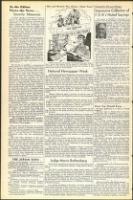
Cartoon drawn on the occasion of National Newspaper Week—
Oct. 1-8—by Dick Spencer of the School of Journalism at the
University of Iowa and furnished through the courtesy of the
Dean of the school, Dr. Leslie Moeller.
National Newspaper Week
Under sponsorship of Newspaper Association Managers,
Natiorial Newspaper Week again will be observed this year,
Oct. 1-8. Having as its slogan for 1950 "American News-
papers—Truth to a Free People," National Newspaper Week
will be the occasion to observe the happy state of affairs in
this land—the fact that we have the right to speak the
truth and to fight for it and that we are a free people.
National Newspaper Week encourages the people of this
great • land to think in terms of perpetual freedom, of
strengthening the functions which assure us our natural
rights.
Thomas Jefferson gave a position of priority over all
other instruments-in the battle for justice to the newspapers
when he said:
"The basis of our government being the opinion of the
people, the very first object should be to keep that right, Were
it left to me to decide whether we should have a government
without newspapers or newspapers without government, I
should not hesitate a moment to prefer the latter."
As long as the press remains free, the people will be
free. As long as the press is strong, the people's conscious
will be clear.
National Newspaper Week, the celebration of which now
is annually endorsed by the American Association of English-
Jewish Newspapers, is a proper time to re-evaluate the stat-
us of the Jewish press in America. Conditions are different
today than they were a generation ago. The virtual stoppage
of immigration has reduced the number of Yiddish readers,
limiting them to the older generation, and has elevated the
Thus, we have entered a new era of panic English-Jewish weekly to a position of prime importance in
and fright. Instead of fighting Communism American Jewish life. The English-Jewish press thus as-
with the practical weapons at our command sumes a place of great importance not only in Jewish life
—through the respected instruments of the but in the general American community because it reaches
F.B.I. — we see the rise of Nazi-Fascist- into the homes of American Jews who are civic-minded and
Communist media like the concentration who are deeply concerned with matters of importance to
camps.
Jewry and to America.
Our own hope, therefore, is that this
The American Jewish community owes an obligation
should prove a passing phase in our coun- to this press to keep it strong, to help the devoted Jewish
try's experiences ; that this period of unwise newspapermen to elevate its standards, to assist it in becom-
panic should pass as have similar threaten- ing the organ of all who are interested in advancing the
ing eras in our history during which our highest Jewish spiritual ideals.
country faced the dangers of sedition laws.
The slogan of National Newspaper Week—"American
President Truman aptly described the
new measure as "hysterical." By over-riding Newspapers—Truth to a Free People"—is applicable to our
his veto, Congress takes us back to the days press as well as to the general American press. By encour-
when sedition laws emphasized an existing aging our press, the community enables it to gather the most
state of panic. Our hopes now are for a reliable news and thereby aim at the truth. Having searched
and found the truth, the people reaches the highest rung of
speedy return to sanity.
freedom with the aid of a pfess of high standards.
Member: American Association of English-Jewish News-
papers. Michigan Press Association.
Published every Friday by The Jewish News Publishing
Co. 708-10 David Stott Bldg., Detroit 26, Mich., WO. 6-1155.
Subscription $3 a year; foreign $4.
Entered as second class matter Aug. 6, 1942 at Post Office,
Detroit, Mich., under Act of March 8, 1879.
Roosevelt's
sayings, in his repartee. The spirit of his im-
r pressive remarks is ably recon-
structed in "The Wit and Wis-
dom of Roosevelt," edited, with
an introduction, by Maxwell
Meyersohn, with the collabora-
tion of Adele Archer. The fine
book has been published by Bea-
con Press, Boston, as another of
its popular series of "Wit and
Wisdom."
Nearly every subject and
F. D. R.
cause is covered in this book:
Democracy, Social Justice, Peace, International
Morality, Brotherhood, the Press, Education,
Youth, Government, Civil Liberties, Labor, ad
infinitum.
The reader will be deeply moved by this col-
lection. Those who strive for freedom and for
good will among all faiths will be impressed to
be reminded of his famous statement:
"Democracy is a living thing—a human
thing—compounded of brains and muscles and
heart and soul. The service of democracy is
the birthright of every citizen, the white and
the colored; the Protestant, the Catholic, the
Jew; the sons and daughters of every country
in the world, who make up the people of this
land. Democracy is every man and woman
who loves freedom and serves the cause of
freedom."
There is a sincerely touching element in the
reproduction of his statement to the D. A. R..:
"Remember, remember always that all of
us, and you and I especially, are descended
from immigrants and revolutionists."
FDR was effective when he spoke thus:
"Justice, kindness, brotherhood and faith . .
are the highest human ideals. They will be de-
fended and maintained. In their victory the
whole world stands to gain; and the fruit of it
is peace."
The entire collectionnearly 150 pages of
them—reflects this spirit.
The author has written a magnificent intro-
ductory essay evaluating the Rooseveltian spirit.
He proves effectively that "Roosevelt spoke WITH
the people, not down to or at them;" that his
"addresses appealed to the human heart because
in them he proclaimed old truths, truths which
the voices of the Prophets had cried down
through the ages."
"The Wit and Wisdom of Roosevelt" is a
magnificent work. It will reawaken in the hearts
of those who read it the admiration that this
land always has shown for its great President.
Facts You Should Know .. .
Judge Morris Rothenberg
Of what significance is a beard in Jewish
tradition?
Different ages in Jewish history have at-
tached their own significance to the beard.
In Biblical times it was an accepted Semitic
custom to wear a beard. The Bible itself prohibits
the "destruction" of the beard by shaving with a
razor blade.
The Talmud considers this only applicable
to a razor and not to depilatories or scissors.
There is a statement in the Talmud which is
translated by some as meaning: "The adornment
of a man's face is the beard." (Tractate Shabbos
152a). During the Talmudic period historians
feel that the custom varied with the location.
For example in Palestine where there was more
Hellenic influence, more Jews clipped their beards
with cutting instruments. In Babylonia more
wore beards. The same condition applied in
medieval times.
In Eastern countries where Mohammedan
custom prevailed, • Jews wore long beards. In
Europe, especially in France and Germany,
beards were clipped. Today, in Western civiliza-
tion, while some of the most pious Jews shave
their beards with cutting instruments, the beard
has remained a symbol of reverence and respect.
The original restriction is found in the Bible
(Leviticus 19:27) where we find the following
statement: "Thou shalt not destroy the corners
of thy beard." The. traditional Biblical commen-
taries have sought for reasons for this restric-
tion in two directions.
Some follow the pattern that it was a heathen
practice at the time to remove the beard and
that wearing a beard was a distinguishing
feature of the Jew.
The Zionist movement in America sits in mourning over
one of its most distinguished leaders—Judge Morris Roth-
enberg.
Less than a month before his sudden death, which oc-
curred only a few minutes after he addressed the national
executive committee of the Zionist Organization of America,
Judge Rothenbeig, in his capacity as national chairman
of the United Palestine Appeal, had called a conference of
the nation's Zionist leaders for Oct. 22 in Washington, D. C.
He had planned to expand the UPA program in support of
Israel. It was to be a continuation of a lifetime of activities
in behalf of Israel.
As a former president of the ZOA, as former president
of the Jewish National Fund of America, as a participant in
every effort dedicated to the cause of ending Jewish home-
lessness—through the Zionist channels as well as that of
the Joint Distribution Committee on whose governing boards
he served for many years—he was one of American Jewry's
most distinguished leaders. Blessed be his memory.
Is it permissible to have instrumental music
at funerals?
Late rabbinic authorities strictly forbade this
custom because, as in prayer, traditionalists
insist upon direct expressions from the human
soul instead of artificial Means of providing ex-
pression. In ancient times there was instru-
mental music at funerals, just as there was at
services in the Temple. In post-Biblical times the.
use of musical instruments vanished from sacred
Jewish occasions.
*
*
*
What is the three - fold priestly blessing?
The three-fold priestly blessing is the one
in which the Lord instructed the priests of
Israel to "Put my name upon the children of
Israel, and I will bless them." It reads: "May the
Lord bless you and keep you. May the Lord
shine his countenance upon you and be gracious
to you. May the Lord lift up his countenance
upon you and grant you peace." It is found in
the Bible in the Book of Numbers. (VI:24-26).