

4
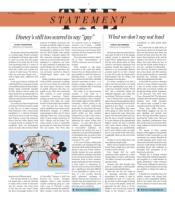
Disney’s still too scared to say “gay”
For decades, Disney has prided itself
on creating magic. Disney’s products
are designed to add some magic to life,
to create an escape from the greater
problems of the world. But all of that
work promoting itself as a source of
joy and happily-ever-after sometimes
seems like a shiny coat of paint over
a cluster of wider issues. The truth is,
when you wish upon Disney’s star …
well, it might make a difference who
you are.
In the grand scheme of things, the
umbrella of Disney companies occupies
an incredible amount of cultural space.
Despite being technically intended
for kids, Disney’s movies, media and
theme parks have an outsized effect on
adults. Such an audience gives Disney
influence and relevance not afforded to
most companies.
As a result, one of the strongest traits
at the heart of Disney’s business model
is that they try to please everyone.
Find themselves with a controversial
installment in a beloved franchise?
Use the next movie to walk everything
back. Release a movie that represents
Pixar’s first box office failure? Stick
to sequels based on existing IP. Get
complaints about the homogenous
nature of stories told in Disney films?
Branch out to different media.
Over the past decade or so, Disney
has leaned into a push for diversity
in media, both in terms of characters
and the creators who bring them
to life. But one area where Disney
has been increasingly hesitant is the
inclusion of LGBTQ+ characters, and
its stance on LGBTQ+ rights. In recent
months, this hesitancy has unfolded
dramatically in relation to the “Don’t
Say Gay” bill in Florida. After initially
not making a statement against the
bill, numerous outraged employees
spoke out on social media; Disney later
apologized to employees and made
an open statement of opposition that
caused Florida Gov. Ron DeSantis to
take away tax-related autonomy that
was previously awarded to Disney’s
Orlando-based
theme
parks
and
resorts.
Disney’s timidness about its support
of the LGBTQ+ community is nothing
new. For years, Disney has walked the
line about Queer characters, trying
to include characters that they can
peddle as gay while also minimizing
their presence to avoid enraging
conservative
Americans.
Disney’s
strategy, up until now, has been trying
to appease both sides; the result,
however, is that neither side is satisfied.
Over the past few years, Disney
and its subsidiaries have made several
half-hearted attempts at LGBTQ+
representation in films and TV shows
(although Disney has a long-running
habit of queer-coding characters). In
2017’s “Beauty and the Beast” live-
action remake, Le Fou is canonically
gay because of a brief dance between
him and Gaston. “Star Wars: Rise
of Skywalker” features a brief kiss
between two women. “Avengers:
Endgame” shows a male character
casually mentioning going on a date
with a man. In “Onward,” a police
officer briefly mentions her girlfriend.
Most recently, a brief kiss between
two married women in “Lightyear”
received a lot of press — initially
because of its removal and subsequent
return, but more so now because of the
countries that have banned the film’s
release because of it.
The connecting word here? “Brief.”
All of these “representations” of
LGBTQ+ characters were less than 10
seconds.
These attempts to add Queer
characters to the canon feel hollow
because they are. Being inclusive and
open-minded is trendy for businesses.
Checking boxes — a gay character
here, a person of Color there, a disabled
character somewhere in there — is a
business strategy designed to prove
a kind of inclusivity that is becoming
more prevalent in the U.S.
The reality of an issue-conscious
economy
is
what
leads
to
a
phenomenon called rainbow washing.
Rainbow washing is when a business
shows public support for the LGBTQ+
community without putting in any
actual work towards empowering
queer folks. It’s associated with empty
gestures like changing logos for pride
month (which are then routinely
changed back on July 1) that create a
front-facing show of support without
addressing the culture within their
company — or, more often than not,
without
acknowledging
donations
to
anti-LGBTQ+
politicians.
It’s
hypocritical but tactical; this way, if
companies are accused of being bigoted
or homophobic, they can point to their
rainbow logo and tell conscientious
consumers, “No … see?”
In the case of Disney, selling pride
merchandise and changing their logo
and social media scheme during Pride
Month is only part of their rainbow-
friendly strategy; the same mentality
behind rainbow-washing is what leads
to the incremental inclusion of Queer
characters. Each of these moments,
despite feeling like the bare minimum,
is then touted as momentous by
directors and executives and conflated
into a significance that feels difficult
(if not impossible) to achieve in the
span of a few seconds. Showing
small,
ephemeral
exchanges
of
affection between gay characters is a
welcome step, but categorizing it as a
“milestone” feels disingenuous; more
often than not, it’s marketing.
S T A T E M E N T
The Michigan Daily — michigandaily.com
4 — Wednesday, June 29, 2022
My dad says that every good joke has
some layer of truth to it. In the ongoing
cultural pursuit to determine what
makes “funny” things funny, he argues
that the most effective jokes are those
rooted in real human experiences and
emotions. Usually, this comment is in
reference to an unreasonably offensive
comment made by me that I attempt
to write off as a joke out of guilt and/or
embarrassment. But not always, and
fortunately, not in this piece.
I’ve always wondered if my dad is
right, so let’s test it out with a very small
and very unprofessional case study of
a joke from Comedy Central’s “Broad
City” that is somewhat realistic yet
absolutely ridiculous. And a little, let’s
say, intimate. That’s your warning!
One of “Broad City’s” many running
gags is that one of its protagonists, Ilana,
sneaks weed through airport security by
putting it up her vagina — as one does.
When the drug-sniffing dog senses
what’s going on, Ilana already has a
plan in motion: She wears white pants
stained with old-period blood and cries
that the dog is sexually harassing her
in a voice eminent of the quintessential
helpless woman. It’s hard to describe
with words without making it seem
wildly disgusting and uncomfortable,
but it’s never failed to make me laugh.
And so I ask myself: If the truth theory
is applicable, where are the roots of this
bit?
I believe it can be boiled down into
three relatively simple truths:
Before weed was legal in much of the
United States, people had to get pretty
creative to move it around.
Even
though
half
the
world
experiences them, periods are a taboo
enough subject to make a well-meaning
TSA officer run back to his podium, no
questions asked.
Someone who bled through their
pants in a public place would typically
feel embarrassed and defenseless.
Ilana uses the last two truths to
her advantage, subverting cultural
expectations for women in order to
accomplish her goal. If I could ever
get my dad to watch enough of “Broad
City” to get to this episode, I think he’d
appreciate the joke. Ilana, in all her
boldness and over-the-top scheming,
brings to the forefront a piece of
womanhood we often quietly tiptoe
around.
So it seems that my dad’s theory, in
this scenario, checks out. We laugh with
Ilana not only because she’s funny, but
because her ideas come from the well-
known lived experience of her and her
audience. The entirety of “Broad City”
follows this trend, telling the story of
two late-20s Jewish women living in a
very real — and often very demeaning —
New York City. The show’s creators and
stars, Ilana Glazer and Abbi Jacobson,
are the modern iteration of a somewhat
particular but extremely necessary
niche; the professional truth-teller.
In the midst of a post-war obsession
with the G-rated, obedient housewife,
a slew of Jewish women worked to
tell the tales of an honest, realistic and
thought-provoking female experience.
In her discourse, “One Clove Away
From a Pomander Ball: The Subversive
Tradition of Jewish Female Comedians,”
historian
Joyce
Antler
chronicles
the cultural space occupied by these
comedians since the mid-20th century.
“Fanny Brice, Molly Picon, and
Gilda Radner mugging it up may not
seem dignified, and certainly Joan
Rivers clowning about fallen vaginas is
anything but,” Antler wrote. “However,
these comedians’ performances show
that Jewish women can be proud of the
comic tradition in which they have been
trailblazers.”
The success of these comedic
pioneers, Antler suggests, can be partially
attributed to their connections to, and
commentary on, womens’ liberation. In
a media landscape where women were
often restricted in self-expression to only
what men could tolerate, Jewish female
comedians forced their audiences to
reconsider their perceptions of the
female body and mind.
“Perhaps this is because women’s
humor often deals with the incongruities
and inequities of a world founded on
gender distinctions,” Antler continued.
“Their humor challenges the structures
that keep women from power by turning
our attention to things that matter to
women.”
It shouldn’t be surprising, then, that
another common trait among these
women is their unapologetic boldness.
They’re the women who can’t be kept
down or silenced or asked to keep their
content clean.
KARI ANDERSON
Statement Correspondent
Read more at michigandaily.com
Read more at michigandaily.com
EMILY BLUMBERG
Statement Correspondent
Design by Priya Ganji
What we don’t say out loud