

Wednesday, September 23, 2015 // The Statement
7B
LSA senior Dominic Jamett, president
of the Student Athlete Advisory Council,
said the administration reached out to
him and other student-athletes for feed-
back on the apparel companies.
He said he appreciates the way the
athletic department is receptive to input
from student-athletes.
“We are pretty lucky that we have an
athletic department that cares so much
about our opportunities,” Jamett said.
“The gear that we get provided is second
to none and students recognize that, and
we definitely do not take that for grant-
ed.”
Student athletes are not the only ones
pleased with the athletic department’s
decision. Though the athletic department
did not reach out to the Alumni Associa-
tion in a similar way, Dave Schueler, vice
president of alumni engagement at the
Alumni Association, said he noticed posi-
tive reaction among alums across their
social media platforms.
“Sometimes just something new is
exciting in general, I think people rallied
around having something new or differ-
ent to talk about,” he said.
Schueler speculates the deal brought
back memories from when the Univer-
sity previously signed with Nike, as the
company worked with beloved Michigan
football coach Lloyd Carr. Because the
University signed with Nike for a lon-
ger period of time than with Adidas, he
says more alumni felt connected to the
“swoosh.”
With the recent hiring of Jim Har-
baugh and contract deal with Nike, alum-
ni can’t help but feel hopeful for the next
chapter in University athletic history,
Schueler said.
“All of the things that are new are
exciting and, perhaps, some of the new
things remind us of the success that the
athletic program, specifically football,
had in years past,” he said.
For Jamett, however, the gear does not
make or break wins. He said not only are
student-athletes unphased by the size of
the deal, fans will not be impacted by the
Nike deal because they came out for the
student-athletes — not the jerseys.
“I do not think the brand of gear is the
biggest thing right now,” he said. “At the
end of the day, it is going to have the block
M and I think that is what people love.”
System and plenty more expressed inter-
est.
He also learned quickly that with a
group of competitive and well-rounded
individuals, he had no problem getting stu-
dent athletes interested in helping, either.
In fact, slowing them down proved to be
the toughest challenge.
***
The
University
Athletic
Department
established the Rachael
Townsend Community
Service Award in 2009.
Hoping to push student
athletes to carry that
one more rep mentality
into helping others, the
idea was to reward the
teams that performed
the most community
service throughout the
year.
It worked, but with a
cost. Hours and interest
in service soared, but
when Moore switched
the award from a quan-
tity-based team honor
to
a
quality-focused
individual one in 2013,
Michigan was admit-
ting it had lost what it
was after.
“We
found
that
everyone was so caught
up in hours and putting
up big numbers, the ser-
vice wasn’t that effec-
tive,” Moore said. “We’d
rather see fewer hours
and participation than
people just in it for the
hours if it increases the
value and impact.”
Michigan
is
the
only school to Moore’s
knowledge that no lon-
ger has an hours-based
reward or quota, and
taking the competition
out of community service
did come with a drop in
participation.
But
the
support was there.
“You can’t make these things manda-
tory, you have to really value it,” said Kine-
siology junior Sophie DuPhily, a member
of the lacrosse team who is also serving as
the SAAC Community Engagement Chair.
“It’s important to get people to find value
in it themselves, not just add it to practice,
school and everything else.”
Moore makes resources and events
known and helps when needed, but has
eliminated enforcements, counting on
teams and student-athletes to motivate
each other.
For DuPhily, whose team was all fresh-
men when the new system took over in
2013, the toughest hurdle is the first one.
“I was a little slow to start on communi-
ty service,” DuPhily said. “We didn’t really
have anyone to show us the way, but once I
got started, I was hooked.”
“We don’t make it mandatory, but I will
try to get people who haven’t gone before
to go with me. The first time is usually the
hardest, after that they can’t wait to go
back.”
In addition to the shift away from man-
datory service, Michigan has tried to
modernize the way its student-athletes go
about service.
Reaching out to the Ginsburg Center,
SAPAC and other campus-based resources,
Moore has set out to increase the educa-
tional component of service. Though it’s
admittedly tough to manage full training
and reflection sessions when balancing the
priorities of student-athletes, Moore says it
never hurts to get creative.
“We might not get hours with (the stu-
dent-athletes),” he said. “But on the way to
and from campus we can discuss why they
get involved in the community and what
they get from the opportunity through
identification, through reflection, through
exploration of themselves.”
While the service may be helpful today,
the true impact will be seen down the road.
***
Once Martin’s bus pulls into the Pioneer
High School parking lot to begin his youth
camp, he’s at home. The Big House may
be across the street, but as he’s greeted by
over a dozen other NFL players volunteer-
ing their time, a wide grin covers his face.
That grin grows to make his 6-foot-2,
306-pound frame look small as the kids
get off the bus and
sprint to the field.
Many hail from the
area of Detroit where
he grew up. Martin
knows the impact his
camp can have on the
kids, because he once
was those kids.
“We can relate to
a lot of the things
they’re saying because
we know the area and
a bit of what they
go
through,”
said
Philadelphia
Eagles
linebacker
Brandon
Graham,
a
former
Michigan
football
player.
“You
might
have gone to the same
schools or know some
of the same people.
The conversation and
connection is there
because you’re from
the same place.”
The same can be
said for current Mich-
igan athletes. When
DuPhily and 30 other
Michigan
student-
athletes
volunteered
at
Camp
Catch-A-
Rainbow — a YMCA
youth camp for cur-
rent or former can-
cer patients — during
spring
term,
many
were
reminded
of
times getting to know
athletes in the past,
and reminded why they
go to Michigan.
“That’s our biggest
goal, to find something for everyone,”
Moore said. “Not everyone wants to work
with kids, so it’s about finding what kind of
work you do want to do — what you’ll get
passionate about. Because when you have
that passion, it shows.”
Despite taking away the scorebook, rules
and trophies, Michigan student-athletes
continue to give back. Despite everything
else they have to worry about, the student-
athletes feel socially responsible.
“I think there’s an obligation to give
back,” DuPhily said. “You’re not getting
a reward for doing it, but you’re a part of
the Michigan family, and that does create a
moral right to give back to the community
and to strengthen that connection in any
way you can.”
The gear that we
get provided is
second to none
CONTRACT
From Page 4B
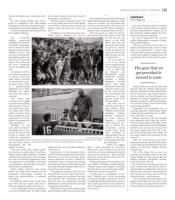
LUNA ANNA ARCHEY/Daily
Members of the Michigan Men’s Soccer Team greet kids and Johntez Williamson and his father
John Williamson after their 3-0 victory over Northwestern on Sunday.