

Wednesday, September 23, 2015 // The Statement
6B
Athletes embrace social responsibility
by Zach Shaw, Daily Sports Writer
I
t doesn’t take long for Jordan Morgan to remember
why he’s spending a gorgeous summer afternoon
cleaning up an eyesore of a street in Detroit. Once
homeless in Detroit, Morgan fought through poverty,
malnourishment and hundreds of other challenges to star
for the Michigan basketball team, earn two engineering
degrees, and eventually go pro in
Europe.
It doesn’t take long for Mike
Martin to remember why he’s bus-
sing kids in from Detroit to his
free youth camp, either. Growing
up in a single-mother household
without a ride to practice, Mar-
tin had to find the drive within
to not only finish his degree but
lead Michigan football to the 2011
Sugar Bowl Championship.
It doesn’t take long to remem-
ber, because they didn’t get there
alone.
Though both — among thou-
sands
of
athletes
worldwide
— have incredible journeys to suc-
cess, they are largely the product
of volunteers, tireless coaches and
family members and community
events that kept their doors open
and their spirits high.
“I can tell you that nobody gets
where they are without the help
of others,” Morgan said. “There
are so many people that are so
invested in me and my welfare, but
there’s a high level of obligation
for myself.”
This obligation sticks with
Morgan, Martin and others that
grew up disadvantaged. But at
Michigan, even those that had an
easier path feel the responsibility
to use their capital, resources and
abilities to give back to the com-
munity — that’s the easier part.
The hard part is making that
desire to give back count. But with
a new department solely focused
on it, alumni leading the way, put-
ting away the scorebook and open-
ing the field to new resources,
Michigan is close to fulfilling its
athlete social responsibility.
***
When the term corporate social responsibility first
was coined in the 1950s, few imagined the concept would
make its way inside Michigan Stadium. Defined by Busi-
ness Dictionary as “a company’s sense of responsibility
towards the community and environment (both ecological
and social) in which it operates,” it was designed to remind
businesses that their job extended beyond financial share-
holders to community stakeholders. Without the support
of consumers, the community, family members, friends
and all employees, a business would fail regardless of its
financial know-how.
While “athlete social responsibility” hasn’t gained the
same official recognition, the parallels are evident. Win-
ning is important, but without the continued support of
boosters, fans, local residents, media members and every-
one involved with the team, even the most successful team
on the field will fail.
To gain that support, student athletes embrace the pres-
sure to make the first move.
“You definitely want to make it come full circle,” Martin
said. “It’s hard to have success and not think about every-
one in the community that helped you, and deserves that
success too.”
Morgan and Martin are far from the first athletes to
give back. Babe Ruth — arguably the first sports celebrity
— was famous for visiting hospitals before games, then hit-
ting home runs for the children he visited. Nearly every
professional team has at least one foundation they contrib-
ute to, and most athletes do individual work as well.
Michigan’s first community service partnership began
with football players visiting C.S. Mott’s Children’s Hos-
pital 25 years ago — a practice that has expanded to all
student-athletes and still occurs every Thursday.
Today, Michigan has 11 major community service part-
ners, and its approximate 900
student-athletes conduct 20,000
hours of service per year, accord-
ing to the athletic department.
“It’s something you’re proud
of,” said defensive line coach Greg
Mattison, who has coached for 41
seasons including eight at Michi-
gan. “When we say ‘Michigan
Man,’ a lot of that has to do with
how you handle success and give
back.”
Achieving 20,000 hours as a
group and raising tens of thou-
sands for charity, community
service participation is at an all-
time high with Michigan student-
athletes. Still, some are skeptical
about the motivations.
With the rise of foundations
and community service came an
equal rise in criticism of “savior
mentality” among those partici-
pating in projects.
Jevon Moore, coordinator at
the Office of Community and
University Engagement, doesn’t
blame people for thinking that
way. Moore oversees all of Michi-
gan’s community service endeav-
ors. He’s happy with the strength
and popularity of the Mott’s vis-
its, but isn’t naïve of the celebrity
mentality.
“For a long time, that’s what it
was — just celebrity appearanc-
es,” Moore said. “Then people got
turned off by that because it seems
like it could just be for attention or
for image.”
The seldom heard of office
opened in 2013 after community
service interest reached record
levels.
And while Moore loved so many
different organizations reaching
out to the teams, coaches and Ath-
letic Administrators, it became clear someone needed to
arrange these in a unified way.
“We wanted to have one place where we could send
potential partners and events and really put a plan in place
to make something work,” Moore said. “We don’t want our
athletes to just show up and be a celebrity face, we want
them to be helpful in more ways, and for the experience to
benefit them as well. We want it to be a two-way street.”
Moore had no problem finding partners that wanted
to work with Michigan student-athletes. Food Gatherers,
Ann Arbor Public Schools, the VA Ann Arbor Healthcare
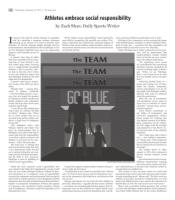
ILLUSTRATION BY JAKE WELLINS