
THE MICHIGAN DAILY
[CHIGAN DAILY
i a
ii:;
F'# I
oEA .,, W.1~W;
Established 1890
Published every morning except Monday during the
University year and Summer Session by the Board in
Control of Student Publications.
Member of the Western Conference Editorial Association
and the Big Ten News Service.
$9ciatd dolleiate ros
1933 tm Mug 7A.. 7 E E1934
MEMBER OF THE ASSOCIATED PRESS
The Associated Press is enclusively entitled to the use
for republication of all news dispathces credited to it or
not otherwise credited in this paper and the local news
published herein. All rights of republication of special
dispatches are reserved.
Entered at the P.ost Office at Ann Arbor, Michigan, as
second class matter. Special rate of postage granted by
Third Assistant Postmaster-General.
Subscription during summer by carrier, $1.00; by mail,
$1.50. During regular school year by carrier, $3.75; by
mail, $4.25.
Offices: Student Publications Building, Maynard Street,
Ann Arbor, Michigan. Phone: 2-1214.
Representatives: College Publications Representatives,
Inc.,.40 East Thirty-Fourth, Street, New York City; 80
Boylson Street, Boston; 612 North Michigan Avenue,
Chicago.
EDITORIAL STAFF
Teeph one 492
MANAGING EDITOR.........THOMAS K. CONNELLAN
CITY EDITOR.. ... ........BRACKLEY SHAW
UDITORAL DIRECTOR ..............C. HART SCHAAF
SPORTS EDITOR.................ALBERT H. NEWMAN
DRAMA' DITORI............... JOHN W. PRITCHARD
WONMEN' XDITOR.................CAROL J. HANAN
NIGHT EDITORS: A. Ellis Ball, Ralph G. Coulter, William
G. Ferris, John C. Healey, George Van Vleck, Guy M.
Whippe, Jr.-
SPORTS ASSISTANTS: Charles A. Baird, Arthur W. Car-
stens, Sidney Frankel, Roland L. Martin, Marjorie
Western.;
WOMEN'S ASSISTANTS: Marjorie Beck, Eleanor Blum,
Lois Jotter, Marie Murphy, Margaret D. Phalan.
REPORTERS: C. Bradford Carpenter, Ogden G. Dwight,
Paul J. Elliott, Courtney A. Evans, Thomas E. Groehn,
John Kerr, Thomas H. Kleen, Richard E. Lorch, David
G. Macdonald, Jel P. Newnan Kenneth Parker, Wil-
11am R. Reed, Robert S. Ruwitch, Robert J. St. Clair,
Arthur S. Settle, Marshall D. Silverman, Arthur M.
Taub.
Dorothy Ges, Joan Hamfner, Florence Harper, Marie
Hold, Eleaor Johnson, Ruth Loebs, Josephine McLean,
Marjorie Morrison, Sally Place, Rosalie Resnick, Kathryn
Rietdyk, Jane Sohneider.
BUSINESS STAFF
TTeephue X124
BUSINESS MANAGER...........W. GRAFTON SHARP
CREDIT MANAGER. ...........BERNARD E. SCHNACKE
WOMEN'S BUSINESS MANAGER ..................
...............CATHARINE MC HENRY
DEPARTMENT MANAGERS: Local Advertising, Fred Her-
trick; Classified Avertising, Russell Read; Advertising
Contracts, Jack Bellamy; Advertising Service, Robert
Ward; Accounts, Allen Knuusi; Circulation, Jack Ef-
roymson.
ASSISTANTS: Meigs Bartmess. Van Dunakin, Milton Kra-
mer, John Ogden, Bernard Rosenthal, Joe Rothbard,
James Scott, David Winkworth.
Jane Bassett, Virginia Bell. Mary Bursley, Peggy Cady,
Virginia Cuff, Patricia Daly, Genevieve Field, Louise
Florez, Doris Gimxumy, Betty reve, Billie Griffiths, Janet
Jackson, Louise Krause, Barbara Morgan, Margaret
Mustard, Betty Simonds.
NIGHT EDITOR: WILLIAM G. FERRIS
Students Need
A review Period...
A WEEK from Friday most of us will
attend our last classes of this se-
mester. The next day the less fortunate ones will
take final examinations. In other words, the sys-
tem as mapped out at present allows one evening
for the reviewing of a course and expects students,
after this insufficient interval, to be able to write
on anything touched in a course that required
from 40 to 100 hours to cover.
With all due respect to the present system of
allotting times for examinations -which we con-
sider to be a miracle of efficiency -it is never-
theless on this one point that we feel students
are being rather badly treated. They are being
expected to do something that is beyond the
normal productivity of humans.
Last year the late Dean John R. Effinger of the
literary college, recognizing the unfair require-
ments of such a system, dismissed all his classes
for the final week of the semester. Unfortunately,
he is no longer with us to carry on this move
which he had hoped to make a part of the exam-
ination system here. However, we feel that it is
up to some other leader to take up this move and
carry it on to its logical conclusion.
We do not ask that all instructors dismiss their
classes a week before the conclusion of each
semester, but that the examination schedule in
the future be so designed that students will have
a review period between the cessation of their
classes and the beginning, of the examination
period. It would be an innovation carrying benefits
for all - concerned. The student would be better
able to review his courses and consequently ac-
tually get more out of them, and the professor
would be in a position which would allow him to
examine students to the full limit of the course,
and expect results.
Yale University, for one, and a number of other
leading institutions, have inaugurated "reading
periods" which they have found to be of such
benefit that they are now advising others to adopt
the plan.
We heartily stand with this move, and add our
plea to those of others aiming towards the inclu-
sion of such a plan in the system here. It is asking
for an opportunity for us to get more out of our
courses, and we feel sure that some of the leaders
in the University will accept the suggestion and
see that Michigan stands with other progressive
universities.
A New Interpretation
not because they were conscientious objectors to
military training, but because they were not!
Sixteen dissenting students, according to Leach,
were "hauled over the coals," by a three-man
administrative board, one member of which was
the local commander of the Ohio State R.O.T.C.
After "testing the consciences" of the group, nine
were allowed to drop military training, but the
other seven were told they must finish their R.
O. T. C. course because they were not truly con-
scientious objectors. The sole judge of whether
the boys were conscientious objectors, let it be
noted, was the administrative committee, which
interviewed the individual students in periods
varying from 10 minutes to one hour.
This is an interesting commentary on adminis-
trative stupidity, in that it shows three men inter-
viewing 16 strangers in the bland belief that con-
scientious objectipn can be discerned, or that
false objection can be ferreted out by exposing
"faulty reasoning" on the part of the student, or
by exposing "a lack of ingratitude to the gov-
ernment." (The quoted phrases are those of
Leach).
Another speaker, also in the Ohio State dis-
sension, blasted at the theory entertained by sev-
eral campus liberals that the death of the "eco-
nomic" cause of war would put an end to armed
conflict between nations. If the economic cause
was no longer present, other causes of war would
immediately rise, he said, pointing out that the
legalistic approach, through such international
organizations as the League of Nations and the
World Court, was far preferable if a kind of super-
national sanction could be obtained by the arbi-
tration body.
Discussion of the relative values of Wilsonian
and Marxian approaches to world peace are inter-
esting, but in a consideration of the Ohio State
case they scarcely shed light on the specific sub-
ject to be discussed - the suspension of the seven
boys. In regard to them we repeat our opinion,
that three men are incompetent to rule on the
state of the conscience.
Campus Opinion
Letters published in this column should not be con-
strued as expressing the editorial opinion of The
Daily. Anonymous communications willbe disrearded.
The names of communicants will, however, be re
garded as confidential upon request. Contributors
are asked to be brief, confining themselves to less
than 300 words if possible.
HURRAH FOR
THE R.O.T.C.
To the Editor:
What's all this talk of abolishing the R.O.T.C.?;
Do the National Students' League and the otherr
radical organizations on the campus realize justc
what the R.O.T.C. means? Surely, the R.O.T.C.
knows what the National Students' League meansc
and so should every 100% American from the Boye
Scouts to the President. The R.O.T.C. is the bul-i
wark of the country - of the very foundations oft
Democracy. As a notable and integrable army s
officer recently proved, the R.O.T.C. moulds char-
acter and makes the world safe for Democracy.p
Are we going to ignore the policies of Woodrow
Wilson? Will we be able to look straight at a
picture of Washington or Lincoln without flinch-
ing if we listen to the desultory, demagogic, and
un-American talk of the "parlor radicals"? Books
like "The First World War" should be suppressed.
They show pictures of maimed veterans - but
what does that prove? It is still glorious to defend
one's flag and home and to protect the honor of
the American woman and her children.
I dare one of the anti-R.O.T.C. traitors to show!
me different.
-A Good American.
A s Others SeeIt
HAPPY WARRIOR
Sometimes we wonder if Franklin D. Roosevelt,
who conferred the title of "the Happy Warrior"
on Alfred E. Smith, when he placed Mr. Smith
in nomination in the Democratic convention at
Houston, is not himself aiming at that distinction
-to which his first 10 months in the Presidency
give him a valid claim.
Few Presidents have been happy, or have made
a show of happiness. However much they coveted
the position and its accompanying honor, nearly
all of them have found it a grim job. Even Mr.
Taft lost his jollity, although he recovered it later,
and could make a jest of his monumental defeat
for re-election.
Theodore was exceptional in finding it fun to
be President. Franklin has not said he finds
amusement in the executive office, but he has not
lost his smile, his urbanity, his charm. If he
worries, he does so when no one is looking. To
the public he presents always the same aspect.
He is the Chevalier Bayard of our times, fearless
and without reproach, who would rather fight
than not, and who battles joyously.
Perhaps the secret is that he acknowledges no
enemies. There is nothing personal in his battles.
What he is fighting is a condition, and in this war
every man and woman of good willyis on his side.
He disarmed personal animosity in the beginning
by making no infallible claims for "my policies."
He said they were experimental; if they failed to
achieve results, they would be abandoned. He
asked for patience, and a fair trial of his sug-
gestions. He got both, and at this writing the
people have no reason to feel that they were led
astray.
There are many who believe Wordsworth had
Lord Nelson in mind when he described the char-
acter the Happy Warrior. Franklin Roosevelt has
all the Nelson courage, and, it would seem, the
Nelson gift of quick decision in an emergency, the
will to do the big and astonishing thing regardless
of conservative precedent. It may well be that
public opinion will take the title he conferred on
Al Smith, and transfer it to himself - the Happy
Warrior.
-The Detroit News.
the Court seemed more conscious of nineteenth
century economic theories than of conditions in
twentieth century America, it is a relief that at
this critical time the liberal dissenters of the last
decade are found in the majority. The decision
is generally considered a sign that the Supreme
Court will not stand in the way of any of the
"New Deal" legislation, much of which is certainly
not compatible with a strict interpretation of the
Constitution along traditional lines.
The decision is significant not only because it
foreshadows judicial support for the extraordinary
legislation enacted in the last year or so, but also
because it represents a break with illiberal Su-
preme Court precedents. For perhaps the first
time a measure clearly repugnant to the letter of
the Constitution, and unrelated to such general
grants of power as are contained in the war
and commerce clauses, has been declared consti-
tutional solely on the ground of urgent public need
produced by economic causes.
In these circumstances it is not odd that three
members of the Court concurred with Justice
Sutherland in his able dissenting opinions. His
legal lore is beyond question, and there is some
truth in the remark that "If the provisions of the
Constitution be not upheld when they pinch as
well as when they comfort, they may as well be
abandoned." But the kind of decision just handed
down demonstrates the way in which clauses of
the Constitution unsuited to present needs are
usually and most painlessly modified. The willing-
ness evidenced by the present majority of the
Court to recognize the need for change, as con-
trated wth the tswiendency of the minority to con-
sider the Constitution more sacred than the na-
tional welfare which it purports to conserve,
promises to restore to the Supreme Court the
popular confidence which in recent years has been
dangerously alienated.
-Daily Princetonian.
Screen Reflections
By HUBBARD KEAVY
HOLLYWOOD -Constance Bennett's titled
husband, Marquis Henry de la Falaise, went to the
island of Bali with a camera and an idea and
came back with a unique picture.
"Legong" (dance of the virgins) is the title of
his five-reel travelog, in color, which is held to-
gether by a slender story. There is no dialog, the
plot being told by subtitles, but there is a syn-
chronized musical score which considerably in-
creases one's interest.
The cast of four natives -the girl, her half-
sister, her father and the boy - performed well
under the joint direction of the marquis and his
countryman, Actor Gaston Glass.
The girl, a temple dancer, falls in love with
one of the musicians; who, on the way to visit her
and her father, sees her half-sister bathing in
a spring. Instead of returning the girl's affection,
the boy and the bather elope. The girl commits
suicide.
Native Dances
Religious dances, which are the high point of
life on the little island, and a huge cremation
pageant are among the several ceremonials shown
vividly.
The film, financed by Constance, is the first of
a series of travelogs to be made by "Bennett Pic-
tures Corp., Ltd." The marquis, now translating
dialog and supervising the synchronization, in
French, of two Lilian Harvey pictures for the Fox
company, leaves soon on another venture. He will
go to French Indo-China to film an animal
"story-log."
Carol Ann Interrupts
There are exceptions to all rules, even to that
simple one, "Quiet, Please," which decorates every
wall of every movie stage.
A scene was being made in "Viva Villa," in
which Wallace Beery has a long, difficult speech.
His adopted daughter, Carol Ann Beery, four; was
visiting him.
In the midst of the difficult scene, she started
running across the stage and no one could halt
her. Suddenly she stepped on a loose board, which
cracked like a gun.
Foster-father, director, tecnicians and 200
extras merely smiled.
If the interruption had been made by anyone
but Carol Ann Beery, aged four, considerable
would have been said, and loudly.
Lee Tracy, who doesn't seem to be able to get a
job since M.G.M. "released" him after the Mex-
ican "accident," is said by a close friend to be un-
worried about the future.
Tracy, the friend declares, is a saving fellow and
has considerable of his movie earnings invested
safely. Altogether, his confidant declares, Tracy
has a nest egg of a hundred thousand dollars.
,%*1 1
I :
y .,,
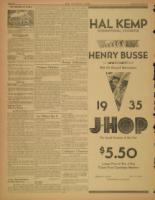
INTERNATIONAL FAVORITES
1i
'{R"', q^G . '7 r' yyl \ Rr{per. , N1iVLfJR YPG\'IKV.U V. {,.f1Y VtlOfP" : ' ,J}V#+yt
v
}
,::y :;
;;,Mattis
riEN Y
S S Fm
With 1-is Gng""ofMerrymakers
/ .
/ r
I
The Social Function of theYear
Collegiate Observer
By BUD BERNARD
With their money safely tucked in stockings,
and with stove pokers handy, 20 co-eds in a co-
operative house at the University of Minnesota
stayed up all night a fortnight ago waiting for
prowlers who had previously molested the house,
'. * *
Students at Florida State College for Women
must take an examination on the college gov-
ernment and constitutional rules. Those failing
the tests are campused for two weeks. At the
end of the punishment another test must be taken
successfully before social privileges are regranted.
According to the Chicago Tribune William
Shakespeare plays halfback on the Notre
Dame footbal team -- and he is ineligible be-
cause he is flunking English.
r*io *
University of Missouri officials in order not to
Lowest Price of Any J-{-lop
Tickets From Committee Members
FEBRUARY NINTH TEN TO THREE
INTRAMURAL BU.I LDING
i
Scanned image of the page. Keyboard directions: use + to zoom in, - to zoom out, arrow keys to pan inside the viewer.
January 18, 1934 (vol. 44, iss. 83) - Image 4
- Resource type:
- Text
- Publication:
- The Michigan Daily, 1934-01-18
Disclaimer: Computer generated plain text may have errors. Read more about this.