
I
Feature
Section
Allow
Ar A60,
t
liii
Featuie
Section
VOL. XXXV. No. 24 ANN ARBOR, MICHIGAN, SUNDAY, OCTOBER 19, 1924
EIGHT PAGES
MICHIGA
IN
THE
ROLE
OF
DEDICATOR
'*
i'
0
r
lip
4
rJ
w ..-1
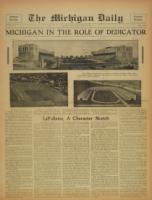
THE THREE STADIA listed for dedication on Michigan's schedule for 1924. Above-
The new Illinois stadium at Champaign. Left-Minnesota's football arena. Below-Architect's plan
of M. A. C.'s stands at completion.
By Williarm H. Stoneman
Michigan's 1924 football season bids fair to go
down in history as one of her greatest, if oily be-
cause of the number of spectacles in which her elev-
en will have engaged by the end of the season.
Already this year the Woiveriies have dedicated
two stadiums, at M. A. C. and ;Urbana,. and on No-
vember 1 there will be a third dedication game at
Minneapolis. A total of 143,000 people will have
witnessed Michigan's Varsity ir th-e three gridiron
battles. The value df the three stadiums dedicated
will be in the neighborhood of two and three-quarter
million dollars.. Never before.in' the history of foot-
ball has any one team dedicated three stadia in one
season and never in years will any team have the
honor of dedicating three such ,magnificent struc-
tures as those at Lansing, Urbana; and Minneapolis..
It will be the fourth great dedication game in
which Michigan has engaged since. her return to the
Western Conference, when the Varsity starts the
Minnesota battle, a week from next Saturday. Ohio
State's great horse shoe, dedicated two seasons' ago
with a 19-0 victory by Michigan is one of the great-
est in the land and accommodates over 52,000 spec-
tators.
The great jIlini stadium, dedicated in a classic
battle yesterday afternoon, is by far the largest of
the stadia being opened by the Wolverines this year.
Memorial Stadium,, as it is ,called in honor of tire
Illinois men who last their lives in the World War,
is a massive structure of reenforced concrete with a
brick and stone exterior, capable of holding 66,000
people.
The structure consists of two main wings, par-
allel to one another on either side of the playing
field. Each wing has a super-deckor balcony great-,
ly increasing the seating capacity and enabling a
largernumber of persons to have seats in advan-
tageous positions. Slightly more than 75 per cent
of the spectators in the Memorial stadium have seats
betweei the goal posts. The step taken by Illinois in
preference to completing a "U" is an advance in the
art of stadium building.-
The cost of the Memorial Stadium, exceeding $1,-
700,000, was taken care of by student and alumni
subscription. Preceding the game at Urbana yes-
terday afternoon the mammoth structure was pre-
sented tothe state of Illinois by. George Huff, direc-
tor of intercollegiate athletics.
In impressive ceremonies Friday afternoon, a
parade of Illinois ex-service men and students
f^" nl niim nrr +d . hestaium where th
The stadium will accommodate exactly 50,263
people and there will be a ramp for approximately
every 1,500.. The circulation of crowds has been the
special study of the architects and according to sta-
tistics compiled the entire crowd can leave the struc-
ture in four minutes. There are 37 arched entrances
leading into the concourse, directly beneath, the
outer part of the "U" and 30 ramps sloping uP
toward the entrances into the stadium proper from
the concourse. The Yale bowl was carefully stud-
ied in the design of the entrances.
The problem of allowing everyone a clear view
of the playing field was also carefully studied in
connection with the cross-section shape of the stad-
ium. As a result seats do not rise in a straight line
but form a dish-shaped curve when the structure is
LaFollette, A
Character Sketch
viewed from the side.
The accoustics of the stadium are better tlan
those in any other in the country:. Signals called on
the playing field are heard as clearly from the top
By Wiliiam H. Hobbs
For a period of seventeen years, from 1889 until
:1906, I was a member of the Faculties of the Uni-
versity of Wisconsin and a resident of the State cap-
ital Madison. During -this period Robert* Marion
LaFollette was for. the first twelve years a mem-
ber of Congress, then for six years Governor of the
state, and though re-elected for a third term, he was
elected to.the- United States Senate -and at the time-
I moved to Ann Arbor he had already sat in the
upper House of Congress about a year.
When LaFollette was Governor, Roosevelt was
making his great fight against special privilege, at
the time firmly entrenched and LaFollette was the
standard bearer of these progressive policies for the
State of Wisconsin. As Governor, he occupied the,
Executive Mansion, which was separated by a single'
house from my own residence, and in the opposite
direction a few doors removed lived John C.
Spooner, a corporation lawyer of outstanding ability,
one of the most brilliant men who ever sat in the
United States Senate, and at the time the High-Priest
of special privilege in that august body. LaFollette
and Spooner were, therefore, in the State of Wis-
consin the leaders of most bitter political factions,
and this condition produced a cleavage at the State.
Capital which extended even to social lines. If un-
pleasantness was to be avoided, one could hardly
accept an invitation to a dinner in Madison without
first learning the names of the other guests..
I was at that time a warm supporter of .LaFol-
lette and on quite intimate terms with him. Though
our political viewpoints are now very different, I can
still testify to the excellent legislative measures
which were written into the Wisconsin statutes dur-
ing LaFollette's administrations. Wisconsin was
unquestionably a pioneer state in the reform legis-
lation of the period-legislation everywhere ap-
proved today; and it was LaFollette's cogent argu-
ments, his strong personality, and his sledge-ham-
mer methods, which are, responsible for- its enact-
ment. Among the progressive laws which he forced
through was one taxing the railways, and later one
establishing a State Railway Commission for the
regulation of rates.
the late President Angell, were present as delegates
and a considerable number were awarded honorary
degrees on this occasion. It was my own good for-
tune to be sitting in the audience beside the vener-
able President Angell when LaFollette as Governor
of the Stage made the address of welcome to the in-
vited guests. At its conclusion President Angell
turned to me and said, "Your Governor is a scholar,"
and later one heard much comment of the same
nature from other eminent visitors.
LaFollette's great ambition in life was at first
to be an actor, but he is small of stature, and a well-
known actor whose counsel he sought strongly ad-
vised him against a career in which he would be so
heavily handicapped. Though a powerful orator,
LaFollette's political speeches depend far more upon
a reasoned argument, than upon "flights" of oratory.
Leaning out from the stage toward his audience and
with upraised finger driving his arguments straight
at the front row of benches, LaFollette asks, "Is not
that fair?" "Could anything be fairer?" Then he
goes over the record of his political enemies with
scorifying denunciation, a method most effective and
frequently referred to as the LaFollette "roll-call".
When he last spoke in Ann Arbor, he appeared com-
pletely worn out, and before the lecture he said to
me, "You can hardly imagine how tired I am, I'
have been speaking practically every day since Con-
gress adjourned, and, exhausted after each address,
it is early morning before I can get to sleep." His
voice, as he began his speech, was husky and diffi-
cultly audible, but it improved steadily as he ta' ked
and after three and a half hours ofacontinuous
speaking it had become strong and resonant with
the audiencequite willing that he continue.At one
time early in the lecture attention seemed to flag,
when the speaker suddenly pointed his finger to a
section of his audience and fiercely denounced stud-
ents there for trying to disturb the meeting. I
had seen nothing that indicated improper conduct
on the part of anyone, and subsequent inquiry did
not reveal any, but LaFollette cleverly appealed to
his audience for sympathy and got a round of ap-
plause; and the spirit of fair-play once aroused he
had the support of his audience to the end. A col-
leagne told me later that he had seen an identical
of Roosevelt for President awl' LaFollette for Gov-
ernor. LaFollette made a 'whirlwind campaign
throughout the state, but it was remarked that he
Spoke no word in favor of Roosevelt, the head of the
ticket, but only for himself.
It was LaFollette's autobiography, published in
1911 and 1913, which first led me to believe him in-
sincere and disingenuous. The burden of the book
is rancor against Roosevelt, who he claimed through
duplicity had cheated him, LaFollette, out of the
Presidency.' Roosevelt, says LaFollette, at first
promised to support hin for the Presidency, and
then, when he found it to his disadvantage, thought
only of himself. Every sort of rumor is in the book
elevated into a fact, but with nowhere any sup-
porting evi'dence worthy of consideration. The larg-
est number of page references in the index is found
under the caption, "Duplicity of Roosevelt", and the
next largest number under "Betrayal of LaFollette".
Sub-heads under "Theodore Roosevelt" are "Sup-
ported, by Wall Street", "His relation to the Steel
Trust", "Has no Tariff policy", and "Opposed th-e
Progressive Movement in Wisconsin".
Roosevelt, for his part seemed always to have
some doubt of the genuineness of LaFollette in re-
form ,measures. So far as I now remember, he
never warmly praised LaFollette. When America at
last took up her responsibilities in the war and
LaFollette came out as the advocate of Germany's
cause, Roosevelt hesitated no longer. Speaking in
St. Paul the week following the infamous speech by
LaFollette in that city which had brought down
upon his head the condemnation of patriotic citizens
throughout the country, Roosevelt denounced La-
Follette as a "Shadow Hun". Of such "Hun's within
our gates", he said; "They are on a-level with Val-
landingham, whom Lincoln sent beyond the Con-
federate lines. I wish, I could send them to Ger-
many as a free gift to the Kaiser . . The most
sinister enemy of democracy in the United States is
Senator LaFollette . . . We are to stand against men
of the type of LaFollette."
When I was supporting LaFollette's policy in
Wisconsin, be presented me with a fine portrait of
himself on which he had written a very warm per-
sonal dedication. This picture I framed and hung
... +~n r.t~c nPm, c-n ir TX-- - - ntor n.
of the bleachers as theyare at the sidelines.
Special amplifiers are being installed to carry
voices of speakers on, the field to all corners of th
arena. The press boxes of the stadium are fur-
nished for the accommodation of scouts and news-
paper men. The one on the south side of the field
is equipped with 140 individual seats and desks to-
gether with complete telegraph and telephone con-
nections.
The field itself has been carefully graded and
seeded to insure the best playing conditions. A 12-
inch layer of clay, four inches of black loam, and
two inches of sandy loam were laid on the field.
This combination remains firm under a test of
three inches of rain in eight hours and inasmuch as
such conditions have never actually arisen in the
Minnesota climate the field will be suitable for
games under any conditions. A good sod has been
laid on the field and will be in perfect condition by
the time of the dedication game.
The actual cost of the stadium amounted to
$750,000 and was raised by subscriptions among
the students anI alumni. The amount was raised
as part of a greater University Corporation fund
which amounted to in excess of $2,000,000.
The new stadium at M. A. C., while not as pre-
tentious as those of Illinois and Minnesota stands
as the finest structure of its kind in a school of the
Aggies size. When Michigan dedicated the stadium
with a hard-fought victory there were 25,000 spec-
tators present, 15,000 more than had ever before wit-
nessed a game at East Lansing.
The new stadium as it now stands will accom-
modate 16,000 spectators in permanent seats and
will be increased in size as the need arises until it
can take care of three times that number. At pres-
ent there are two parallel tiers of seats with nine
ramps leading into the seats of each tier. With the
growth of the school a curve of seats will be added,
completing the "U" at the south end of the field.
Funds for the erection of the stadium came out
of a $3.000.000 lumn for general building on the
Scanned image of the page. Keyboard directions: use + to zoom in, - to zoom out, arrow keys to pan inside the viewer.
October 19, 1924 (vol. 35, iss. 24) - Image 9
- Resource type:
- Text
- Publication:
- The Michigan Daily, 10-19-1924
Disclaimer: Computer generated plain text may have errors. Read more about this.