
ANN ARBOR, MICFi
Y 'MAGAZINE
HIGAN, SUNDAY, OCTOBER 16, 1921
.obert Frost -Poet
S) and the hallelujah ragtime of Lindsay sees him only as a very human, very'
recent editorial to the love lyrics of Sara Teasdale likable man.
and the delicate verses of Edna St. He is of average height, with streak-
Vincent Millay. Of these' new poets, ed black and gray hair that is neither
Percy MacKaye who have been writing for the past de- carefully smoothed nor consciously
ship at Miami cade or so, one of the most conserva- rumpled. . His eyes are kindly and
wed by that of tive yet probably the finest artist of sympathetic and not without a good
the University all is Robert Frost, whose three pub- humored twinkle; and his mouth
standing being lished volumes contain some of the usually frames a smile.
the poets have best American verse since 1900. One is immediately at ease in his
live there and And now the students of Michigan: presence, and finds him full of enter-
t to Ann
e subject
ment by
I no less
ent body
tary cul-
such ex-
thall and
ints out,
sicS goes
this fact
'he text
outs, and
eve that
with the
century.
ong, for
He is optimistic as to the future of
literature in America and is anxious
to do all he can to encourage young
authors, whom he advises to use as
material for their writings the local-
ity with which they are most familiar.
The value of this counsel is shown
by the fact that his own work is the
embodiment of the spirit of New Eng-
land, where he has spent the larger
part of his life. His book, North of
Boston is described by Louis Uter-
meyer, the well-known poet-critic, as
"one of the most intensely American
books ever written."
Mr. Frost takes a very open minded
and sysopathetic attitude toward the
various art forms, seeing both good
and bad in all of them. He has, how-
ever, little, interest in "movements"
and other such generalizations. He
believes that anything can be the sub-
ject for art and says, "I do not think
that one cart bound art by definitions
or make set rules for what is or is
not beautiful." Neither does being
"for" or "against" anything appeal to
him. "Controversies are good fun,"
he admits, "but I do not believe much
is accomplished by them." If he is
"against" anything in literature' it
would seem to be Greenwich Village
and Psychoanalysis... While granting
that the latter is not entirely without
value, he believes its introduction into
literature to be a mistake.
Iis own verse, which is mostly of
the country, especially New England,
he writes usually in sone or two
"shots." \He polishes it very little,
writing the entire poem without in-
teruption If he finds that it is not
taking form as he wants it, he leaves
his first attempt and starts afresh.
Although his name is usually as-
sociated with New England, Mr Frost
was born in San Francisco. At ten,
however, he came east to Lawrence,
Miss., where he spent the remainder
of his boyhood. In 1895 he was mar-
ried and in 1897 moved to Carbridge
and attended Harvard for a time. For
the next 15 years he led a varied
existence. At the end of that time he
went to London where he became
acquainted with a number of the liter-
ary men of the day an& had his first
book, "A Boy's Will", published. The
next year "North of Boston" was
issued both in England and in this
country. When he returned to the
United States in 1915 he had become
famous, although previous to his trip
to London he could get 'nothing pub-
lished here. His last book was print-
ed in 1916. Since then he has spent
his time teaching at Amherst, farming,
and writing verse which has been
printed in the magazines. He now has
enough verse on hand for at least one
more book and it is to be hoped he
sees fit to publish this in the near
future for, again to quote Untermeyer,
"he has uttered (and is voicing) some
of the deepest notes in American
poetry."
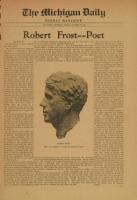
ROBERT FROST
From the Original In Plaster by Aroldo Du Chene
east remain wi l have an opportunity to meet and taining observations and interesting
become personally acquainted with Mr. literary reminiscenses. He has a wide
n, however, Frost. The University has furnished acquaintance in the literary world
d; and this him with a comfortable home on and a huge fund of stories about well
ive. It has Washtenaw avenue and here he will known people which he tells with a'
raditions in reside for a year, holding open house whimsical humor.
shocked any for students interested in literary His chief interests in reading are
g Whitman. affairs. poetry and essays, but he does not
s been re- Mr. Frost is an unusual mixture of confine himself to these forms. Rec-
it of revolt. the visionary and the practical.- He ently he read the five novels which
etry is very has a keen sense of beauty, yet there 'have attracted so much comment,
content its is nothing of the eccentricity we are "Main Street", Moon-Calf," "Poor
cited, rang- apt, usually erroneously, to associate White", "Miss Lulu Bett," and "The
of Sand- with poets. As one talks with him one Age of Innocence," and considered
of Masters, forgets that he is a famous poet and them very good.
Scanned image of the page. Keyboard directions: use + to zoom in, - to zoom out, arrow keys to pan inside the viewer.
October 16, 1921 (vol. 32, iss. 19) - Image 11
- Resource type:
- Text
- Publication:
- The Michigan Daily, 1921-10-16
Disclaimer: Computer generated plain text may have errors. Read more about this.