

SUNDAY MAGAZINE1
ANN ARBOR, MICHIGAN, SUNDAY, FEBRUARY -1922
Duteh"Robinson Crusoe"
(By Lois Elisabeth Whitcomb) ism, at aprobable familiarity with the
Lucius L. Hubbard, a regent of the Printed Eleven 'Years Before Defoe's a Dutch story on the part of Defoe, al-
though the proof is not by any means
University oMichDutacn has transla Translated by RegentcHubbard onlu"v.The simlrty beten
into English the Dtch story, "Sjouke 1\asae J ee1 J~~la~4 theetwo bookshis so glreatbhoweer,-
Gabbes," by IHendrik Smeeks, origin- that when "Sjouke Gabbes" was
ally published in 1708, eleven years translated into German in 1721 it was
sode of the discovery of the footprint sembling it, but had no Talons or thought to..be an imitation of "Robin-
before the publication of "Robinson in the sand, always associated with Claws more than common, its Flesh son !Crusoe," a supposition that is
Crusoe," whIch bears a marked resem- the story of Robinson Crusoe as one was Carrion, and fit for nothing." The somewhat amusing when one considers
blance to the Dutch book. of its most distinctive points, occurred change seems a significant one. As what the true status of the matter
The tfanslation of "Sjouke Gabbes" also in "Sjouke Gabbes." Mr. Hubbard points out, Defoe might probably is.
(Wahr) has as sub-title "A Dutch Resemblances' such as those already as well have added "unlike the bird Mr. Hubbard does not try to be-
Source for Robinson Crusoe" and quoted are interesting, but the trivial described in Krinke Kesmes." little the English novel as a literary
bears the following dedication: "To achievement. Indeed it is a much
the People of Holland this little book more adequate and interesting treat-
is respectfully inscribed in the hope ment than is the work of Hendrik
that it may help award to one of their Smeeks, auw Defoe has proved his
countrymen the meed that is justly claim to his material as surely as
his." has Shakespeare or Browning. More-
This meed is, according to Mr. Hub- ver, in the eighteenth century, even
,7 tdirect plagiarism, especially from one
byard, the recognition of Defoe's in- nuaat aohews ratc
debtdnes toSmeks or te Rbinlanguage to another, was a practice
dabtednass to Smacks for the Robin- that was generally countenanced and
son motif, and, to some extent, for its nbt wassgderdyconta ceay
thrughut henaratie.ot coniderd contrary to literary
treatment throughout the narrative. Mi. ethics.
Hubbard has included in his book the
part of the story in the original Dutch Quite aside from its likeness to
which parallels the English novel. In .'Robinson Crusoe," "Sjouke Gabbes"
addition he has placed quotations from is a story charming for its own sake
'Robinson Crusoe" (the third edition " Vin its quaintness and simplicity. In
of W. Taylor, London, 1719, 'lion type') his introduction Mr. Hubbard says:
a d page references to "Rob"non "Hoogewerff touches upon the per-
Crusoe" in a narrow column beside the j sonality of Smeeks and says in effect
"Sjouke Gabbes" text to facilitate com- 4 that he must have been a peculiar
parison of the two. k ,man, of a character more or less
" t y, *y li bizarre; that ha certainly possessed
The general outline of the storne is bmin;at e easury an that
similar. The earlier narrative gives t imagination in large measure, and that
h -e s-Duh bnthis above all makes it worth while to
tha experiene .s of a Dutch cabin boy, c rad what he writes. The episode of
Sjouke Gabbes, who was abandoned e cat bo ithe Tro ofismacks'
the cabnby is the roof of Smeeks'
on an island, Krinke Kesmes, in the rk ability to picture things to himself.
South Sea, and existed alone there for's
manyYeas, jst s i Defe'sstgy $ ' , With a character such as this, it can
Rany years, ust as in Defoe's story not surprise us that he it was.-that
Robinson Crusoe lived alone ups hIs conceived the Robinson motif and first
island. Besides the similarity of the ,worked it out in narrative form.'
framework, there are many specific Hoe'ri, ot innarem orm.'
likenesses. M r ' " : Hoogewerf, not in agreement with
;:ssStaverman, says that the merit in the
For example, the word "skipper" narrative is not restricted to single
occurs only once in each book, and at passages, but the style is uniformly
the same place in the nrrative. t asgsbtte tlrs nfrl
thier M r.'Hubbarntesisathe. ', smooth and sprightly; the story itself
"Schipper," Mr ubbard notes, is the is unstudied and exceedingly well
ordinary term in Dutch for master of a told, least of all dry or dull. For
ship. these reasons alone, even without its
In both books the iastaway is vis- probable connection with Robinson
ited by savages, and it is at the time , -ruso, the narrative should ha of in-
of this visitation that the first use of tercst to us. It is as if the writer him-
the spy-glass is made by each exile. self had fallen, in the episode, under
In both cases the hero's habitation is 'y the charm of his material, for here
secure against attack,but is not pro- his style becomes markedly more
viioned with water. The first visits- sprightly than is the case In the book
tion of the savages passes in both stor- as a whole. The tone, too, has invol-
les without bloodshed, but the second untarily become different, and it is due
time the natives come, Sjouke kills to this that the episode, which is far
one of them, and .without apparent and away the best and most attractive
reason, decapitates him, just as in the part of the book, comes to stand on
English tale Friday cuts off the head its own merits."
of a dead savage, this also at the time """" "" It is the opinion of Professor F.
of thie seeond visit of the savages.'N. Scott that in thoroughly investigat-
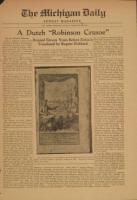
Both castaways kept journals, both The above picture is a reproductio n of the frontispiece from the original ing the Dutch prototype of 'Robinson
built huts whch they called "for- edition of "Sjouke Gabbes," printed in Holland in 1708. (Courtesy of George Crusoe" Mr. Hubbard has made a real
tresses" or "castles"; both obtained contribution to the history of English
from a wrecked ship great stores of Wahr, Ann Arbor) literature. The University of Michi-
supplies, including a carpenter's ;an should count it distinctly to her
chest; both prayed that there would honor that there is among her regents
be a survivor of the unknown ship differences between the two tales are Other points of, careful difference -a word too often connoting politics
but in each case "there was nothing even more convincing. On one occa- are to be noted: on Robinson's island so ardent a scholar as Mr. Hubbard
left in the ship that had life" except a sion Siourke goes hunting and shoots' there were wild goats; on Krinke Kea- has proved himself to be.
dog. Both had a peculiar horror of a large bird, which he describes as mes, wild bulls; Sjouke made a wag- A collection of editions of "Robinson
having to go without clothes, and took having beautiful plumage, thick, red, on, Robinson, a wheelbarrow; Robin- Crusoe" which Mr. Hubbard has
the greatest care to preserve the gar- curved claws, and flesh that proves to son's examination of the little brook brought together contains more than
meants that remained to them. Robin- be delicious. Robinson makes the fol- which he discovered was in the oppo- six hundred different imprints. It is
son Crusoe "could not. abide the lowing record of a hunting episode: site direction from Sjouke's, though said to be the finest Robinson library
thoughts of .,.. going naked, and "I shot at a great Bird which I saw each stream headed in a section where in existence. He is also collecting edi-
in the latter part of the Dutch story sitting upon a Tree on the Side of a fruit was plentiful, and each emptied tions of "Gullivar's Travels" and has
Sjouke says "My greatest hardship great Wood.....I took it to be a into a cove near to the exile's hut. recently written a book on Swift's
was that I had to go naked." The api- Kind of a Hawk, its Color and Beak re- These things indicate, if not plagiar- famous masterpiece.