
The Michigan Daily - Sunday, May 20, 1984 - Page 9
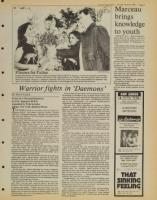
Flowers for Fallon Associated Press
Pamela Sue Martin, who portrays Fallon Carrington Colby on ABC-TV's 'Dynasty' receives the 'Bambi' award Friday
in Munich, W. Germany. On hand with flowers and congratulations was Al Corley who once played Fallon's brother
Steven Carrington. 'Dynasty's' producers replaced Corley two years ago after he bad-mouthed the nighttime soap
opera. The 'Bambi' recognizes excellence in television, even if it happens to be imported from the States.
Warrior fights in 'Daemons'
Marceau
brings
knowledge
to youth
CHICAGO (AP) - Marcel Marceau,
known best for his silence, was in a
talkative mood last week about his In-
ternational School of Pantomime in
Paris.
The school's entire faculty and student
body were flown here at the end of Mar-
ceau's U.S. tour.
Marceau, 61, said Monday his school
makes sure that mime will live on when
the master is no longer around to prac-
tice his craft.
"If we want mime, it must not be con-
sidered an art carried on the shoulder's
of one man," he said during an
exhibition at the University of
Chicago's International House.
In addition to these activities, Mar-
ceau will also bring his unique talent to
Ann Arbor for the Summer Festival,
where he will conduct Master classes in
mime June 30-July 24.
Classes and training are rigorous,
with student dropout rates very high,
Marceau explained.
The challenge, Marceau said, is to in-
still the same artistic passion he em-
ploys.
2 INDIVIDUAL THEATRES
DAILY 1:00 P.M. SHOWS
$2.00 SHOWS BEFORE 6:00 P.M.
A LOVE STORY
ON THE EDGE!
In cerfain parts of Paris,
love is more
dangerous fhan money.
By Mark Kulkis
Forest of a Thousand Daemons
by D.O. Fagunwa M.B.E.
translated by Wole Soyinka
140 pp. New York: Random House
THIS WEEK'S review is of a book written by Chief D.O.
Fagunwa M.B.E., the famous Nigerian novelist, entitled
Forest of a Thousand Daemons. Although first published in
1939, this new edition is the first English translation of the
book ever to be released.
What's that? Don't tell me you've never heard of Forest of
a Thousand Daemons! I don't believe it! Why, the inside
cover of the book claims that it's one of Africa's "most
revered and widely read novels". Gee, I just can't under-
stand why ... well, wait a second. Maybe the book's real title
will ring a bell. (The text has been translated from Yoruban, a
dialect south-western Nigeria, by Wole Soyinka.) It is
Ogboju Ode Ninu Igbo Itunmale. You say you've still never
heard of it, eh? Well, in that case, it's my extreme pleasure
. well, maybe semi-extreme pleasure ... to introduce you to
the world of Akara Ogun, that brave African warrior who
happens to be the main character and partial narrator of
D.O. Fagunwa's "classic" African novel.
The story is basically an odyssey-type epic fable. It opens
when Akara-Ogun, now an old man, pays a visit to the
narrator one morning. Although the narrator (supposedly
Fagunwa himself) has never seen the old man before, he in-
vites him to sit down and talk awhile.
Once comfortable, the old man discloses the fact that he is
Akara-Ogun, once a great hunter, and that he now seeks
someone to write down the many adventures he claims to
have had throughout his life, because he fears that his death
is near, and does not want to his story to die with him. The
narrator runs to get his writing utensils, and Akara-Ogun
begins his tale.
On the first day, Akara describes his chaotic childhood,
which included having a mother who was a witch, and who
murdered all of his brothers and sisters. He then tells of his
first sojourn into Irunmale Forest, the "Forest of a Thousand
Daemons", and of his adventurers in and subsequent escape
from that most dangerous of forests.
The second day, he tells of his secondi journey into Irun-
male. Why, you may ask, would he dare to go back into
Irunmale, when he barely escaped with his life the first time?
In Akara's own words: "I think I do not lie when I say that
anyone who has listened to these adventures could not fail to
believe that I would never dream of hunting again. But no, I
did hunt again, for it is in the profession to which a man is
trained that he must serve."
Not only does he hunt again, but he chooses Irunmale to do
his hunting in! Needless to say, he again returns safely, this
time with much wealth which he has managed to accumulate
during his many years (yes, years - he ended up marrying
one of the "ghommids", or magical pseudo-human
inhabitants of Irunmale) in the forest.
The last day, Akara describes his journey to Mount
Langbodo, a magical kingdom located just to the right of
Heaven, which he undertook at his king's behest. He tells
them now he and a company of great warriors overcame
many obstacles, and finally reached Mt. Langbodo and
retrieved the magical "object" that the king desired. This
"object" turned out to be nothing but a bit of advice from the
king of Mt. Langbodo: worship God, and your kingdom will
be peaceful and happy for the rest of your days.
Don't buy this book expecting any sort of consistency in the
text. For example, sometimes Akara acts deathly afraid of
the ghommids of the forest, fearful of their great magic; at
other times, he abuses them as if they were nothing but pesky
gnomes.
Another big problem with the book is the style of the
narrative. Instead of being an engaging recreation of his ad-
ventures, Akara's narrative reads like: 1) we did this; 2) we
went there; 3) we did that; 4) we returned home. The style is
so stilted and even primitive that you never really get into the
book. This kind of writing does, however, make for some
very, very quick reading.
Sometimes, though, the very primitiveness of the book
makes it amusing. For instance, at one point in the book,
Akara and his hunting party come face to face with a
terrifying creature. Akara mentions that the appearance of
the thing was so hideous that "our buttocks turned to water
from fear". There are many such expressions to be found
throughout the book, all equally amusing. The crude
illustrations of the book are likewise liable to grow on you.
The thing I disliked most about the book was the way it flir-
ted with symbolism, especially in the first half of the book,
hinting at a deeper "message" or theme below the mere ad-
venture story. For instance, Akara arrives at one city
somewhere below the Earth, where citizens are all blind -
they run here and there without ever really knowing where
they are going. Hmmmm . . . that scene appears strangely
symbolic. But what does it all mean?
Disappointingly, the central theme, not at all hidden, turns
out to be: worship God, and your life will be a peaceful and
happy one. The reason the people in the city couldn't see was
because they were blind to God's existence. (Incidently, it is
the Christian God that Fagunwa refers to.)
Sorry, but I can't recommend that anyone (African culture
majors perhaps excluded) buy this book. If Forest of a
Thousand Daemons was indeed Fagunwa's "most famous
book", I can understand why it was the only one to be tran-
slated into English.
(R)
SUN. 1:10, 3:10, 5:10, 7:10, 9:10
MON. 1:00, 7:10, 9:10
THE MAN WHO BROUGHT
YOU "GREGORY'S GIRL"
AND "LOCAL HERO"
A Mad Cop Caper
to Steal Sinks?!
BILL FORSYTH
THAT
SINMKINIG
G{
SUN. 1:30,3350, 5:30, 7:30.9:30
MON. 1:00, 7:30,9:30
Scanned image of the page. Keyboard directions: use + to zoom in, - to zoom out, arrow keys to pan inside the viewer.
May 20, 1984 (vol. 94, iss. 8) - Image 9
- Resource type:
- Text
- Publication:
- Michigan Daily, 1984-05-20
Disclaimer: Computer generated plain text may have errors. Read more about this.