
OPINION
4
Page 6
The Michigan Daily
Saturday, May 14, 1983
The Michigan Daily
Vol. XCIII, No. 5-S
93 Years of Editorial Freedom
Managed and Edited by students of
The University of Michigan
Editorials represent a majority opinion of the
Daily Editorial Board
'Proper places'
W HILE SOCIAL mores and antiquated
beliefs on the "proper place" for women
in education may be tough to change, sexual
discrimination on the job is a problem that
should never take place at the University.
A recent affirmative action report reveals
some frightening examples of women's
inability to ascend the professional ladder at
the University.
Many women faculty members feel they
must work harder than their male colleagues to
gain the same level of recognition. In some
cases, women professors feel that attaining
tenure is incompatible with raising a family,
and are forced to choose between a homelife
and successful career.
Another example of discrimination, is
requiring women to serve on committees which
need female representation. The University
should be able to control these subtle and
unnecessary forms of sexual discrimination.
This indirect sexual discrimination may hurt
the University's ability to attract and keep
qualified women faculty members.
As is the case with all minorities on campus,
women faculty members must be actively
sought after if they are expected to stay. The
University must make such a commitment and
develop policies which stop unfair treatment of
women faculty members.
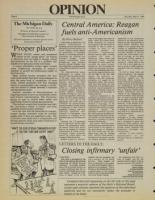
"InHATS THE GOOFOF EING COMMAIIER-IN{HIEF
IF YOO CAN'T EVEN HAVE SECRET WARS?
C.
Central,
fuels an,
By Perry Bullard
In the name of democracy, the
Reagan Administration is
fostering war and anti-American
sentiment in Central America. As
covert military actions against
the government of Nicaragua
spread, an increasing number of
Americans are realizing that
President Reagan, United
Nations Ambassador Jeane
Kirkpatrick, and National
Security Advisor William Clark
have absolutely no understanding
of the political realities in Central
America.
The Administration seems
determined to repeat the
shameful interventionist policies
of the past which have only
polarized the people of Central
America and fueled their
animosity toward Americans.
Typically, such animosity has
served as a building block of
revolution against American-
backed regimes. Honduras,
currently serving as a base for
American-supported Somocista
rebels, served a similar purpose
nearly 30 years ago in the
disgraceful CIA covert effort to
overthrow the democratically
elected President Jacobo Arbenz
of Guatemala in 1954. Years of
repression, violence, and anti-
American sentiment have
followed in Guatemala, and
prospects of avoiding an El
Salvador-type civil war there are
dim.
Likewise, the U.S.-sponsored
Bay of Pigs fiasco and the eight
known CIA assassination attem-
pts against Castro have served
only as an impetus for further
militarization of Cuban society,
increased Cuban animosity
toward the United States, and
stronger Cuban-Soviet ties.
Results of past U.S. interven-
America: Reagan
ti-A merican ism
tions in Nicaragua have been no
better. When the United States
killed thousands of innocent
Nicaraguans in the destruction of
Greytown in 1854 in order to
"avenge an insult to the
American minister of
Nicaragua' (Congressional
Record, June 23, 1969), it hardly
furthered the cause of
democracy. Later, when 5,000
American troops occupied
Nicaragua for seven years and
installed the hated dictator
Somoza, Sr., the U.S. planted the
seeds of an inevitable revolution.
In fact, the Sandinistas take their
name from AugustoSandino, who
led the fight in the late 1920s
against the American oc-
cupation. Like that seven-year
occupation, U.S. support for the
Somocista rebels may accom-
plish short-term goals, but such
tainted ties will inevitably prove
extremely counter-productive to
the long-run interests of both the
United States and the people of
Central America.
American harassment of the
Sandinista government will only
strengthen the political extremes
at the expense of more centrist
elements in Nicaragua. As the
Sandinistas are forced to further
militarize their society to counter
subversive threats, the
possibility of elections will dwin-
dle; the treatment of Miskito In-
dians along the Honduran border
will worsen; and the chances for
democracy anywhere in Central
America will diminish. 41
The present American policy
will also increase external and in-
ternal threats to the stability of
the government of Honduras.
Just four months ago, the Hon-
duran army went on "Orange
Alert," and for a short period, a
Honduran-Nicaraguan border
war seemed imminent. Internal
opposition to the militaristic
policies of the Honduran gover-
nment has also been growing in
recent months. Honduras, once
thought to be exempt from the
violence of neighboring states,
recently has begun to experience
increased numbers of terrorist
actions and "death squad" mur-
ders of civilians. As one State
Department official (quoted in
the New York Times) sum-
marized it: "Being called a tool
of the CIA is not a good way to
stay in power in Latin America,
especially when the charges are
true."
As well as being futile and
counter-productive, the Reagan
policies are blatantly illegal.
American support for the
Somocista rebels training at
bases in Florida and California is
a clear violation of the Neutrality
Act. Furthermore, aid to rebels
operating in Honduras and Costa
Rica is a flagrant violation of the
Boland Amendment and the
Charter of the Organization of
American States, which provides
that "no state or group of states
has the right to intervene, direc-
tly or indirectly, for any reason
whatever, in the internal or ex-
ternal affairs of any other state."
Moreover, the use of "advisors"
in Honduras to train the rebels
may well be in contravention of
the War Powers Act.
Current policy toward
Nicaragua is, in sum, counter-
productive military adventurism
and a detriment to peace and
justice in Central America. The
United States should seek peace
through means consistent with
democratic principles and
American law.
Bullard is Ann Arbor's
Representative in the
Michigan House of Represen-
tatives.
4
4
4
4
4
LETTERS TO THE DAILY:
Closing infirmary 'unfair'
To the Daily:
This letter is prompted by the
letter to the Daily by David Gross
concerning the Health Services
infirmary. As foreign students
here at the University we see it as
a great misfortune that the in-
fimary at the Health Services has
been closed. Closing the infir-
mary is unfair to all of the
students who are assessed a fee
every semester for the Health
Services. These students will
have no alternative to the expen-
sive fees at the hospital when in-
patient care is necessary. The in-
firmary at the Health Services is
a special place on this campus
where we have received excellent
care in our times of illness.
We understand that this is a
time of budget cuts but the
question must be asked: Is this in
the best interests of the students?
-K. Mariappan
Sahari Jantan
Azaleha Zainddin
Ahmed Fauzi Hasan
Shariff Baksh
Mohd Rasip Hassan
Abdul Hziz Hussein Sazally
a
Unsigned editorials appearing on the left side of this page
represent a majority opinion of the Daily's Editorial Board.
Letters and columns represent the opinions of the individual
author(s) and do not necessarily reflect the attitudes or
beliefs of the Daily.
4
Scanned image of the page. Keyboard directions: use + to zoom in, - to zoom out, arrow keys to pan inside the viewer.
May 14, 1983 (vol. 93, iss. 5) - Image 6
- Resource type:
- Text
- Publication:
- Michigan Daily, 1983-05-14
Disclaimer: Computer generated plain text may have errors. Read more about this.