

0 0
0
0
1
IBy Jenna SkollerPhoto illustration by Jed Moch
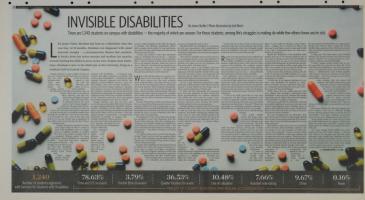
There are1,240 students on campus with disabilities - the majority of which are unseen. For these students, among life's struggles is making do while few oth
ers know you're sick.
L SA junior Claire Abraham has been in a wheelchair since she
was four. At 18 months, Abraham was diagnosed with spinal
muscular atrophy - a neuromuscular disease that essential-
ly breaks down her motor neurons and weakens her muscles,
severely limiting her ability to move on her own. Despite these limita-
tions, Abraham is now in her third year at the University, living in a
residence hall on Central Campus.
Though Abraham is quite capable of living on
her own, it hasn't always been that way. For her
first two years at the University,
Abraham com- muted to Ann
Arbor each day with her
mother, Stacy Abraham, who
helped her adjust to life as
a college student with a disability.
The Abrahams said that, in her three years on
campus, Claire hasn't encountered
much adversity, and that stu-
dents have generally been glad
to help - they will assist Claire
by pushing buttons she can't
reach or isn't strong enough to
push and will open doors for her.
Some students will, however, when in
a hurry, leta door slam into Claire or only open
one door, leaving her in a vestibule unable to get
through the second door. "But for the most part,
a lot of people are very aware of her chair and
they'll try to go out of their way or (apologize) if,
they didn't notice to get the door for her," Stacey"
Abraham said.
Though Abraham's experience is often
what people think of when it comes to
those with disabilities, there is a larger
group of disabled students on campus
who deal with similar struggles but of
a completely different nature. For these
individuals, whose disabilities are considered
invisible' - those that aren't first apparent
to the general observer - the
struggle lies not only in cop-
ing with their disabilities,
but doing so in a world that
doesn't . know they're
sick.
Stuart Segal, ;
interim director
of Services for
Students with Disabilities - a University orga-
nization that offers assistance to students with
various types of disabilities - said there are 1,240
students currently registered with SSWD. The
majority of these students, however, aren't vis-
ibly disabled. They have invisible disabilities -
mental and chronic health conditions, traumatic
brain injuries, pervasive development disabilities
like Asperger's syndrome and visual and hearing
impairments. And though the majority of students
registered with SSWD have invisible disabilities,
to the University community these may appear
less common simply because they are unseen.
Though Abraham says she has been well
received and accommodated while at the Universi-
ty, many students registered with SSWD who have
invisible disabilities shared different opinions.
Many expressed feelings of isolation and stressed
that further efforts need to be taken - like peer
support groups or mentorships - to improve the
experience of students on campus with
invisible disabilities. Others said, how-
ever, that what truly needs to be done
is to increase awareness for stu-
dents with all types of disabilities,
not just visible ones.
LSA sophomore
Candyce Hill
suffers from
albinism, a
disease that
results from a
lack of melanin
pigment in the
eyes, skin and
hair. For some,
albinism
can be a visible disability, but for Hill, the disease
is invisible. The albinism significantly affects
Hill's eyesight and her ability to read small print,
but to the University, Hill simply looks like she has
blonde hair and fair skin.
"I think the problem is that when (someone)
looks at a disability that you can see - someone
walking on crutches or someone who's completely
blind - then it's almost as if they know that they
have to be sensitive and they really don't have a
choice," Hill said. "Butwhenit's notsomethingyou
can notice right away - and in fact if they never
told you, you might never know - it's almost like
they get the sense that it can't be that bad."
When Beth Becker began her masters pro-
gram at the University in 2006, her pri-
mary concern was, like most, academic
success. But less than a year after moving to Ann
Arbor, Becker was diagnosed with an uncommon,
yet severe, disorder called Wegener's granuloma-
tosis - an autoimmune disease that damages the
lungs, kidneys and other internal organs. Since the
disease only affects internal organs, the condition
is not visible to the public. But the symptoms of the
disease and the results of Becker's treatment are
significant.
Because of her illness, Becker sometimes loses
her voice and suffers from sporadic memory loss,
making it difficult for her to participate in class.
And while she was rarely absent beforethe diagno-
ses, Becker is now forced to miss class for extended
periods of time to receive treatments that often
require days of recuperation.
Throughout her time at the University, Becker
has struggled to deal with limitations from her
disease that negatively affect her academic per-
formance. For example, though she would like to
avoid taking narcotics to stay active in class - the
pain medication she takes makes her lethargic and
unresponsive - the effects of doing so are often
debilitating.
"It could be finals week. It could be the first day
of class," Becker said of when her symptoms flare
up. "It's really completely unpredictable, which is,
I think, one of the hardest things about having a
chronic disease at school."
Because ofher disability, Becker has been forced
to redefine her metrics for success. Getting an 'A'
on an exam or a paper is no longer a top priority
for her. "One day it might be getting out of bed, the
other it'might be submitting a paper for
publication," she said. "I think when
you're dealing with a chronic illness
or a disability, your definition of
success can change from day-to-day."
Though Becker has attempted to restructure
her life, and expectations, with consideration of
her disability, she has found it difficult to do so in
a setting as competitive and academically rigorous
as the University.
"(It)'s hard to (redefine success) when you're in
an environment that has a very strict definition of
success," Becker said. "And that (definition) is pro-
ductivity. So, when you can't be productive, you
feel unsuccessful. And that's hard."
Like Becker, many of the students registered
with SSWD are only recently disabled. Some were
diagnosed with the disability shortly before com-
ing to the University; others were diagnosed well
into their time at college. For those with new dis-
abilities like Becker, learning to accept new limita-
tions is often difficult and unwelcome.
"It was a huge adjustment going from a high-
achieving, healthy student who could do what she
wanted to being limited by this disease and its
effects and its medications," Becker said.
To help with this adjustment, the University
does encourage professors to allow certain aca-
demic accommodations for students registered
with SSWD, like extra time for exams, exten-
sions for class assignments and additional excused
absences. However, many students feel uncom-
fortable asking for these accommodations.
Rackham graduate student Leslie Rott said that
during her first year at the University, she seemed
to wake up every day with a new and unfamiliar
symptom. But despite undergoing multiple diag-
nostic tests, no one could initially pinpoint the
cause. It wasn't until a week before the end of the
academic year that she was diagnosed with rheu-
matoid arthritis and lupus - a chronic inflam-
matory disease
that attacks
the
body's
tissues "
and
organs.
Rott
said
she was
unsure of
what accom-
modations she would be entitled to going
into her second year.Unlike those whohavelived most
of their lives with disabilities, she had no previous
experience as a disabled individual and
didn't even know how to go about
asking for accommo- dations.
"A part of it, too, is that, at least in my case, I'm
asking for help and accommodations that I. don't
want to be asking for, that I never thought I would
have to be asking for," she said. "So it's really dif-
ficult to actively try and do this yourself."
R ecentUniversitygraduate AnnaLembrykwas
diagnosed with lupus during her junior year
of college. In addition to academic accommo-
dations, Lembryk has had to deal with the social
aspects of her disability. Her condition requires
her to sleep more than the typical college student.
She goes to bed around 10:30 p.m. every night and
takes a half-hour nap every day - a sleep schedule
that often places a burden on her social life.
LSA sophomore Anna Clements has to deal
with similar issues. Clements was in a car accident
at the end of high school that resulted in a trau-
matic brain injury, which caused memory loss and
depression. And while most students can procras-
tinate and pull all-nighters to catch up with work,
Clements can't stay up late to study or write papers
because her "brain just doesn't function" if she is
exhausted.
"I have to be really good with not only time
management, but also energy management. And
so I have to gauge the number of the hours in the,
day that I have energy, and I have to get everything
important into those hours," she said. "When I use
my energy on socializing or going to the gym -
things that are completely fine for most people -
for me, it's now that my energy
isagone."
LSA junior Robbie
Dembo first began expe-
riencing chronic back pain
during his freshman year
at the University. The pain
severely impedes his ability to
walk even short distances, forcing him to drive
everywhere he goes. Dembo said this not only
affects his studies, but like Lembryk and Clements,
his social life as well. In addition to taking a lighter
course load, which means he might notgraduate in
four years, Dembo said he must cope with having
to say "no" to his friends when they invite him to
do something he
can't do because
of his physical
limitations.
"I want to
be able to tell
(that) 'I can't walk far because I have limita- fact tl
tions,' " Dembo said. "I want to be able to say Demb
that, and I want them to turn around and be able fortal
to say, 'OK, I understand that. Let's find some- who i
thing to do closer by.' "whee
Despite the difficulties of the disability itself, To
Dembo said one of the hardest things he has to stude
deal with is coming to terms with his disability in supp<
a community that, he says, is not always tolerant torsh
of those with limitations. He said because his dis- "I
ability isn't immediately visible, people judge him ful, es
when, for example, he has to take the elevator up if the
only one floor because he can't walk up stairs. work
Becker echoed this sentiment, stressingthe dif- rienc
ficulty of having an invisible disability in an envi- with
ronment that often fails to recognize the disabled relati
community as a whole. acros
"I think one of the biggest challenges for stu-
dents with disabilities or illnesses, is when
they're invisible,"she said."Youknow, when I get
on a commuter bus, it's hard for me to say, 'Can I
have your seat?' just small things."
Unlike issues that are widely discussed, like
race, religion and sexuality, a discussion about
disabilities is often ignored., Students like Dembo
and Becker say the support that exists for students
with disabilities is simply not adequate.
Rn+t, n+ti- nriinly thA iifr111ipof nio
niche at the1
are unaware
"It's not
said. "So it's
like Im part
ment when 9
what's going
Rott said
at the Unive
way issues t
cussed. Rot1
studentswit
communicat
ible illnesses
n1so M;C
n.